
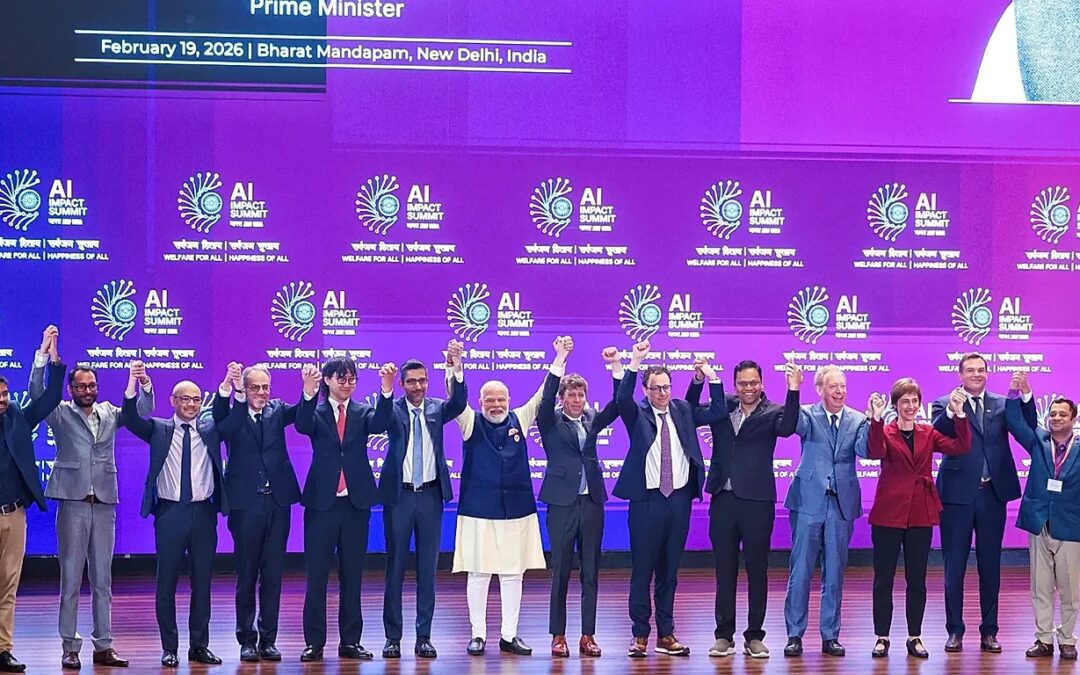
At the global AI summit in New Delhi , a defining geopolitical fault line emerged: the United States rejected proposals aimed at establishing a centralized framework for global artificial intelligence governance. The decision has sent ripples through diplomatic, technological, and commercial circles, raising fundamental questions about collaboration, sovereignty, and the future structure of the AI industry.
The summit, hosted under India’s leadership, was designed to promote cooperation, solidarity, and regulatory convergence around AI safety, ethics, and deployment standards. Many participating nations advocated for shared oversight mechanisms—an international architecture to manage risks ranging from algorithmic bias to autonomous weapons and economic disruption. The U.S., however, declined to support binding global governance structures, emphasizing instead national regulatory flexibility, innovation freedom, and market-led development.
This rejection carries several immediate implications.
First, it reinforces a fragmented regulatory landscape. Without U.S. backing, the prospect of a unified global AI framework becomes significantly weaker. The world may now see the emergence of competing governance blocs: a European-led model emphasizing precaution and rights-based oversight, a U.S.-driven innovation-first model, and alternative state-centric frameworks emerging from other major powers. For multinational AI firms, this fragmentation increases compliance complexity and operational cost. Companies will need to navigate divergent standards on data usage, safety testing, transparency, and accountability.
Second, the move intensifies geopolitical competition. AI is widely regarded as a strategic technology akin to nuclear power or the internet in its transformative capacity. By resisting centralized global oversight, the U.S. signals that AI leadership is a national priority tied to economic growth, military capability, and technological dominance. This stance may accelerate an AI arms race dynamic, where nations prioritize speed and scale over harmonized safeguards. Cooperation becomes conditional, transactional, and strategically selective rather than universally coordinated.
Third, innovation may accelerate—but unevenly. Supporters of the U.S. position argue that premature global regulation could stifle experimentation and slow breakthrough development. A less constrained environment may enable American firms to move faster in frontier research, commercialization, and deployment. However, the absence of shared guardrails also raises systemic risk. Safety protocols, transparency norms, and cross-border accountability mechanisms may lag behind technological capability, increasing the probability of misuse, accidents, or destabilizing economic shocks.
For developing nations, the implications are complex. On one hand, a decentralized system offers flexibility: countries can tailor AI policy to their economic context without conforming to rigid global standards. On the other hand, without strong multilateral coordination, smaller economies may struggle to influence rule-setting or protect their data sovereignty against dominant tech powers.
The broader industry prognosis suggests bifurcation rather than unity. AI will likely evolve within parallel regulatory ecosystems. Cross-border partnerships will continue—but increasingly within aligned political blocs. Standards bodies, trade agreements, and regional alliances may become the primary venues for AI governance instead of universal treaties.
In the long term, market forces may push partial convergence. Global supply chains, open-source communities, and international research collaboration create natural interdependence. Yet formal governance unity now appears less probable.
The Delhi summit will be remembered not for consensus, but for crystallizing a central truth: AI is no longer merely a technological revolution. It is a geopolitical instrument. And the world’s leading power has chosen strategic autonomy over centralized global control.
The result is a future defined not by singular governance—but by competitive coexistence.
