




Conferences
AI Events
Lifestyle
Lifestyle
Conferences
Fintech
Automotive
Automotive
Medical Tech
Medical
Technology
Technology
Lifestyle
Lifestyle
Technology
Technology
Automotive
Automotive
Fintech

ai trademarket: Enhancing AI's Impact Across Industries

Welcome to the third industrial revolution... AI!

AI TradeMarket designs, deploys, and advises on bespoke applied artificial intelligence for process and workflow upgrades alongside modern marketing and media ecosystems.

We unite AI strategy, proprietary technology, and hands-on execution to help forward-thinking organizations navigate a rapidly shifting digital landscape – from predictive campaign intelligence and automated media planning to enterprise-wide AI integration.

Whether you are exploring strategic possibilities, engineering operational systems, or defining the future of intelligent media, AI TradeMarket delivers the insight, tools, and infrastructure to move forward with absolute confidence.

Interactive Media Platform
Plan, Visualise & Forecast Your 2027–28 Campaigns
Access the AI TradeMarket Planning Portal — our proprietary interactive environment for ROI forecasting, live ad placement previews, events and persona-driven targeting.
Launch Portal
Q4 2026 AITM MARKET ADVISORY & STRATEGY · WEEKEND EDITION

AI’s Record IPO Meets a Market Reckoning Over Returns

Anthropic’s record-setting public debut did not halt Wall Street’s tech retreat. Following Thursday’s steep drop, where the Dow shed 1,101 points and the S&P 500 posted its sixth straight loss, the sell-off spread globally on Friday. In Asia, SoftBank plummeted 16.2% in Tokyo, while Japan’s Nikkei and South Korea’s Kospi both tumbled over 5%. In US midday trading (as of 12:00 pm ET / 5:00 pm UK), Anthropic shares retreated 10.8% toward its $83 IPO price, the Nasdaq dropped 2.2%, the S&P 500 slid 1.0%, and Nvidia fell over 6% to multi-month lows near $136. Investors are aggressively questioning debt-funded data-centre capital expenditure, sovereign export restrictions, and a Federal Reserve poised to raise interest rates in December. With Thanksgiving week bringing thin holiday trading and a data-heavy Wednesday, here is what leadership teams must do now.

−1.0% S&P 500 · Friday intraday (12:00 pm ET / 5:00 pm UK)
extending slide to ~7,135; Nasdaq −2.2%, Dow +0.2%
−16.2% SoftBank · Friday close, worst day in over two years
Nikkei −5.1% (−3,000+ pts), Kospi −5.2% (<5,000)
−10.8% Anthropic (ANT) · Friday intraday (12:00 pm ET)
at $86.67 vs $97.17 Thu close; IPO price was $83.00
94% December Fed hike priced (25bp) · CME FedWatch
10-year yield ~5.03%; decision due 9 Dec
12 NovHuang resigns
16 NovExport curbs in force
17 NovNvidia beats & raises
19 NovAnthropic IPO, Dow −1,101
20 NovGlobal sell-off, tech slides
25 NovPCE, Bessent deadline
1 DecHuang House interview
9 DecFed rate decision
The Headline Risk

Export Controls Are Now a Market Risk, Not Just a Policy One

The revised Commerce Department export rule, now formally in effect, mandates individual export licences for advanced accelerator chips shipped to entities in Singapore, Malaysia, Thailand, Indonesia, and Brazil, and restricts data centres providing large-scale compute to Chinese entities. Scrutiny is expanding across the hardware tier: an activist short seller’s report alleging that AMD server firmware reached a sanctioned Chinese server vendor knocked roughly 7% off AMD on Thursday. AMD categorically denies wrongdoing and affirms full compliance with US export controls, and the report does not constitute a regulatory finding. Nevertheless, markets are treating any hardware vendor or cloud infrastructure provider with significant Southeast Asian or Chinese exposure as subject to compliance friction and supply delays.

The Measured Response

Plan for Scrutiny, Not Sweeping Law

Following November’s midterm elections where Democrats secured majorities in both chambers, the incoming Congress will not convene until January, and presidential veto power limits immediate sweeping federal AI legislation. Near-term regulatory pressure will operate through congressional hearings, agency investigations, and executive oversight. Jensen Huang has consented to a closed-door interview with three House committees on 1 December. The Senate Banking Committee has requested testimony from Huang and Commerce Secretary Howard Lutnick, while Treasury Secretary Scott Bessent has set a ten-day deadline (expiring circa 25 November) for Nvidia’s board regarding export-control compliance. The bipartisan AI OVERWATCH Act proposes codifying semiconductor export restrictions into statute, alongside press reports of an informal SEC civil disclosure review (unconfirmed).

The Silver Lining

Gridlock Buys You Time, and Policy Cuts Both Ways

Because comprehensive federal statutory overhauls remain constrained by divided government, policy implementation will arrive incrementally, allowing enterprise technology leaders time to adapt infrastructure and supply arrangements. Simultaneously, the executive branch continues to champion domestic AI leadership: the Wall Street Journal reports the administration plans to designate over two dozen domestic firms, including Nvidia, Amazon, Microsoft, OpenAI, and Anthropic, as “national champions” (reported, pending official release). The recent summit in Shenzhen produced diplomatic statements but no formal easing of chip restrictions. The bilateral US-China trade truce remains in force through 10 January 2027, but national security officials affirm that semiconductor controls are non-negotiable; enterprises should assume advanced chip restrictions are permanent structural parameters.

New chip-export licensing rule in forceAMD short report, deniedBessent deadline to Nvidia, ~25 NovHuang to face House committees 1 DecSEC probe reportedAI OVERWATCH Act proposedUS-China truce to 10 Jan
The Headline Risk

A Sell-Off That Has Gone Global

Thursday’s session opened with an AI rally and closed in a sharp reversal, with equities hitting daily lows during Anthropic’s first afternoon of trading. The S&P 500 dropped 2.0% to 7,176 (slipping beneath its 200-day moving average), the Dow lost 1,101 points (2.2%), and the Nasdaq-100 closed 15% below its October peak. On Friday, the rout cascaded through Asian bourses: SoftBank, a prominent backer of OpenAI, dived 16.2% in Tokyo, while Japan’s Nikkei 225 fell 5.1% (−3,000+ points) and South Korea’s Kospi plunged 5.2% below the 5,000 mark. As of Friday midday in New York (12:00 pm ET / 5:00 pm UK), Anthropic fell 10.8% intraday to $86.67, the Nasdaq dropped 2.2%, the S&P 500 shed 1.0% near 7,135, and Nvidia slid over 6% to $136.60, marking its seventh consecutive weekly loss.

The Measured Response

Audit Concentration and Rate Exposure

Current market friction reflects a re-evaluation of return on investment rather than declining enterprise demand. Investors are scrutinising debt-financed data-centre construction, multi-year GPU capital commitments, and prolonged revenue payback cycles. With the Fed funds target at 3.75% to 4.00%, CME FedWatch futures price a 94% probability of a 25-basis-point rate increase at the 9 December FOMC meeting (with Governor Waller advocating a 50bp move to curb 3.1% core PCE inflation), and the benchmark 10-year Treasury yield is holding near 5.03%. Institutional desks are actively de-risking concentrated positions. CFOs and CIOs should immediately quantify balance-sheet exposure to debt-financed IT infrastructure and stress-test vendor commitments against higher-for-longer borrowing costs.

The Silver Lining

Demand Is Still There, and Capital Is Still Flowing

Underlying commercial deployment remains massive. Anthropic raised $81.3 billion in its public offer alongside a $26 billion private placement, drawing 846 million shares in day-one trading volume. Nvidia’s Q3 data-centre revenue surged 110% year-on-year to $107.6 billion, accompanied by a $130 billion forward outlook. Market strategists attribute the equity downturn to valuation multiples, capital structure risk, and interest-rate pressures rather than a retrenchment in software adoption. For enterprise leaders, compressed equity valuations do not reduce available computational capability; in practice, supplier multiple compression improves enterprise buyer leverage when negotiating multi-year model access, reserved instances, and cloud service agreements.

S&P 500: ~7,135 intraday (12pm ET)Nasdaq −2.2% intradayAnthropic ~$86.67 (−10.8% day two)Nvidia ~$136.60 (−6.2%)SoftBank −16.2% Tokyo close10-yr yield ~5.03%25bp Fed hike 94% priced
The Headline Risk

Two Opposite Errors

Enterprise executive teams risk committing two equal and opposing tactical errors in this environment. The first is permitting operational AI pipelines to become tightly coupled to a single proprietary foundation model, single-vendor silicon architecture, or unhedged compute pricing structure, leaving enterprise workflows acutely vulnerable to sudden leadership departures, export reclassifications, or vendor financial stress. The second is reflexively halting high-ROI automation initiatives because public equity benchmarks and tech valuations experienced a sharp weekly correction. A record public offering did not insulate the market from macro rate pressures, and robust hardware earnings did not resolve governance scrutiny; strategic decisions must decouple from day-to-day market volatility.

The Measured Response

A Role-by-Role Checklist

CEO: Map critical enterprise AI capabilities to identify single-point dependencies across hardware vendors or sovereign jurisdictions; establish trigger thresholds for supplier reallocation if trade or governance investigations intensify. CFO: Stress-test ongoing compute expenditures against sustained 5.0%+ cost of capital; institute milestone-gated capital releases tied to verifiable operational savings or revenue within 6 to 12 months. CTO / CIO: Architect modular abstraction layers across foundation models and cloud providers; audit whether third-party services rely on hosting infrastructure in the five APAC countries affected by the new Commerce licensing regime. General Counsel: Review vendor representations regarding export-control compliance and data provenance.

The Silver Lining

Volatility Is a Negotiating Window

High-performance alternatives exist across foundation models (Anthropic Claude, OpenAI, Google Gemini, open-weight architectures) and compute platforms (Nvidia, AMD, hyperscaler custom ASICs). When market conditions pressure vendor share prices and capital discipline tightens, enterprise buyers with portable architectures possess decisive negotiating leverage. Cloud providers and model vendors facing slowing enterprise growth rates are increasingly receptive to flexible minimum-spend commitments, aggressive per-token pricing discounts, and hybrid deployment terms. AI TradeMarket’s AI Stack & ROI Audit provides the independent framework required to benchmark your enterprise architecture, reduce supplier exposure, and lock in preferential commercial terms.

Vendor-neutral architectureCapEx rate stress-test (5%+)Milestone-gated AI ROIAPAC export compliance auditCloud & chip portabilityRenegotiating compute contracts
What Is Reported

Leadership and Investigations: Where It Stands

Nvidia co-founder Jensen Huang resigned as CEO and board member on 12 November after 33 years, following an independent board inquiry into personal conduct, including relationships with a former executive of Singapore-based Megaspeed (whom US intelligence agencies reportedly scrutinise regarding potential foreign state intelligence links; Megaspeed denies all wrongdoing and Chinese officials call the allegations baseless). Huang has publicly expressed willingness to resume leadership if invited; however, board chair Harvey Jones affirmed that the board does not plan reinstatement. CFO Colette Kress continues as interim CEO, Heidrick & Struggles is conducting the executive search, and Wachtell Lipton is assisting governance reviews. Treasury Secretary Scott Bessent directed the board to provide answers on export compliance by circa 25 November. The Wall Street Journal reports an unconfirmed civil SEC disclosure inquiry. These represent reported inquiries and allegations, not adjudicated legal findings.

The Economic Read · Speculative

Why It Matters Beyond One Company

Nvidia anchors global AI capital deployment, making its corporate governance and compliance posture a bellwether for the entire technology ecosystem. Operating results remain formidable: Q3 revenue reached $115.8 billion (+103% year-on-year, outpacing $108 billion guidance), adjusted EPS was $2.68 vs $2.48 consensus, and Q4 guidance stood at $130 billion. However, the stock dropped 3.3% on Thursday to $145.98 and sank another 6.2% intraday on Friday to $136.60 by midday (12:00 pm ET), down over 40% from its October peak, entering its seventh consecutive weekly loss (its longest weekly losing streak since 2008), with market capitalization dipping below $3.4 trillion. Two data points demand executive attention: total supply obligations rose to $390 billion from $279 billion, and management announced “disciplined and selective” allocation criteria for emerging AI startups. Enterprise planning scenarios: 1) Orderly permanent CEO appointment and clean export clearance stabilising supplier confidence; 2) Extended search or regulatory overhang prolonging price volatility; 3) Stricter licensing reducing revenue from China-adjacent channels.

Q3 revenue $115.8bn, +103%Q4 guide ~$130bnFriday intraday: ~$136.60 (−6.2%)Market cap <$3.4T (behind Alphabet)Supply commitments $390bnInterim CEO: Colette KressBessent deadline: ~25 NovHouse interview: 1 Dec7th straight weekly loss
The Headline Risk

A Short Holiday Week With a Heavy Wednesday

US financial markets will close on Thursday 26 November for Thanksgiving and conduct an abbreviated session on Friday 27 November (closing at 1:00 pm ET / 6:00 pm UK). Holiday liquidity will be substantially reduced, creating conditions where institutional rebalancing and headline flow can trigger exaggerated price moves. Crucially, major macroeconomic and regulatory releases are compressed into Wednesday 25 November: the second estimate of Q3 GDP, October PCE price index data (the Fed’s preferred inflation metric), durable goods orders, initial jobless claims, and the Federal Reserve’s Beige Book. With a December rate hike priced at 94%, an elevated core PCE print would fuel market expectations of a 50bp move. Wednesday also coincides with the expiration of Treasury Secretary Bessent’s compliance inquiry deadline for Nvidia’s board.

The Measured Response

Dates for the Diary

Monday 23 Nov: S&P Global flash Manufacturing and Services PMIs. Tuesday 24 Nov: Conference Board Consumer Confidence index. Wednesday 25 Nov: Super Wednesday: Q3 GDP revision, October PCE inflation, Durable Goods, Initial Claims, Fed Beige Book, and Treasury’s deadline for Nvidia. Thursday 26 Nov: US markets closed for Thanksgiving. Friday 27 Nov: Black Friday early US cash market close (1:00 pm ET). Tuesday 1 Dec: Jensen Huang’s closed-door deposition before House committees, followed by Nvidia’s general counsel on 2 Dec. Friday 4 Dec: US November Employment Report (Non-Farm Payrolls). 8 to 9 Dec: Federal Open Market Committee meeting, with interest rate decision on 9 Dec. 10 Jan 2027: Expiration of the US-China bilateral trade truce.

The Silver Lining

Most of the Catalysts Are Scheduled

Unlike unscheduled leadership departures or unexpected short-seller releases, the major market catalysts of the coming fortnight follow an exact calendar schedule. Enterprise leadership teams can establish clear, pre-committed decision pathways ahead of Wednesday’s data releases: determining threshold actions if PCE inflation signals continued tightening, establishing vendor procurement alternatives should regulatory reviews prompt additional hardware delays, and utilizing holiday trading lulls to finalize 2027 IT capital budgets methodically rather than reacting impulsively to market volatility.

Wed 25 Nov: PCE, GDP, Beige BookWed 25 Nov: Bessent Nvidia deadlineThu 26 Nov: US markets closedFri 27 Nov: US early close (1pm ET)1 Dec: Huang House interview4 Dec: US Jobs report8–9 Dec: Fed rate decision10 Jan: US-China truce ends

AITM Proprietary Analysis

Image 1 Image 2 Image 3 Image 4 Image 5 Image 11 Image 6 Image 7 Image 8 Image 9 Image 10 Image 1 Image 2 Image 3 Image 4 Image 5 Image 11 Image 6 Image 7 Image 8 Image 9 Image 10
LOADING...
Connecting to markets...

Innovative AI TradeMarket Features

Automotive Innovations

Manufacturing efficiency through advanced AI-driven technologies.

Aerospace Advancements

Operations and maintenance with AI.

Fintech AI Solutions

Predictive analytics and automation for Financial services.

Loading industries...

AI Stock Prices Bar Chart

Subscribe to our newsletter for accessible AI econometrics insights..

Up-to-date stock performance of leading companies in the artificial intelligence space. Monitor the market trends with real-time major stock prices.
Data Science & AI Engineering

The architecture behind our market intelligence

Every insight we at AI TradeMarket surface is the output of a disciplined pipeline — raw market data is ingested, cleaned, engineered into features, modelled, and validated before it ever reaches a dashboard. This is the methodology that underpins everything we build.

Time-series forecasting NLP & sentiment modelling Anomaly detection Ensemble learning Predictive analytics
Work with our analytics team →
Illustrative representation of our multi-stage data pipeline
AI TradeMarket Network  |  Platform Architecture

Engineered for Market Leadership

AI TradeMarket bridges high-level econometrics with specialized industry intelligence, delivering end-to-end framework clarity across global commercial markets.

8+

Global Sectors Covered

Deep-dive strategic coverage spanning Automotive, Energy, Aerospace, Fintech, and emerging deep-tech markets.

Real-Time

Market Econometrics

Live tracking of major AI stock performances, capital movement indicators, and quantitative technology indices.

Monthly

Institutional Briefings

Curated research, market analysis, and executive briefings designed for key stakeholders and technical leaders.

R&D

Dedicated .AI Portal

Seamless cross-platform integration with our specialized portal focused on machine learning algorithms and core science.

AI Media Infrastructure

From Strategy to System

Our AI Media Planning Portal is not a concept deck — it’s a live, production-grade platform used to model campaigns, forecast ROI, and simulate audience behaviour in real time.

Access the Planning System →
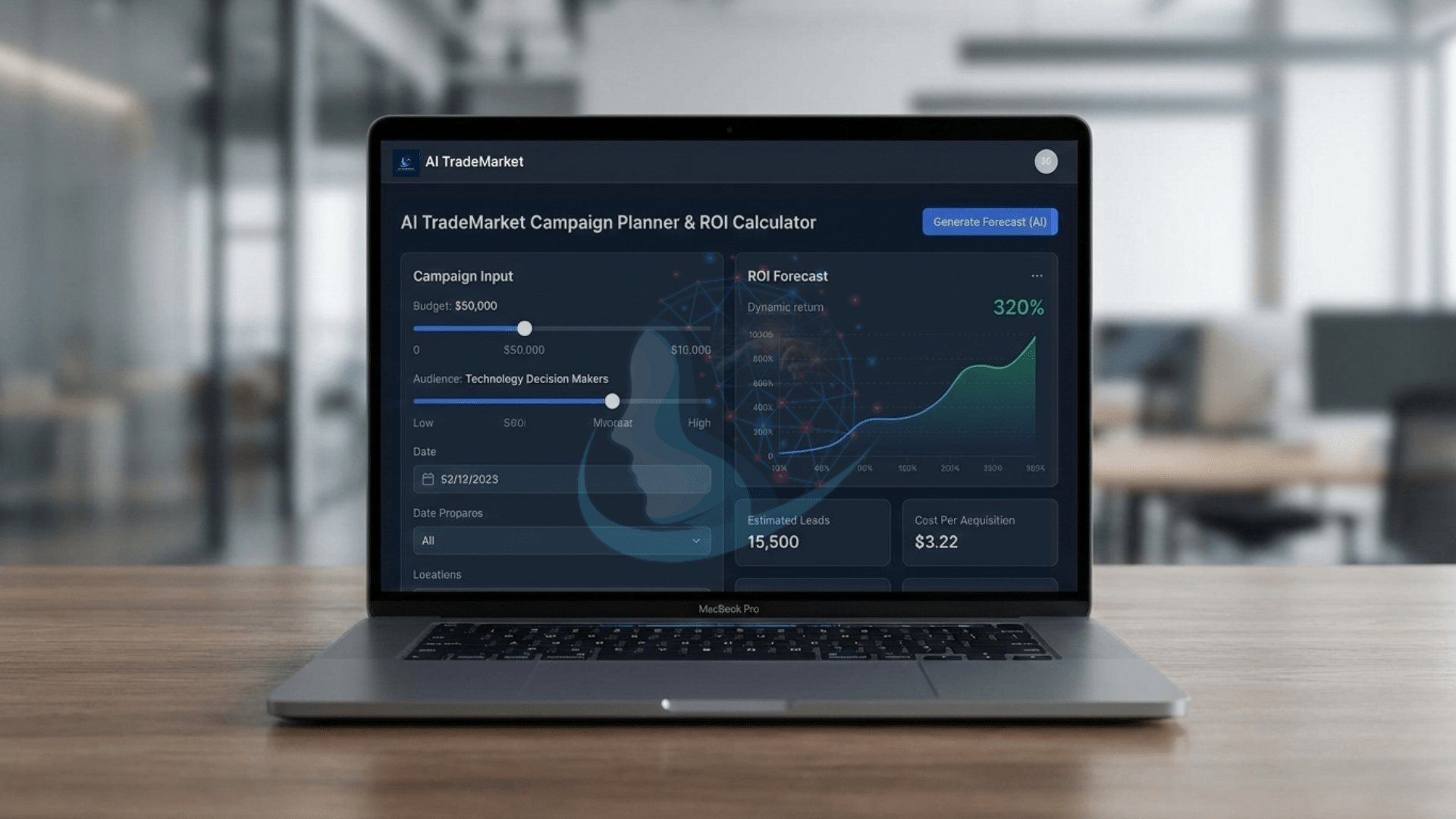
AI TradeMarket Media Planning System
AI
AI Assistant Toggle