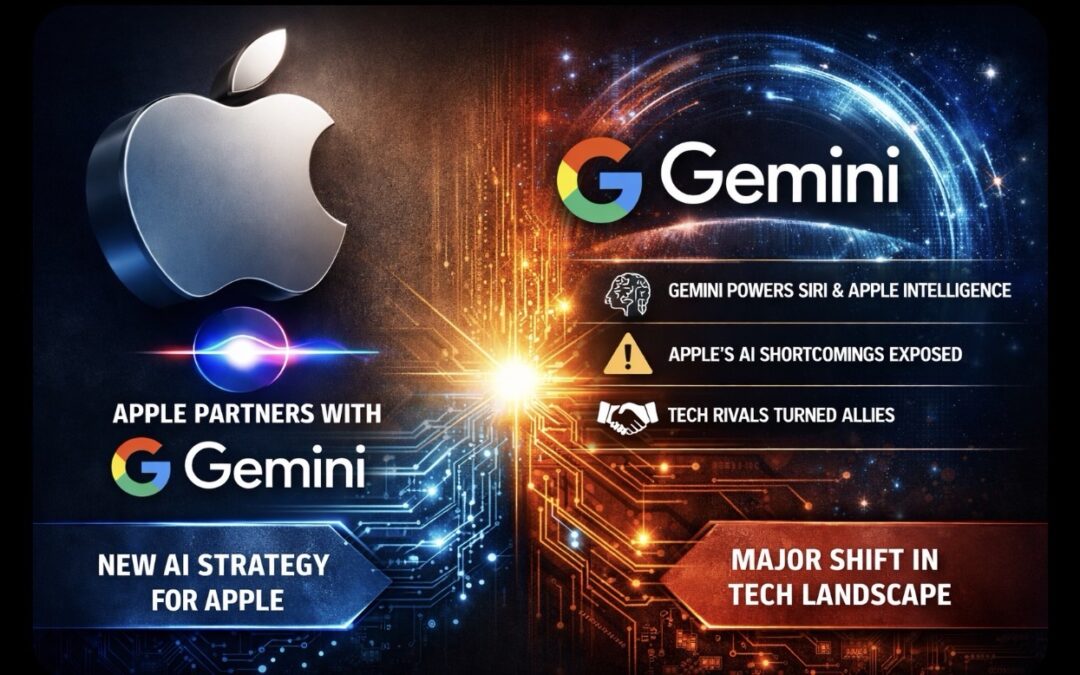
In a move that has rippled through global markets and executive suites alike, Apple Inc. has officially entered a multi-year partnership with Google to embed Google’s Gemini AI as the backbone of its next-generation Siri and broader Apple Intelligence features. The announcement — once unthinkable for a company synonymous with carefully controlled, in-house innovation — marks a stark acknowledgment that Apple’s own artificial intelligence efforts have trailed behind rivals and that a strategic alliance is now preferable to struggling alone in an AI arms race.
Historically, Apple has cultivated a fiercely independent technology stance: silicon, operating systems, app ecosystems — built inside Cupertino’s tightly guarded labs. But behind the polished marketing narratives of “AI-powered” features in recent OS releases, Apple has struggled to match the technical prowess of leading language models developed by Google and OpenAI. Siri, once a star of smartphone AI, became a poster child for stagnation — repeatedly criticized for shallow understanding and limited contextual reasoning. The partnership with Google’s Gemini underscores that Apple has reached an inflection point where external excellence outweighs internal pride.
The deal — reportedly valued at roughly $1 billion per year — positions Gemini’s massive multimodal AI capabilities to enhance Siri’s comprehension, planning, and generative tasks while retaining Apple’s signature privacy framework by running much of the processing on Apple’s Private Cloud Compute infrastructure.
For Apple, the implications are profound:
Brand and Strategy Recalibration. Apple’s dependence on an external AI engine — especially from a rival that dominates search and cloud computing — marks a dramatic paradigm shift in corporate strategy. Apple is effectively outsourcing the brain of its digital assistant while keeping control of identity and experience. Competitive Signaling. By selecting Gemini over other contenders like OpenAI’s ChatGPT or Anthropic’s Claude, Apple tacitly acknowledges that Google’s AI remains best-in-class for broad reasoning and generative tasks, at least for the immediate future. Market and Valuation Effects. Alphabet’s stock surged on the news, momentarily pushing its market cap above $4 trillion — a symbolic testament to investor confidence in its AI dominance. Regulatory Spotlight. Such deep collaboration between two tech titans could expedite antitrust scrutiny, as regulators question whether this cements an unhealthy concentration of power in the AI supply chain. Critics like Elon Musk have already voiced concerns about “unreasonable concentrations of power” emanating from a partnership of this scale.
Industry prognosis is equally dramatic. This pact could accelerate an AI realignment in which cross-ecosystem model provisioning becomes the norm — a departure from closed, proprietary stacks toward a world where platforms license, share, and integrate best-of-breed intelligence. For smaller players and startups, the playing field may tighten further; tech giants with deep pockets and sprawling user bases could lock in de-facto standards for intelligence layers across devices and services.
Yet Apple’s leaders frame the deal as not a capitulation but a practical strategy: a bridge to the future rather than a surrender of autonomy. Insiders indicate Apple continues to invest in its own LLM developments with an eye to eventually supplant Gemini with proprietary models when the technology matures.
For CEOs and strategic planners, the lesson is clear — AI leadership today is not merely about owning the stack but about orchestrating the best technology, wherever it resides. Apple’s embrace of Gemini may well be remembered as one of the most consequential pivots in Silicon Valley history — and a harbinger of AI’s next era of collaboration, competition, and consolidation.
