
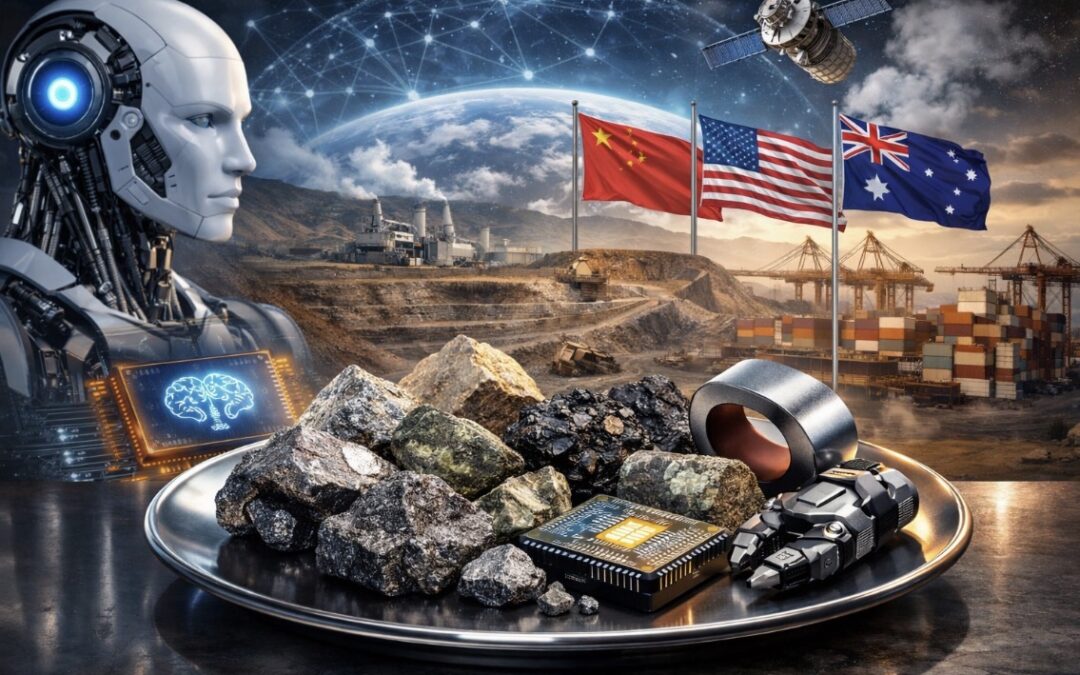
Rare earth elements (REEs) are a group of 17 chemically similar metals—including neodymium, dysprosium, terbium, and europium—that are essential for high-performance magnets, semiconductors, batteries, and advanced electronics. Despite their name, they are not geologically rare; rather, they are difficult and costly to extract in concentrated form.
Global distribution and structural imbalance
The global distribution of rare earths is highly asymmetric. China dominates production, accounting for roughly 60–70% of global mining and around 90% of processing and refining capacity. This dominance extends to downstream manufacturing: Chinese facilities produce over 90% of rare-earth permanent magnets, a critical component in everything from data-centre cooling systems to robotics and electric motors.
Yet reserves are more geographically dispersed. China holds around 40% of global reserves, while Vietnam, Brazil, Russia, India, Australia, and the United States also possess significant deposits. This paradox—widely distributed resources but concentrated processing capacity—defines the strategic vulnerability of modern supply chains.
Rare earths and artificial intelligence
Artificial intelligence depends heavily on rare earths at multiple layers of the technology stack. High-performance magnets are essential for data-centre cooling systems, robotics, and advanced manufacturing equipment. Rare earths are also used in semiconductor fabrication, precision optics, sensors, and energy-efficient power systems that enable AI workloads.
As AI models scale, demand for advanced chips, servers, and robotics accelerates, increasing reliance on rare earth inputs. This creates a structural link between AI growth and critical mineral supply. The result is a new industrial reality: AI is not just software—it is deeply physical, dependent on mineral extraction, refining, and geopolitically sensitive supply chains.
Geopolitics: from resources to leverage
Rare earths have become instruments of geopolitical power. China’s ability to influence supply has already been demonstrated through export controls and regulatory tightening affecting materials used in chips and defence technologies. Analysts warn that even modest disruptions in rare-earth supply could trigger massive economic losses across dependent industries.
Other nations are responding with industrial and strategic policies. The United States and its allies are attempting to build alternative “mine-to-magnet” supply chains, but technical complexity and high capital costs make rapid diversification difficult. Countries such as Australia and Brazil are investing heavily in mining and refining capacity, while strategic mineral reserves and international partnerships are emerging as tools of economic security.
Implications for manufacturing and investment
For manufacturers, rare earths are no longer just commodities—they are strategic inputs. Companies designing AI hardware must now consider supply-chain resilience alongside performance and cost. For investors, rare earths represent both opportunity and risk: concentrated supply creates price volatility, geopolitical leverage, and long-term structural demand driven by AI, electrification, and defence.
Ultimately, rare earths are reshaping the global economic order. The AI revolution is accelerating not only technological competition but also a mineral arms race. In this emerging landscape, control over rare earths is becoming as decisive as control over data, chips, or algorithms—transforming geology into geopolitics and minerals into power.
