
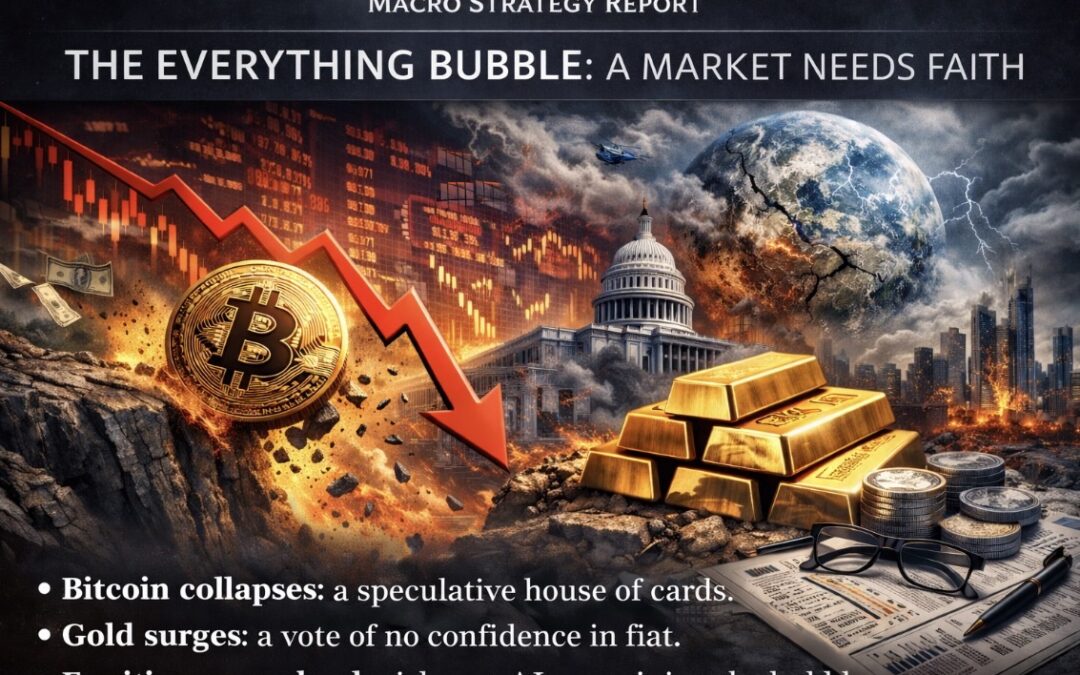
Crypto, Gold, AI, and the Anatomy of a Historic Market Bubble
For the second time in a century, global markets appear to be standing on the edge of a historic valuation extreme. The last time stocks were this expensive relative to underlying earnings was just before the dot-com bubble burst in 2000. Today, the conditions feel eerily familiar—only this time, the stakes are larger, the narratives more seductive, and the systemic risks far more complex.
Gold, Fear, and the Collapse of Monetary Confidence
Gold’s recent surge—up roughly 70% over the past year—offers a clear signal: investors are increasingly anxious about the stability of the dollar and the broader financial system. While gold has experienced short-term volatility, its long-term trajectory reflects a deeper shift in market psychology.
Historically, gold rises not because it generates value, but because it preserves trust when trust in institutions erodes. In that sense, gold’s rally is not speculative—it is defensive. It is a hedge against currency debasement, fiscal irresponsibility, and geopolitical uncertainty.
This makes gold fundamentally different from most digital assets, whose value is driven less by fear and more by speculation.
Crypto: A Hierarchy of Trust in a Speculative Ecosystem
The crypto market is not a single asset class but a spectrum of trust. At one end lie countless tokens widely perceived as speculative or outright worthless—projects with no intrinsic utility, sustained only by hype and momentum.
Bitcoin has long occupied a unique position within this ecosystem. It was considered the “least speculative” digital asset, the closest thing crypto had to a legitimate currency. Unlike NFTs, meme coins, or short-lived projects, Bitcoin was believed to represent something more durable—a decentralised alternative to fiat money.
Yet its recent collapse challenges this assumption. Bitcoin’s failure to act as a hedge during macroeconomic stress exposes an uncomfortable truth: even the most established crypto asset is still governed by sentiment rather than fundamentals.
Crypto, in other words, is not a scam in the traditional sense—but it is not yet a reliable store of value either. Its worth is derived from belief, not intrinsic economic output.
The Stock Market: Not a Scam, But a System Under Strain
Unlike crypto, the stock market is not fraudulent. It is anchored in real companies, revenues, and economic activity. But that does not make it immune to distortion.
Years of quantitative easing and near-zero interest rates have artificially inflated asset prices. Corporations have engaged in massive share buybacks. Investors, flush with liquidity, have pushed valuations to historic extremes.
Today, the cyclically adjusted price-to-earnings ratio suggests that stocks are among the most overvalued in modern history—surpassed only during the dot-com era.
This does not mean markets will crash tomorrow. But it does mean the margin for error is dangerously thin.
“This Time Is Different”: The Most Dangerous Phrase in Finance
Every major financial collapse has been preceded by the same refrain: “This time is different.”
Before 2000, the internet was supposed to rewrite economic laws.
Before 2008, financial engineering was said to have eliminated risk.
Today, artificial intelligence is the new justification for limitless valuations.
The argument is seductive: AI will generate trillions of dollars in productivity gains, create unprecedented wealth, and transform every industry. Therefore, today’s valuations are not inflated—they are simply forward-looking.
But this narrative contains a critical blind spot.
If AI leads to widespread automation and job displacement, who will buy the products and services that AI-powered companies produce? If unemployment rises to 10–20%, as some projections suggest, the economic foundation of consumer demand could weaken dramatically.
In other words, the AI boom could simultaneously create technological abundance and economic fragility.
A Market High on Its Own Supply
Wall Street today appears intoxicated by its own narrative. Investors continue to buy assets not because fundamentals justify them, but because everyone else is buying.
This is the essence of a bubble: prices rise not because value increases, but because belief intensifies.
Bitcoin, equities, and even parts of the precious metals market are now intertwined within a broader psychology of fear, hope, and speculation. The system has become a tinderbox—stable on the surface, but vulnerable to sudden shifts in sentiment.
History suggests that crashes rarely occur because of a single event. They happen when confidence breaks. And when it breaks, it breaks quickly.
Conclusion: Between Bubble and Reckoning
We are not yet in a crash. But we are no longer in a normal market either.
Bitcoin’s collapse, gold’s surge, and AI-driven stock market exuberance are not isolated phenomena—they are symptoms of a deeper structural imbalance.
The question is no longer whether markets are overvalued. The question is how long belief can sustain valuations that fundamentals cannot.
When that belief finally falters, the correction may not be gradual. It may be spectacular.
