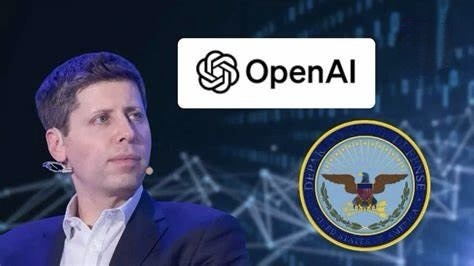
In recent days, reports have suggested a significant shift in the relationship between the U.S. government and leading artificial intelligence providers. Anthropic, long regarded as one of the more safety-focused AI companies, appears to have been sidelined in favour of OpenAI for key federal deployments. Whether driven by policy disagreements, procurement strategy, or political pressure, the implications are substantial — not only for the companies involved but for national security, markets, and global stability.
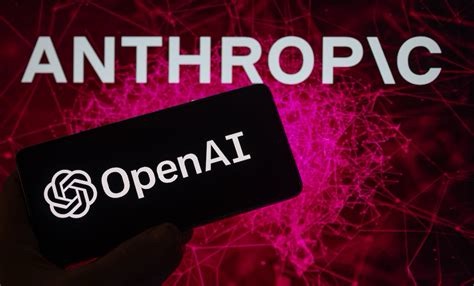
At its core, this development underscores a growing tension between AI safety philosophy and government imperatives. Anthropic has built its brand around rigorous guardrails and a cautious approach to high-risk applications. If a breakdown occurred over the scope of permissible use — particularly in defence, intelligence, or surveillance contexts — that would reflect a deeper structural issue: governments, especially during periods of geopolitical tension, often prioritise capability and speed over restraint.
For Anthropic, the immediate consequence is reputational ambiguity. Among policymakers aligned with a hard-security stance, being replaced may signal unreliability. Yet within the broader technology and ethics community, standing firm on safety principles could strengthen its long-term credibility. Investors and enterprise clients will be watching closely. Losing a major government contract affects revenue forecasts, but it can also reposition the company toward sectors such as healthcare, finance, and regulated industries where robust safety alignment is a selling point rather than a constraint.
For OpenAI, stepping into a larger government role represents both opportunity and risk. The opportunity is obvious: deeper federal integration brings funding, influence, and long-term strategic positioning. It further entrenches OpenAI as a foundational infrastructure provider rather than merely a commercial AI vendor. However, expanded involvement in defence or intelligence systems increases scrutiny. Civil society groups, international observers, and rival states will examine how its models are deployed, especially if used in operational or analytical capacities linked to conflict zones.
Replacing one AI provider with another inside government systems is not frictionless. Large federal departments integrate AI models into workflows, data pipelines, secure environments, and classified networks. Migration requires technical re-validation, retraining of personnel, security auditing, and compatibility testing. There are financial costs associated with re-engineering systems, renegotiating contracts, and potential downtime. Even when both providers operate at the frontier of model performance, differences in architecture, safety layers, and system prompts can materially affect outputs.
The timing amplifies the stakes. With heightened instability in the Middle East and ongoing global tensions, AI tools increasingly support intelligence synthesis, logistics modelling, cyber defence, and strategic forecasting. In such an environment, reliability and predictability matter as much as raw capability. A transition between AI providers during geopolitical volatility introduces operational complexity, even if temporary.
Beyond immediate logistics, the shift also signals consolidation. Government reliance on a smaller number of dominant AI firms increases systemic concentration risk. If one provider becomes deeply embedded across agencies, switching costs grow over time. That dynamic can reduce competitive pressure and reshape the balance of power between public institutions and private AI companies.
However, there are limits to what this development changes. It does not slow the overall integration of AI into government operations. It does not resolve unresolved regulatory questions about autonomous systems, surveillance thresholds, or accountability in AI-assisted decision-making. Nor does it fundamentally alter the global AI race. Competitors in Europe, China, and elsewhere will continue advancing capabilities irrespective of U.S. procurement decisions.
What it does change is perception. The episode highlights how intertwined AI firms have become with national strategy. It raises questions about corporate autonomy under political pressure and about how ethical commitments hold up when confronted with state power.
In the longer arc, this may be less about one company replacing another and more about defining the rules of engagement between advanced AI developers and governments operating in an increasingly unstable world.
