
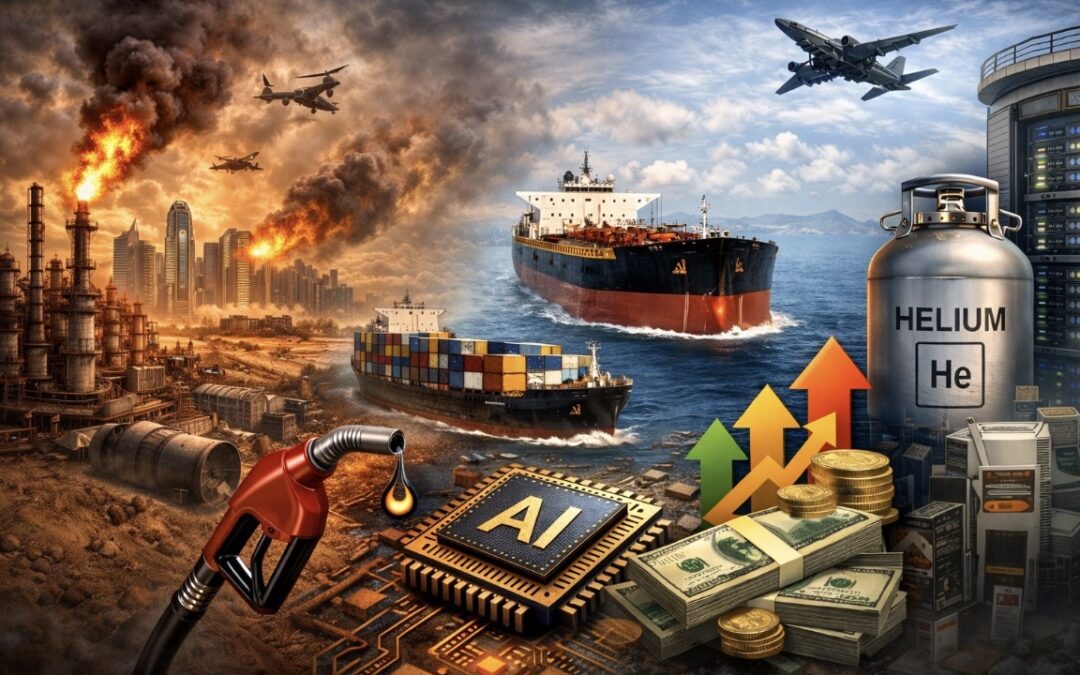
Artificial intelligence is often portrayed as a purely digital technology, existing in the cloud and driven by software. In reality, AI depends on an enormous physical infrastructure that requires energy, hardware, logistics and global supply chains. Because of this, conflict in the Middle East could have a far greater impact on the development of AI than many people realise.
The most immediate pressure would likely come from energy markets. Much of the world’s oil supply flows from the Persian Gulf region, and any escalation in conflict that disrupts production or shipping routes could push global energy prices significantly higher. A particularly sensitive chokepoint is the Strait of Hormuz, through which a substantial portion of the world’s crude oil exports travel each day. If tankers were prevented from passing through the strait due to military activity or security risks, global oil prices could spike rapidly.
Higher crude prices would ripple across the entire technology sector. AI infrastructure requires vast amounts of electricity. Training large models involves thousands of specialised processors running continuously for weeks or months inside hyperscale data centres. Companies such as Microsoft, Google and Amazon are investing billions into expanding these facilities, but their operating costs remain heavily tied to energy prices.
If oil and gas prices rise sharply, electricity prices are likely to follow. That would immediately increase the cost of running AI workloads. Data centres already consume enormous amounts of power, and the expansion of generative AI has dramatically increased demand for computing capacity. In a high-energy-price environment, companies may need to slow their expansion plans or pass increased costs on to customers.
Transport and logistics would also become more expensive. Rising fuel costs affect shipping, aviation and road transport. The AI industry relies on the rapid global movement of high-value components such as GPUs, networking equipment and specialised cooling systems. Manufacturers including NVIDIA and Intel depend on tightly coordinated international supply chains to deliver advanced chips used for AI training and inference. If fuel prices surge, the cost of moving these components around the world would increase as well.
Inflation is another important factor. Energy price shocks often ripple across the global economy, increasing the cost of construction materials, industrial equipment and manufacturing processes. Building a new AI data centre already costs billions of dollars. If the price of steel, concrete, electrical equipment and cooling systems rises alongside energy costs, fewer facilities may be built in the near term.
There are also smaller but still important supply considerations. For example, countries in the Gulf region produce specialised industrial gases used in various high-tech processes. Qatar, for instance, is a major producer of helium, which plays a role in certain semiconductor manufacturing and scientific cooling systems. While helium is only one piece of the broader technology supply chain, disruptions to exports illustrate how geopolitical instability can affect unexpected parts of the AI ecosystem.
Ultimately, the conflict highlights a fundamental truth about artificial intelligence. Despite its digital appearance, AI is deeply dependent on the physical world: energy, shipping routes, industrial materials and global stability. When geopolitical tensions threaten those foundations, the effects can reach far beyond oil markets and directly influence the pace and cost of technological progress.
