
The Strait of Hormuz’s pivotal role in global trade is increasingly at risk due to geopolitical tensions, with significant ramifications for artificial intelligence development.
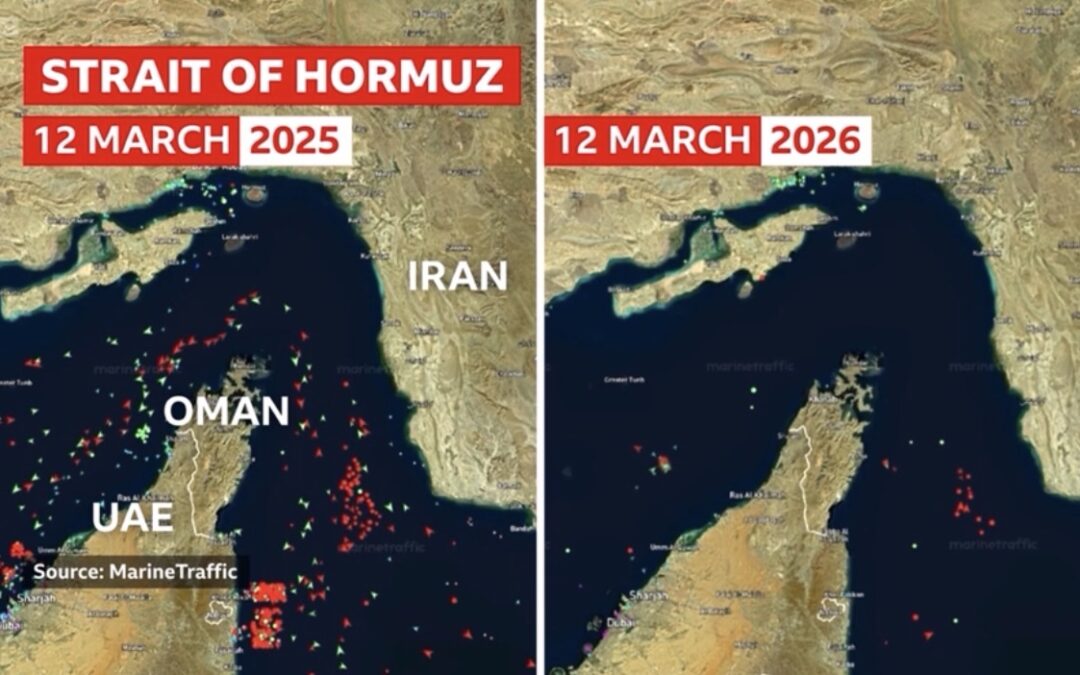
The images accompanying this article captures a stark before-and-after moment. On 12 March 2025, the Strait of Hormuz—one of the world’s most important maritime arteries—appears crowded with shipping traffic. A year later, on 12 March 2026, the corridor is almost empty.
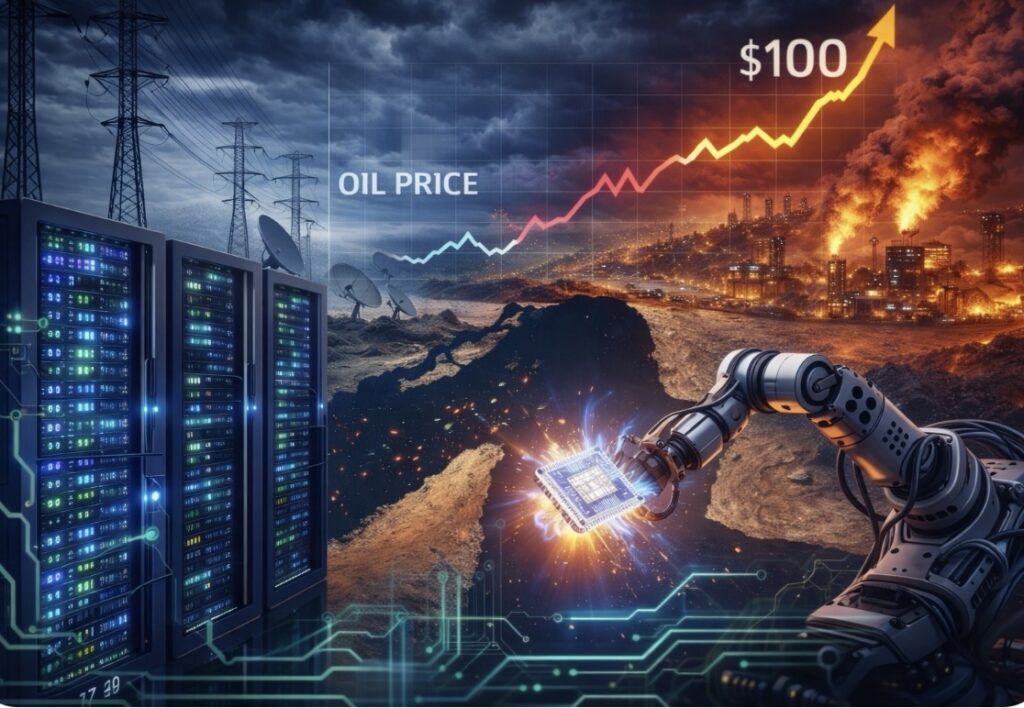
This dramatic reduction in vessel activity illustrates the profound disruption caused by the ongoing Middle East conflict. The strait normally carries roughly a fifth of the world’s traded oil, along with liquefied gases, industrial materials, and a range of global commodities including food and perishables. With oil prices already exceeding $100 per barrel today, the immediate economic implications are obvious.
But for corporate leaders, the deeper issue is not only energy markets—it is the ripple effect on artificial intelligence.
Energy Is the Hidden Input Behind AI
Artificial intelligence may appear digital and weightless, but its physical foundations are energy-intensive. Training large models requires enormous computational infrastructure: hyperscale data centres, high-performance GPUs, and vast cooling systems operating continuously.
These facilities depend on stable, affordable electricity.
When geopolitical disruption drives energy prices higher, AI development becomes more expensive. Data centre operators already account for power as one of their largest operating costs. If sustained oil and energy price volatility spreads into electricity markets, the total cost of AI training, inference, and deployment will rise.
For companies aggressively scaling AI capabilities, the implication is simple: margins tighten.
Even firms not directly operating infrastructure will feel the impact through cloud pricing. Cloud providers may eventually pass increased energy costs through higher compute pricing, affecting startups and enterprises alike.
Supply Chains for AI Hardware Are Vulnerable
The second, less obvious risk lies in hardware supply chains.
Many AI components—semiconductors, rare gases used in chip manufacturing, advanced cooling systems, and specialised metals—move through global shipping routes connected to the Gulf region. Disruptions in this corridor can slow logistics, increase shipping insurance costs, and create delivery bottlenecks.
Helium is a notable example. It is critical in semiconductor fabrication and advanced research environments. Any disruption to supply routes raises the possibility of shortages or price spikes.
For companies racing to deploy AI infrastructure, delays in GPU clusters or server components can derail deployment timelines.
In a sector where technological advantage depends on speed, logistics disruption becomes a strategic risk.
Data Centres and the Energy Security Question
This moment may accelerate an existing trend: the geographic redistribution of AI infrastructure.
Hyperscale providers are increasingly locating data centres in regions with stable energy supplies, renewable capacity, and political stability. The volatility now emerging from energy chokepoints reinforces the logic behind these decisions.
Executives should expect a stronger shift toward:
• Renewable-powered data centres
• Long-term power purchase agreements
• Geographic diversification of compute infrastructure
• On-site energy generation and battery storage
Energy resilience is becoming an AI strategy, not just a sustainability initiative.
AI May Also Become a Tool for Managing the Crisis
Ironically, the same technology threatened by energy volatility may help mitigate it.
AI systems are already being used to optimise energy grids, forecast demand, improve shipping logistics, and manage commodity markets. As geopolitical uncertainty grows, governments and corporations will increasingly rely on predictive AI to manage supply chain disruption and energy allocation.
This creates a feedback loop: instability drives the need for AI, while also raising the cost of operating it.
What CEOs Should Take Away
The empty shipping lanes in the image are more than a geopolitical signal. They represent a systemic shock to the global infrastructure that quietly powers the digital economy.
Three executive priorities emerge:
Audit AI energy exposure. Understand how sensitive your AI operations are to electricity pricing and cloud compute costs. Diversify infrastructure risk. Avoid concentration of AI workloads in energy-vulnerable regions. Integrate geopolitics into AI strategy. Energy security and supply chains now directly influence digital competitiveness.
The conflict may persist, and neither side currently appears willing to retreat. If the disruption to maritime trade continues, volatility in energy and logistics markets will remain elevated.
For leaders investing heavily in artificial intelligence, the lesson is clear: the future of AI will not be shaped solely by algorithms and chips.
It will also be shaped by shipping lanes, energy markets, and geopolitical stability.
