
For more than a century, the automotive industry has been defined by mechanical engineering. Engine performance, manufacturing quality and vehicle design determined which manufacturers succeeded and which struggled.
That era is rapidly coming to an end.
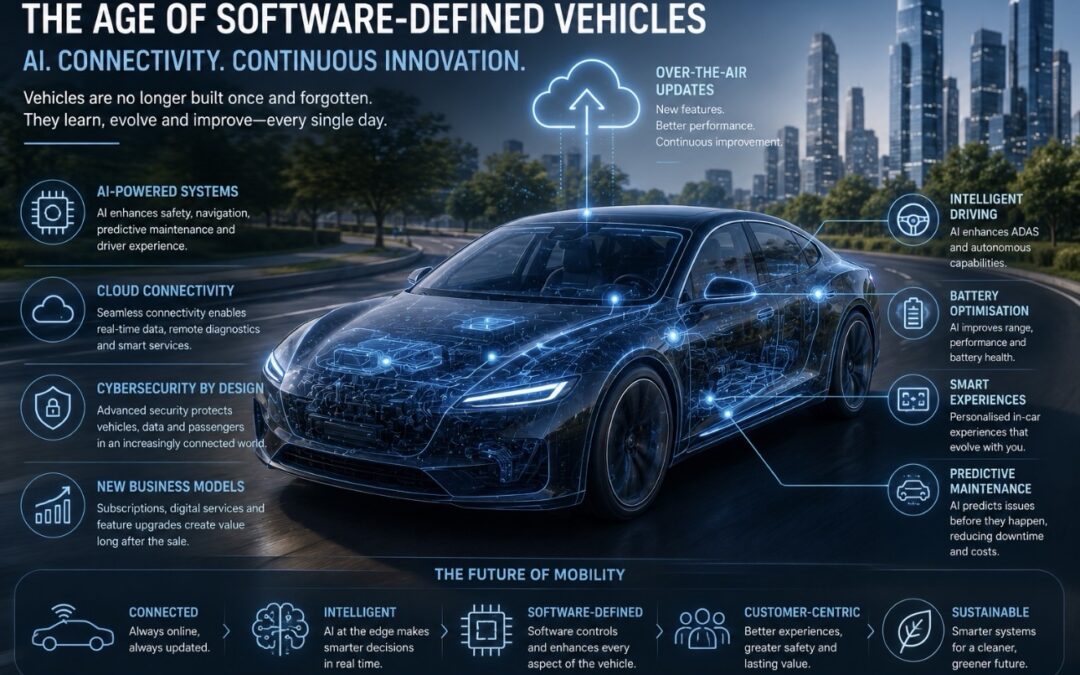
Today’s most valuable innovation is no longer found beneath the bonnet—it is embedded in millions of lines of software running throughout the vehicle. The modern automobile is evolving into a Software-Defined Vehicle (SDV), where features, performance and even safety capabilities can improve long after the car leaves the factory.
During the final week of July 2026, this transformation became increasingly evident. Automotive semiconductor manufacturers reported growing demand for AI-enabled vehicle technologies, while industry investment continued to accelerate towards software platforms, intelligent cockpit systems and edge artificial intelligence. (Futurum)
Artificial intelligence now plays a role in almost every aspect of a vehicle’s lifecycle. On the production line, AI-powered vision systems identify manufacturing defects before vehicles reach customers. During vehicle development, machine learning reduces engineering time by simulating thousands of design scenarios. Once on the road, AI continuously analyses driving conditions, improves navigation, enhances driver assistance systems and enables predictive maintenance.
The implications extend far beyond convenience.
Software-defined vehicles allow manufacturers to deliver new functionality through secure over-the-air software updates, much like smartphones receive operating system upgrades. Features that previously required new hardware can now be deployed remotely, reducing maintenance costs while improving customer satisfaction throughout the vehicle’s lifetime.
This shift is also transforming automotive business models.
Manufacturers are increasingly viewing vehicles as long-term digital platforms rather than one-time product sales. Subscription services, premium software packages, advanced driver assistance features and connected mobility services are creating recurring revenue streams that simply did not exist a decade ago.
However, this opportunity introduces new challenges.
As vehicles become connected computing platforms, cybersecurity moves to the forefront. Protecting customer data, securing wireless software updates and defending vehicles against cyber threats are becoming board-level priorities. Trust will become just as important as innovation.
Consumers are also demanding greater transparency around how artificial intelligence makes driving decisions, particularly as autonomous technologies become more capable. Building explainable and secure AI systems will therefore become a competitive advantage rather than merely a regulatory requirement.
Perhaps the most important lesson is that the automotive industry is no longer competing solely with other car manufacturers. Today’s competition increasingly includes cloud providers, semiconductor companies, AI developers and software platforms. Success will depend on how effectively these technologies work together to create safer, smarter and continuously improving vehicles.
The future of mobility is no longer defined only by electric powertrains or autonomous driving. It is being shaped by intelligent software, trusted artificial intelligence and connected ecosystems.
For the automotive industry, the most valuable component inside tomorrow’s vehicle may not be the engine or the battery—it will be the software that brings everything together.
