Artificial intelligence has entered a new era.
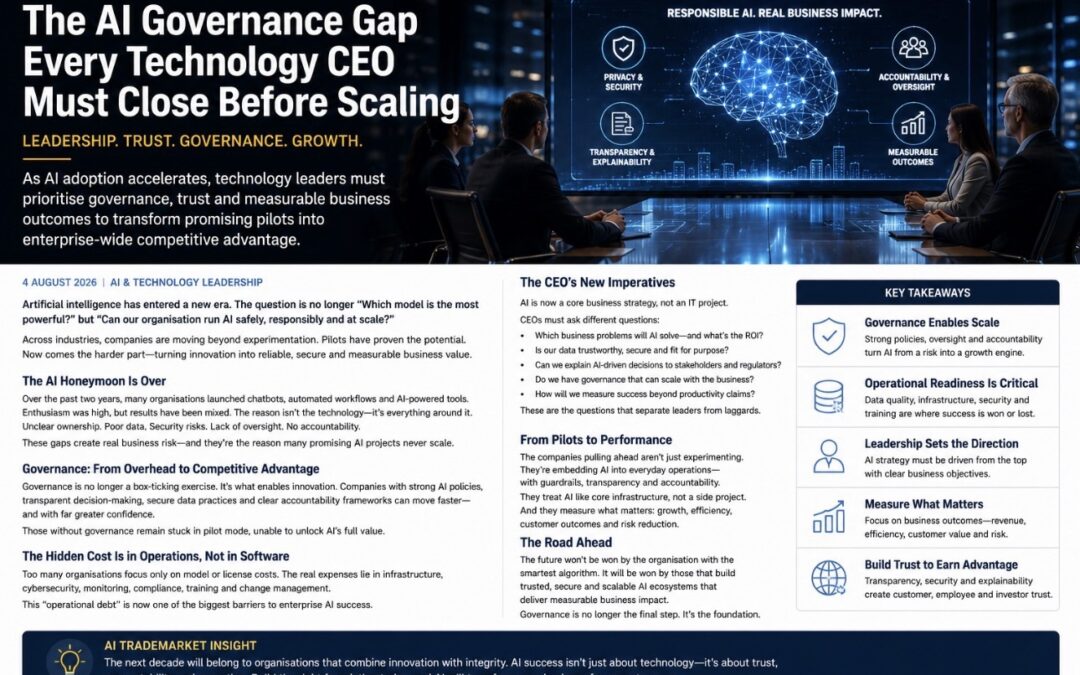
For the past three years, the technology industry has been obsessed with one question: Which company has built the most powerful AI model? Today, however, a far more important question is emerging in boardrooms around the world: Can our organisation deploy AI safely, responsibly and at scale?
That shift marks one of the biggest changes in enterprise technology this year.
Across the industry, organisations are moving beyond AI experimentation. Early pilot projects have demonstrated impressive capabilities, but many businesses are discovering that deploying AI across an entire organisation is significantly more challenging than introducing a chatbot or automating a single workflow.
The real challenge isn’t intelligence. It’s governance.
Without clear policies, secure data management, accountability and measurable business objectives, even the most sophisticated AI systems struggle to deliver lasting value. Technology leaders are beginning to realise that governance is no longer a compliance exercise—it is becoming a competitive advantage.
The companies making the greatest progress with AI share one common characteristic. They treat artificial intelligence as core business infrastructure rather than a standalone technology project.
Just as organisations invest in cybersecurity, cloud computing and digital transformation, AI now requires the same strategic planning, executive oversight and long-term investment. Decisions around data quality, regulatory compliance, employee training and risk management have become just as important as selecting the right AI platform.
For CEOs, this represents a significant change in leadership priorities.
The conversation is no longer about purchasing the latest AI solution. Instead, executives must ask whether their organisation is ready to operate AI at enterprise scale. Is company data accurate and accessible? Can AI-generated decisions be explained to customers and regulators? Are employees trained to work alongside AI systems? How will success be measured beyond productivity claims?
These questions are becoming central to every successful AI strategy.
Another important trend is the growing role of trust.
Customers, employees and investors increasingly expect organisations to demonstrate transparency in how AI is used. Businesses that can explain how AI supports decision-making, protects sensitive information and maintains human oversight are likely to earn greater confidence than those pursuing rapid deployment without appropriate safeguards.
Trust is becoming a commercial asset.
At the same time, organisations are discovering that the hidden costs of AI often lie outside the software itself. Investment in infrastructure, cybersecurity, governance frameworks, staff training and ongoing monitoring frequently exceeds the cost of the AI models. Businesses that underestimate these operational requirements risk creating fragmented systems that are difficult to manage and expensive to maintain.
The technology sector is therefore entering a new phase of maturity.
Innovation remains exceptionally fast, but success is no longer determined solely by technological capability. It is increasingly measured by an organisation’s ability to integrate AI into everyday business operations while maintaining security, transparency and accountability.
This evolution presents a significant opportunity for technology providers.
Companies offering governance platforms, cybersecurity solutions, compliance tools, AI monitoring services and enterprise integration expertise are becoming essential partners in helping organisations scale artificial intelligence responsibly. As AI adoption accelerates, demand for these supporting technologies is expected to grow alongside the models themselves.
The future of artificial intelligence will not belong exclusively to organisations with the smartest algorithms. It will belong to those capable of building trusted, secure and scalable AI ecosystems that deliver measurable business outcomes.
The race to develop more intelligent AI continues, but the next generation of market leaders will be defined by something far more valuable: the ability to transform innovation into sustainable business success.
As the AI economy enters its next chapter, governance is no longer the final step in deployment.
It is the foundation on which every successful AI strategy will be built.
AI TradeMarket Insight
Artificial intelligence is no longer simply transforming technology—it is transforming leadership itself. The organisations that succeed over the next decade will be those that treat AI as a long-term business strategy rather than a short-term technology investment. Trust, governance and measurable value are becoming the true currency of the AI economy. Companies that recognise this shift today will be far better positioned to lead tomorrow.
