AI is moving into a new phase of commerce: it is beginning to buy things on our behalf.
That may sound like a small evolution from today’s AI assistants, but the implications for banking, payments and retail could be enormous.
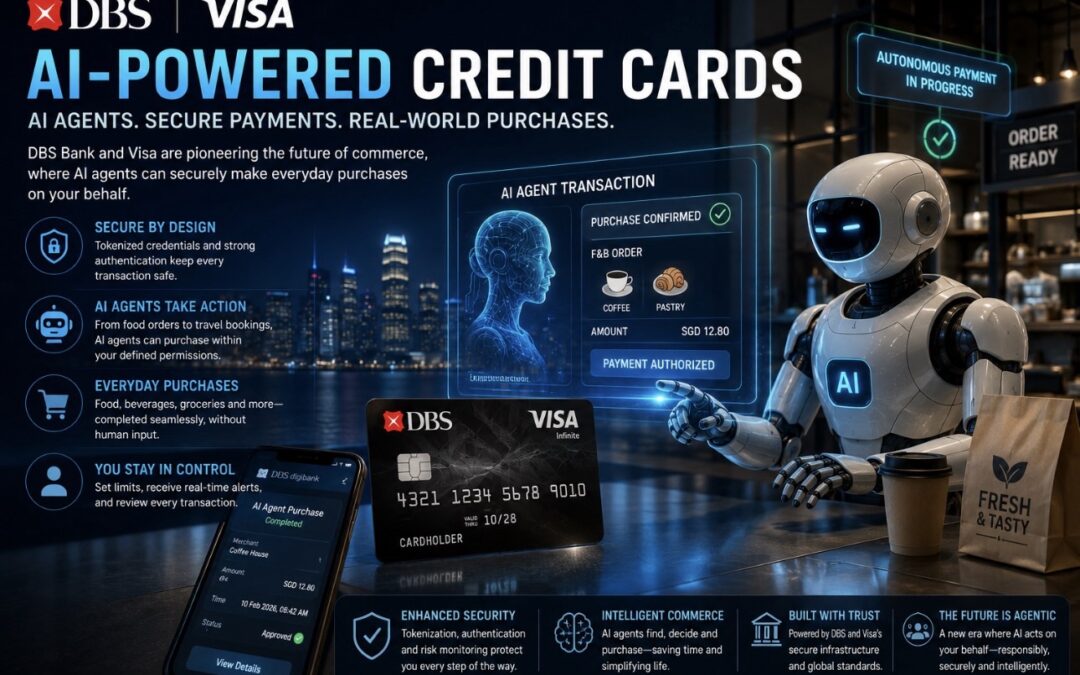
In February 2026, Singapore’s DBS Bank and Visa announced a pilot allowing AI agents to complete everyday food and beverage purchases using DBS/POSB cards through secure, issuer-controlled systems. The technology uses tokenised payment credentials, authentication and transaction controls designed specifically for agent-initiated payments.
The significance is not really the coffee or the meal.
It is the fact that the customer no longer necessarily has to be the person pressing the final payment button.
From AI Assistant To AI Buyer
Until recently, an AI assistant could search for a product, compare prices and recommend what you should buy.
The next generation can potentially complete the transaction.
Imagine telling an AI agent:
“Find me the best available flight to New York next Friday, within my budget, and book it.”
Instead of returning a list of websites, the agent could potentially select the appropriate option, authenticate the transaction and make the purchase within predefined permissions.
Visa’s Intelligent Commerce infrastructure is being designed around precisely this transition, using agent-specific tokenised credentials, authentication and payment controls.
The consumer remains in control, but the interface between intention and transaction becomes AI.
Why Tokenisation Matters
Giving an AI unrestricted access to someone’s credit-card number would create obvious security problems.
The solution being developed is different.
Instead of exposing the underlying card credentials, AI agents can use secure, tokenised credentials associated with the agent and the specific circumstances in which it is authorised to operate.
Visa describes these as AI-ready credentials: secure tokens that allow trusted agents to make purchases while maintaining authentication, permissions and issuer controls.
This is an important distinction.
The future of AI commerce cannot simply be about giving machines access to money.
It has to be about giving machines controlled authority to spend money.
The Bigger Opportunity For Banks
For financial institutions, agentic commerce could represent a fundamental change in the customer relationship.
Today, the bank provides the account and payment infrastructure while the customer initiates the transaction.
Tomorrow, the bank may increasingly provide the financial operating system through which AI agents act on the customer’s behalf.
That creates opportunities around personalised financial services, automated purchasing, intelligent budgeting, subscriptions, travel and business procurement.
DBS is already pushing beyond payments. In July 2026, the bank announced that its AI-enabled assistants were moving towards agentic capabilities, allowing authenticated customers to complete selected banking tasks rather than simply receive answers.
The direction is clear: AI is moving from answering questions to taking action.
But Trust Becomes The Product
The biggest challenge may not be technology.
It may be trust.
What happens if an AI agent purchases the wrong product?
What if a merchant is fraudulent?
What if the agent misunderstands the customer’s instruction?
What happens when an AI makes thousands of transactions simultaneously?
These are not hypothetical issues for the payments industry.
Visa’s architecture therefore incorporates tokenisation, authentication, transaction controls, spending permissions and fraud monitoring. Its Trusted Agent Protocol is also designed to help merchants verify that an AI agent is legitimate and authorised to transact.
That could become one of the defining competitive advantages of agentic commerce.
Consumers will not simply ask whether an AI can buy something. They will ask whether they can trust it to buy something.
The CEO Question
For CEOs, this development deserves attention because it potentially changes the economics of customer acquisition.
Today, companies optimise websites and apps for human customers.
Tomorrow, they may also need to optimise their businesses for AI customers.
An AI agent could compare thousands of products in seconds.
It could evaluate price, availability, delivery time, reputation and customer preferences before making a purchasing decision.
That means brand visibility could increasingly depend not only on how attractive a website is to humans, but on whether an AI agent can understand, evaluate and transact with the business.
The emerging competition may therefore be:
Human-to-business commerce versus machine-to-business commerce.
And the second category could scale dramatically faster.
The Beginning Of Agentic Commerce
Visa has predicted that a significant proportion of digital storefront interactions could eventually be initiated by AI agents, while its work with banks, merchants and technology companies is already moving agentic commerce from experimentation toward real-world transactions.
The DBS pilot is therefore more than an interesting experiment in Singapore.
It represents an early glimpse of a world where consumers increasingly communicate their intent rather than manually execute every transaction.
The customer says what they want.
The AI finds it.
The financial infrastructure verifies it.
The agent completes it.
And the payment network makes sure everyone can trust what happened.
For the banking and payments industry, that could be one of the most consequential transformations since the arrival of online commerce.
The next generation of credit cards may not simply be cards we use. They may be financial credentials that AI agents use on our behalf.
AI TradeMarket Insight
The strategic opportunity extends far beyond banking. Every business that accepts digital payments should begin considering what happens when its next customer is not a person, but an AI agent acting on behalf of one. Agentic commerce could fundamentally reshape discovery, purchasing, customer relationships and payment infrastructure. The companies preparing for machine-driven commerce today may have a significant advantage when AI becomes the new interface between consumers and the economy.
