Artificial intelligence has moved beyond being a productivity tool.
It is now becoming a boardroom-level organisational decision.
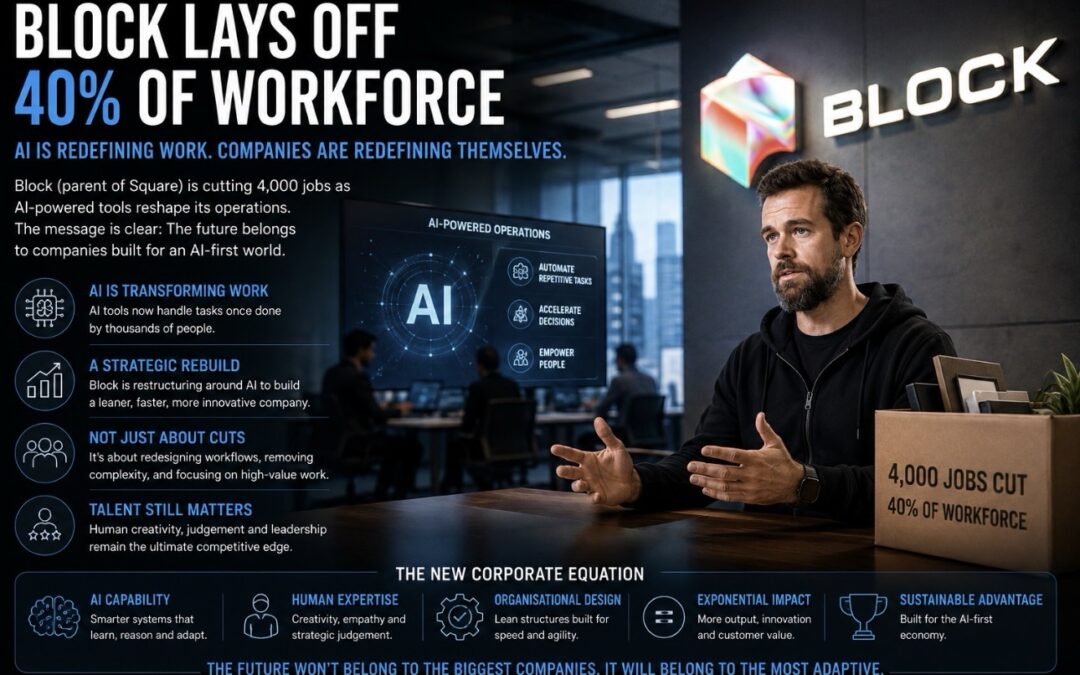
That became impossible to ignore when Block, the fintech company behind Square and Cash App, announced plans to eliminate approximately 4,000 positions—around 40% of its workforce—as it restructures around increasingly capable AI tools.
For years, CEOs have talked about AI helping employees work faster.
Block is demonstrating what happens when that philosophy is taken to its logical conclusion.
The question is no longer simply:
“How can AI help our employees?”
It is becoming:
“If AI can do more of the work, how should we redesign the company?”
From Productivity Tool To Organisational Strategy
The traditional corporate model is built around people.
Departments have managers.
Managers have teams.
Teams have specialists.
Information moves through layers of an organisation, with people coordinating tasks, reviewing work and making decisions.
AI challenges that structure.
An increasingly capable AI system can analyse information, write software, generate documentation, conduct research, support customers and automate repetitive processes.
The technology therefore doesn’t simply make an existing organisation faster.
It creates the possibility of designing an entirely different organisation.
That is the significance of Block’s decision.
The “Smaller Company” May Become The More Powerful Company
A smaller workforce does not necessarily mean a smaller business.
That distinction is critical.
If 10,000 employees were previously required to operate, maintain and grow a technology company, but increasingly capable AI systems allow the same organisation to achieve more with substantially fewer people, then headcount becomes a much less useful measure of corporate capability.
The competitive advantage could increasingly come from:
AI capability × human expertise × organisational design.
A company with fewer employees but significantly greater technological leverage could potentially outperform a much larger competitor.
This changes the traditional relationship between revenue, employees and productivity.
But There Is A Major Caveat
It would be a mistake to interpret Block’s decision as proof that AI can simply replace 40% of any company’s workforce.
Every organisation is different.
Jobs are not collections of isolated tasks.
Employees carry institutional knowledge, judgement, relationships, creativity, accountability and experience that cannot necessarily be replicated by an AI system.
There is also a significant difference between demonstrating that AI can perform a task and demonstrating that AI can safely perform that task at enterprise scale.
That distinction becomes particularly important in industries such as finance, healthcare, pharmaceuticals, aviation and critical infrastructure.
The real challenge for CEOs is therefore not deciding which employees AI can replace.
It is determining which work should be redesigned around AI while preserving the human capabilities the organisation cannot afford to lose.
The Middle-Management Question
One of the most interesting consequences of this transition could be the transformation of corporate hierarchy.
For decades, managers have existed partly because information had to move through people.
Someone gathered information.
Someone analysed it.
Someone prepared a report.
Someone reviewed the report.
Someone presented the recommendation.
AI can potentially compress that entire process.
A CEO could increasingly have access to real-time operational intelligence without waiting for multiple layers of management to prepare it.
That does not mean managers disappear.
It means their role may change.
The manager of the future may spend less time moving information around the organisation and more time providing judgement, leadership, accountability and human coordination.
What Happens To Entry-Level Jobs?
This may be the most uncomfortable question.
Many traditional entry-level roles have historically provided young employees with an opportunity to learn how businesses operate.
They perform repetitive tasks.
They analyse data.
They prepare documents.
They write basic code.
They answer straightforward customer questions.
AI is increasingly capable of performing many of these activities.
If companies automate too aggressively, they could create a paradox:
How do you develop experienced employees if AI eliminates many of the jobs through which people traditionally gain experience?
This is a strategic issue that CEOs and boards need to consider now.
The future workforce still needs people who understand the business.
But the path toward developing that expertise may look very different.
AI Doesn’t Just Reduce Costs — It Changes The Operating Model
This is where the Block example becomes particularly important.
The conventional approach to AI adoption is to give employees an AI assistant and ask them to become more productive.
That is essentially putting a copilot inside the existing organisation.
The more radical approach is to redesign the organisation around AI from the beginning.
Instead of asking:
“How can AI make this department more efficient?”
the CEO asks:
“If we were building this company today with the AI available to us, what would the organisation actually look like?”
That is a much more disruptive question.
It potentially affects recruitment, management structures, software development, customer service, finance, marketing, sales and even the physical size of corporate offices.
The CEO Question
Block’s decision should therefore not be viewed simply as another technology-sector redundancy story.
It is a warning—and potentially an opportunity—for every CEO.
The competitive question is increasingly moving from:
“Are we using AI?”
to:
“Are we organised for an AI-first economy?”
Companies that simply add AI tools to legacy processes may achieve incremental productivity improvements.
Companies that redesign their workflows, decision-making structures and operating models around AI could achieve something considerably more significant.
They could fundamentally change the economics of running a business.
The New Corporate Equation
The industrial age rewarded companies for adding people, factories and physical infrastructure.
The digital age rewarded companies for adding software, networks and data.
The AI age may reward companies that can combine intelligence, technology and relatively small numbers of highly capable people.
That doesn’t necessarily mean the future belongs to companies with the fewest employees.
It means the future may belong to companies with the greatest productive leverage per employee.
Block has put that proposition on the table in a particularly dramatic way.
The rest of the corporate world now has to decide what it means for them.
AI TradeMarket Insight
The Block story is bigger than one company’s workforce reduction. It represents a fundamental question about how businesses should be designed in an AI-first economy. CEOs should not simply ask where AI can reduce headcount; they should ask where AI can eliminate unnecessary complexity, accelerate decision-making, increase productivity and allow talented people to achieve significantly more.
The companies that understand this distinction could build organisations that are smaller, faster, more intelligent and more competitive—without sacrificing the human judgement that ultimately makes those organisations valuable.
AI TradeMarket — AI Marketing & Industry Intelligence
