
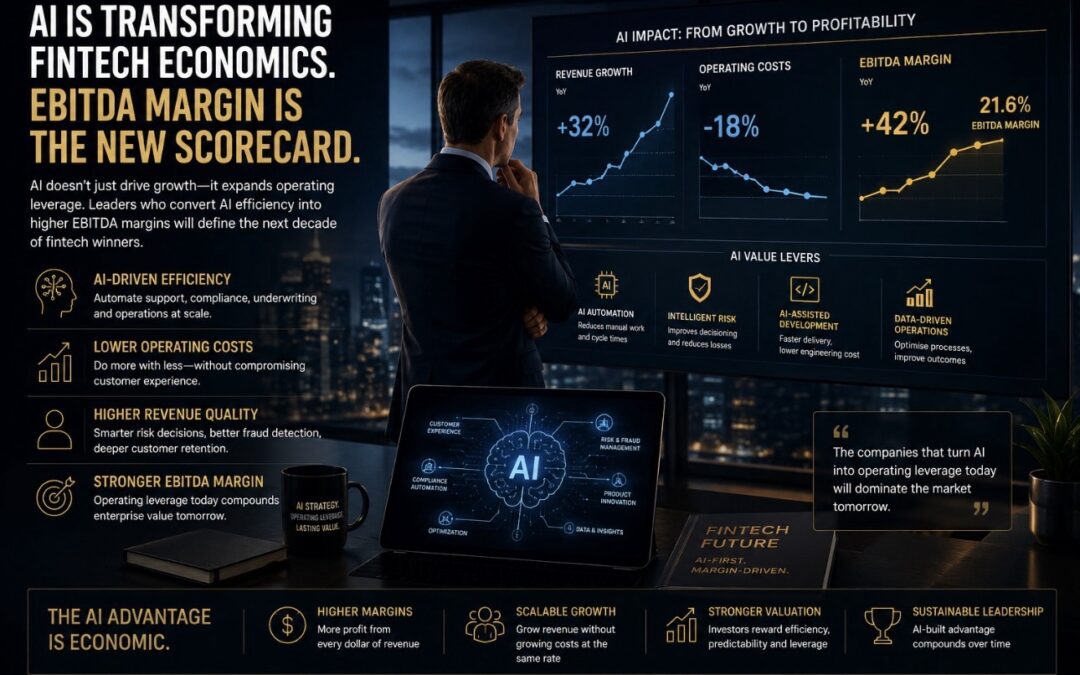
For years, fintech has been defined by growth.
Customer acquisition, transaction volumes, market share and revenue growth have dominated the conversation. But as the sector matures — and investors increasingly demand a credible path to profitability — another question is becoming harder for fintech CEOs to ignore:
What is AI actually doing to the economics of the business?
This is where EBITDA margin becomes particularly interesting.
Not because executives need another definition of EBITDA, but because margin can provide a useful signal of whether the enormous investment in AI is ultimately translating into operating leverage.
The promise of AI in financial services has never simply been about building better chatbots. The bigger opportunity is to fundamentally change how financial businesses operate.
Customer service can be automated. Fraud detection can become increasingly sophisticated. Compliance processes can be accelerated. Software development can become more productive. Credit assessment, underwriting, financial analysis and back-office operations can all potentially be performed with fewer manual interventions.
If those efficiencies materialise at scale, the economic impact should eventually become visible in the numbers.
This is where EBITDA margin becomes an AI metric.
Imagine two fintech companies generating identical revenue growth.
Company A continues expanding its workforce and operational infrastructure broadly in line with revenue.
Company B uses AI to automate substantial portions of customer support, compliance, software development and operational processes.
Both companies may report similar revenue growth.
But if Company B can increase revenue without proportionally increasing operating costs, its EBITDA margin should begin to expand.
That difference could become strategically significant.
A fintech generating $1 billion in revenue at a 10% EBITDA margin produces $100 million of EBITDA.
If AI-enabled operating efficiencies help push that margin to 15%, the same revenue base produces $150 million of EBITDA.
Nothing about the revenue figure has changed.
The economics have.
That is the real AI story for fintech.
The technology industry’s fascination with increasingly powerful AI models can sometimes obscure the question CEOs ultimately have to answer: What does this technology do for the business?
For fintech, one of the clearest answers could be operating leverage.
AI has the potential to allow businesses to handle greater transaction volumes and customer activity without increasing costs at the same rate.
That could fundamentally alter the traditional relationship between growth and headcount.
Instead of adding employees every time the customer base expands, companies may increasingly build AI-assisted operating models in which relatively small teams oversee increasingly automated processes.
The implications extend beyond cost reduction.
AI could also improve revenue quality.
Better fraud detection can reduce losses. More sophisticated personalisation could improve customer retention. AI-assisted underwriting could potentially improve risk selection. Faster product development could shorten the time required to bring new financial services to market.
In other words, AI could influence both sides of the margin equation: increasing revenue potential while reducing the cost of delivering it.
But there is an important warning for investors.
A higher EBITDA margin does not automatically prove that an AI strategy is working.
Companies can improve margins through layoffs, reduced investment or temporary cost-cutting. Conversely, a business investing heavily in AI infrastructure may initially see margins decline before the productivity benefits appear.
The more meaningful question is therefore not simply whether EBITDA margin is rising.
It is why.
Are margins improving because the organisation has become structurally more efficient? Is revenue growing faster than operating costs? Are AI investments replacing repetitive processes while allowing employees to focus on higher-value work?
And perhaps most importantly:
Is the improvement sustainable?
For fintech CEOs, this may represent a shift in how AI investment is evaluated.
The conversation is moving from “How much AI are we deploying?” to “What economic advantage is AI creating?”
That is a much more important question.
The next generation of fintech leaders may therefore compete not simply on who has the most sophisticated AI capabilities, but on who can translate those capabilities into measurable operating leverage.
Revenue growth will remain important.
But if AI fundamentally changes the cost of delivering financial services, EBITDA margin could become one of the clearest indicators of whether a fintech company’s AI strategy is creating genuine commercial value.
AI TradeMarket Insight: The real AI advantage in fintech may not be having access to the technology — increasingly, everyone will. The advantage will be building an operating model capable of turning AI capability into sustained margin expansion, stronger productivity and scalable growth.
