For years, automotive AI has largely been discussed in terms of autonomous driving, connected vehicles and increasingly sophisticated in-car experiences.
The latest Porsche–Tata Consultancy Services (TCS) deal suggests the bigger transformation may be happening somewhere else: inside the enterprise itself.
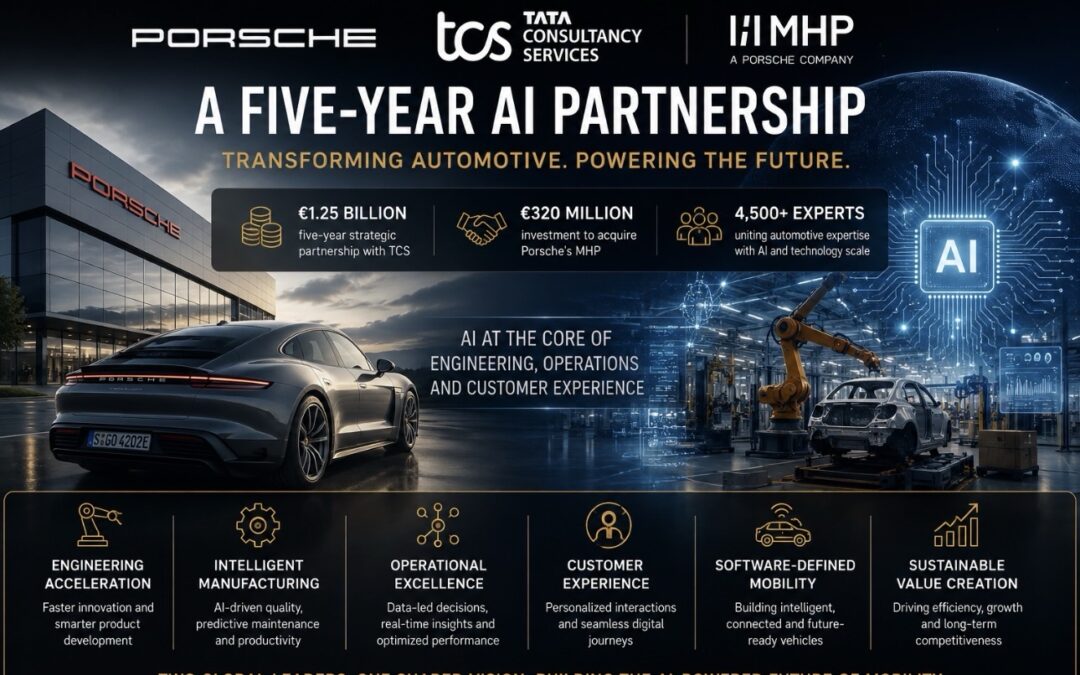
Porsche has committed to a five-year strategic partnership with TCS worth €1.25 billion, alongside TCS’s planned €320 million acquisition of Porsche’s management and IT consultancy MHP. The transaction remains subject to regulatory approvals.
This is not simply an IT outsourcing agreement.
It is a significant example of a global manufacturer treating AI as an industrial capability that needs to be embedded across the entire value chain.
AI Moves Beyond the Dashboard
The partnership is designed to bring AI into Porsche’s:
- Engineering
- Manufacturing
- Operations
- Customer experience
- Enterprise transformation
- Software-defined mobility
TCS will also establish a dedicated AI Mobility Centre of Excellence for Porsche, with the objective of moving AI applications from individual projects towards scalable deployment.
That distinction matters.
The first phase of enterprise AI was dominated by experimentation: copilots, chatbots, productivity tools and isolated proofs of concept.
The next phase is much more consequential.
AI becomes part of how the company actually operates.
The Strategic Significance
Porsche is effectively combining three assets.
Porsche brings:
Deep automotive engineering, manufacturing expertise, product knowledge and an established premium customer ecosystem.
TCS brings:
AI, engineering, technology, transformation capabilities and global delivery scale.
MHP brings:
Specialist automotive and industrial consulting expertise, including digital transformation, SAP, manufacturing digitalisation, AI and connected mobility. MHP employs more than 4,500 people globally.
The result is potentially more important than any individual AI application.
It creates an infrastructure for industrialising AI across the organisation.
The CEO Question Is No Longer “Where Can We Use AI?”
For CEOs, the more interesting question is increasingly:
“Where does AI change the economics of the business?”
That means looking beyond the technology itself.
Can AI reduce engineering cycle times?
Can it improve production planning?
Can it identify manufacturing problems before they become expensive?
Can it optimise supply chains?
Can it reduce operational complexity?
Can it personalise customer interactions at scale?
Can software-defined vehicles generate new recurring revenue?
And perhaps most importantly:
Can all of this be integrated into the company’s existing operating model rather than sitting alongside it?
That is where the real economic opportunity lies.
From AI Projects to AI Infrastructure
The Porsche–TCS agreement is notable because of its scale and duration.
A five-year commitment signals that the objective isn’t simply to launch a handful of AI pilots. It points towards a longer-term transformation programme in which AI, data, engineering and software become increasingly interconnected.
Porsche’s own announcement describes the partnership as a way of accelerating the development, scaling and integration of AI applications across key areas of the business.
This is the direction many large enterprises are likely to take.
Instead of asking individual departments to experiment with AI independently, organisations will increasingly build centralised AI capabilities that can be deployed across the enterprise.
The Software-Defined Enterprise
There is another important signal here.
The partnership isn’t only about AI.
It sits alongside the broader transition towards software-defined mobility.
The modern vehicle is increasingly becoming a software platform. But the same principle is beginning to apply to the manufacturer behind it.
Engineering is becoming software-intensive.
Manufacturing is becoming data-intensive.
Customer relationships are becoming digitally managed.
And operational decisions are increasingly capable of being augmented — or eventually automated — by AI.
The car may be software-defined.
Increasingly, the company making the car will be as well.
The Financial Implication
The €1.25 billion commitment also illustrates an important shift in how businesses may evaluate AI investment.
AI spending cannot simply be measured by the cost of licences, models or infrastructure.
The meaningful measurement is increasingly:
What does AI do to revenue, operating costs, productivity, margins and return on capital?
That brings AI directly into the CFO’s conversation.
If AI can increase engineering productivity, reduce downtime, optimise procurement and improve customer retention simultaneously, the economic impact can become considerably larger than the original technology investment.
This is where AI moves from being a technology initiative to becoming a business transformation strategy.
The Bigger Picture
TCS’s acquisition of MHP also demonstrates another trend.
Technology companies increasingly need deep industry expertise, while traditional industrial companies increasingly need sophisticated technology capabilities.
The boundaries between technology companies and industrial companies are therefore becoming less distinct.
Automotive companies need to understand AI.
Technology companies need to understand manufacturing.
Consultancies need to understand both.
And the companies capable of bringing those disciplines together may have a significant advantage.
AI TRADEMARKET INSIGHT
The Porsche–TCS agreement is a useful indicator of where enterprise AI is heading.
The competitive advantage will not necessarily come from having access to the best AI model.
It will come from integrating AI deeply enough into the organisation that competitors cannot easily replicate the resulting operating model.
That means AI strategy increasingly belongs in the boardroom — alongside capital allocation, operational efficiency, product strategy and long-term competitiveness.
For CEOs, the question is no longer whether AI will affect the economics of their industry.
It is how quickly they can turn AI capability into measurable enterprise value.
The Porsche deal suggests that some of the world’s largest industrial companies are already moving from experimentation to execution.
And that may be the real beginning of the AI-powered industrial enterprise.
AI TradeMarket
Tracking how artificial intelligence is changing business, industries and markets.
AI TradeMarket
