For years, the enterprise AI conversation has centred on a simple proposition: give an employee an intelligent assistant and productivity will improve.
That proposition is now beginning to look outdated.
The more significant development may be the emergence of AI agents that can work together.
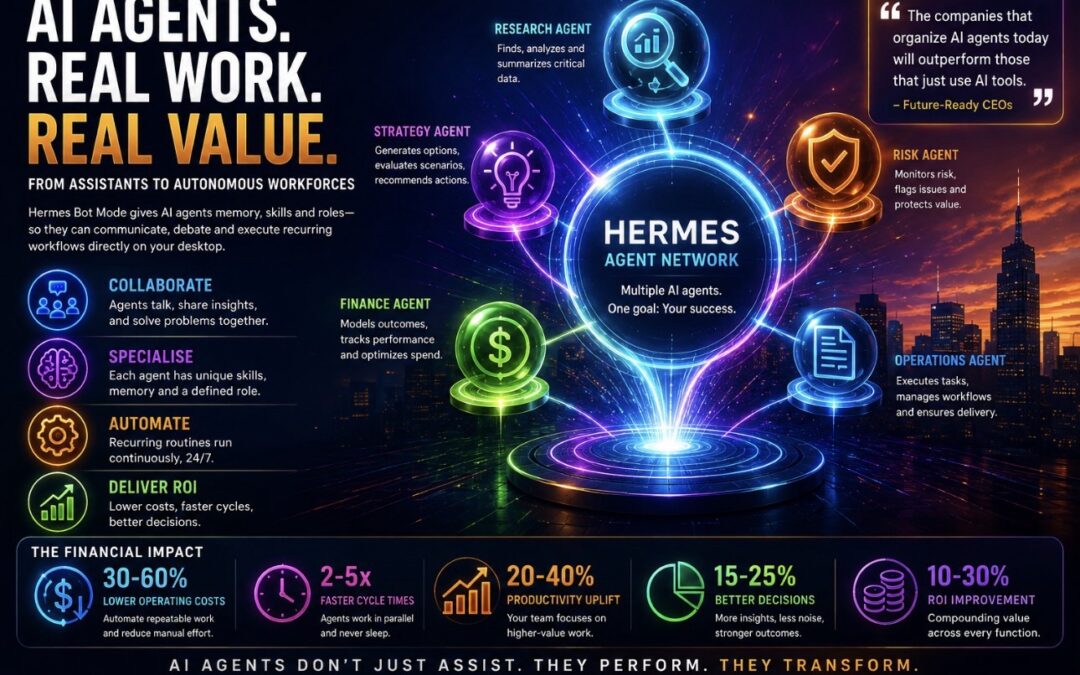
Hermes Bot Mode, highlighted in the accompanying image, points towards this next stage. Instead of treating AI as a single conversational interface, the model creates individual agents with their own memory, skills and roles — allowing them to communicate, debate and coordinate around tasks.
For business leaders, that distinction is important.
An assistant helps an employee do their job.
A network of agents could potentially perform parts of the job itself.
That changes the economics of AI adoption.
Imagine a financial services organisation where one agent monitors market information, another analyses risk, another prepares management reports and another checks compliance requirements. Rather than asking a human employee to orchestrate every stage, those agents could communicate with one another, challenge assumptions and pass work between themselves.
The human moves further up the value chain — from performing individual tasks to supervising an intelligent operating system.
The enterprise implication
The most interesting feature may not actually be the chatbot interface. It is the combination of memory, specialised skills and persistent execution.
Memory means an agent can potentially maintain continuity rather than beginning every interaction from scratch.
Specialised skills allow different agents to be configured around particular functions.
Recurring routines introduce another important concept: AI that does not simply wait for an employee to issue an instruction.
That begins to resemble an autonomous digital workforce.
For CEOs, this raises a much bigger question than whether their employees should use AI.
The question becomes:
Which functions of the organisation should increasingly be performed by AI agents?
Customer service. Research. Software development. Financial analysis. Procurement. Compliance. Marketing operations. Internal reporting. IT support.
The list is expanding rapidly.
But autonomy also creates a new governance challenge.
If multiple agents can make decisions, exchange information and initiate actions, businesses will need clear boundaries around permissions, accountability, data access and escalation to humans.
The organisation that simply deploys agents without designing those controls could create a new class of operational risk.
Conversely, organisations that build the architecture properly could gain something potentially much more valuable than incremental productivity: continuous digital execution at scale.
AI Trademarket Insight
The significance of Hermes is not that AI has learned to have a group conversation.
It is that AI is moving towards organisation.
The next competitive advantage may come from companies that stop thinking about AI as software employees use and start thinking about it as a coordinated layer of digital labour operating across the enterprise.
The strategic winners will not necessarily be those with the most AI tools.
They may be the companies that best understand how to organise intelligent agents around their business model — and where humans remain indispensable.
