
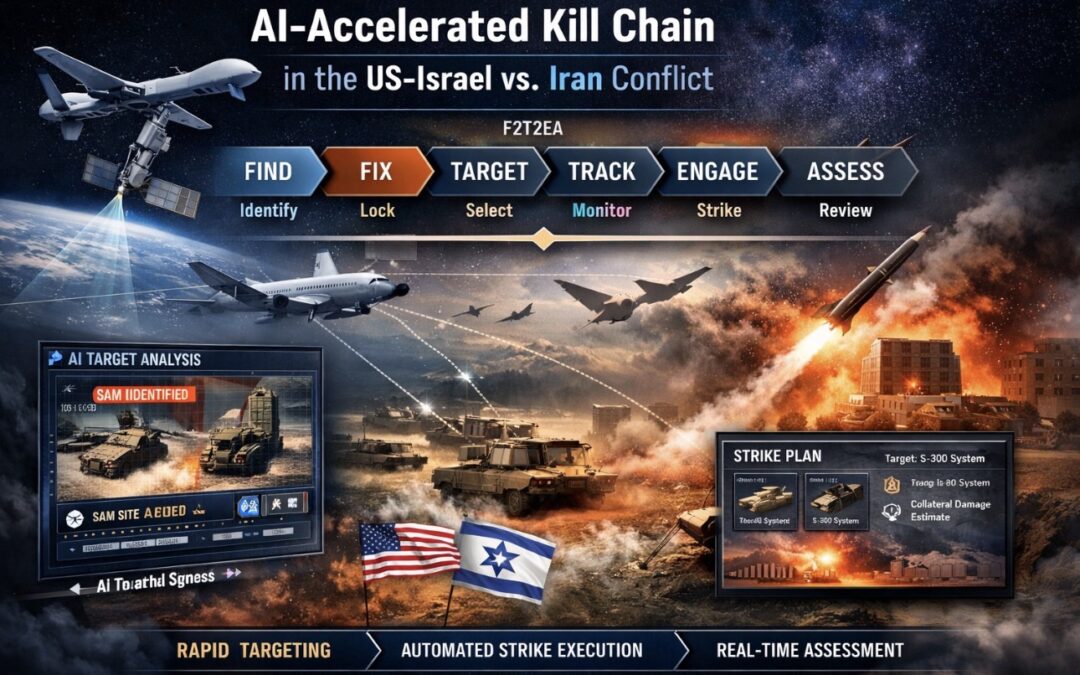
Modern warfare has always depended on the speed at which information can be gathered, analysed, and turned into action. Today, artificial intelligence is dramatically compressing that cycle. In the current confrontation between Israel, the United States, and Iran, AI is accelerating what military planners call the kill chain—a sequence known as F2T2EA: Find, Fix, Target, Track, Engage, and Assess.
Historically, each step in this process required separate intelligence systems and significant human analysis. Intelligence officers collected data from satellites, drones, intercepted communications, and human sources. Analysts then sifted through that information to identify targets before passing recommendations up the chain of command. The process worked, but it was slow. The bottleneck was almost always analysis.
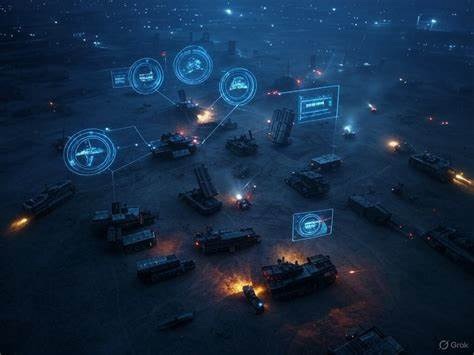
Today that constraint is disappearing.
The early stages of the kill chain—finding and fixing targets—are increasingly driven by AI-enabled sensors and platforms. Persistent surveillance drones such as the General Atomics MQ-9 Reaper provide continuous video feeds across vast geographic areas. Satellite constellations simultaneously gather imagery and thermal signatures from space, while signals intelligence aircraft intercept electronic communications.
One example is the Boeing RC-135 Rivet Joint, a surveillance aircraft designed to collect and analyse electronic signals, including radio transmissions, radar emissions, and communications traffic. Aircraft like this monitor command networks, military coordination, and operational chatter across the battlespace. The volume of information generated by these platforms is immense—far beyond what human analysts could traditionally process.
For decades, the military could collect far more intelligence than it could effectively analyse. That imbalance created a fundamental delay in the kill chain. Analysts would manually review drone footage, satellite imagery, and intercepted communications to identify potential targets. In high-intensity conflicts, thousands of hours of video or signals data could accumulate faster than teams could review it.
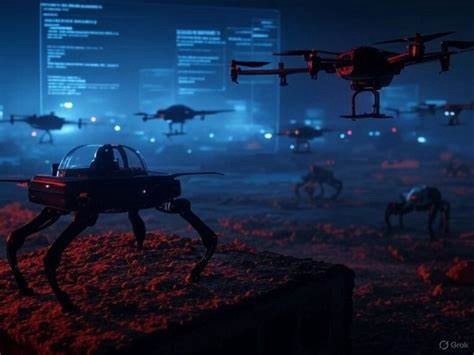
Artificial intelligence is now addressing that bottleneck.
Modern AI systems automatically scan drone footage, satellite imagery, and signals intercepts, detecting patterns and classifying military assets in real time. Tanks, missile launchers, radar installations, logistics convoys, and command vehicles can be automatically identified and labelled across millions of data points. Instead of analysts searching for targets manually, the AI highlights probable threats instantly.
This capability becomes especially important when tracking mobile systems such as the S-300 surface-to-air missile system. Unlike fixed installations, these air defence units are designed to move rapidly to avoid detection and counterattack. AI-driven surveillance systems can detect and track such movements across multiple intelligence sources, combining imagery, signals, and behavioural patterns to maintain continuous awareness.
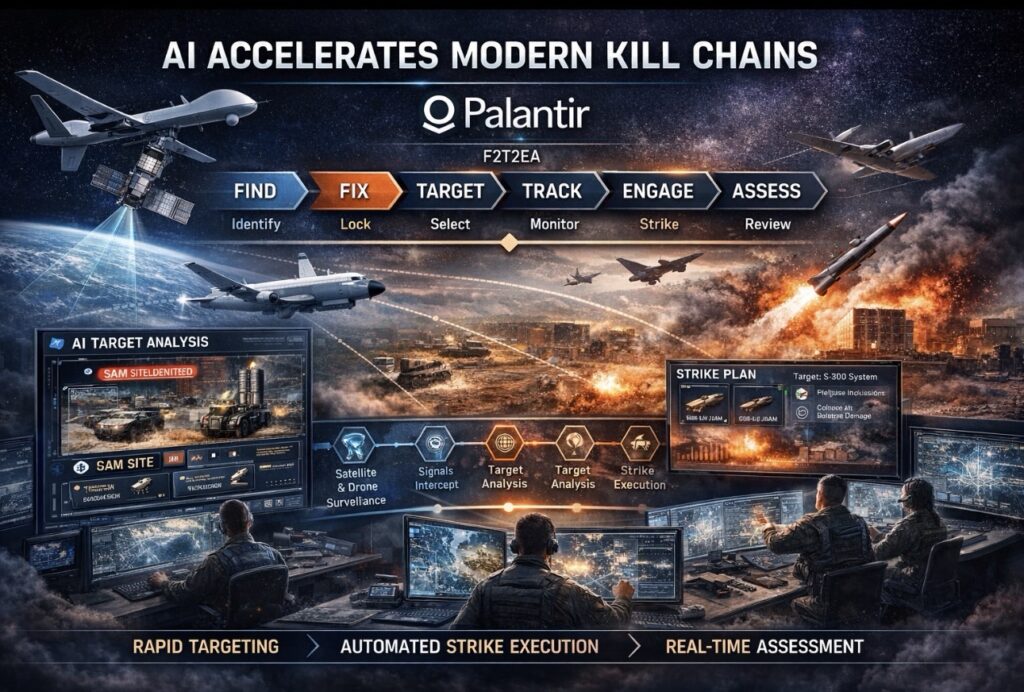
Companies like Palantir sit directly within this evolving operational architecture. Their platforms are designed to fuse intelligence streams—from satellite imagery and drone surveillance to signals intercepts and human reporting—into a single operational environment. The significance lies less in the individual data sources and more in the ability to correlate them rapidly, enabling commanders to move from detection to decision with far fewer organisational and analytical bottlenecks.
Once targets are identified, AI platforms move into the next stage of the kill chain: generating potential courses of action.
Previously, commanders would consult multiple separate systems—target databases, intelligence feeds, operational planning tools—to determine how to strike a target. Each system provided only part of the picture, requiring human operators to combine the information manually.
Modern AI platforms fuse these feeds into a single operational interface. Human intelligence, signals intelligence, and drone imagery appear together within one visualisation environment. Commanders can see the target, nearby infrastructure, friendly assets, and threat environments simultaneously.
From there, the system can automatically generate strike options.
The AI evaluates available assets—drones, aircraft, precision-guided munitions, or long-range missiles—and determines which option offers the highest probability of success with the lowest operational risk. It also calculates potential collateral damage by modelling blast radius, surrounding structures, and civilian infrastructure.
If hospitals, schools, religious sites, or residential areas fall within a potential strike zone, the system can estimate likely casualty levels based on weapon selection and impact location. Those calculations help commanders determine whether to proceed with an attack, modify the strike method, or abort the mission entirely.
This capability dramatically shortens the final stages of the kill chain. What once required multiple teams working across several systems can now occur within a single integrated platform. Identification, course-of-action generation, and strike execution can occur in minutes rather than hours or days.
As artificial intelligence becomes embedded deeper into the F2T2EA cycle, the role of firms like Palantir becomes increasingly structural to how modern militaries operate. They are not weapons manufacturers in the conventional sense, but providers of the analytical infrastructure that compresses the time between intelligence collection and operational action. In a battlespace defined by data volume and decision velocity, platforms that can integrate sensors, intelligence, and targeting workflows are likely to become as strategically consequential as the hardware that ultimately delivers the strike.
The implications are profound.
Conflicts can now see thousands of targets identified and prosecuted in a matter of weeks. AI does not merely assist commanders—it fundamentally changes the speed and scale of military operations.
The war involving Israel, the United States, and Iran is therefore not the first conflict involving artificial intelligence. But it may represent one of the clearest demonstrations of how AI is transforming the kill chain itself.
In modern warfare, victory is increasingly determined not only by weapons or manpower, but by the speed at which information becomes action. Artificial intelligence is now compressing that timeline—and reshaping the battlefield in the process.
