
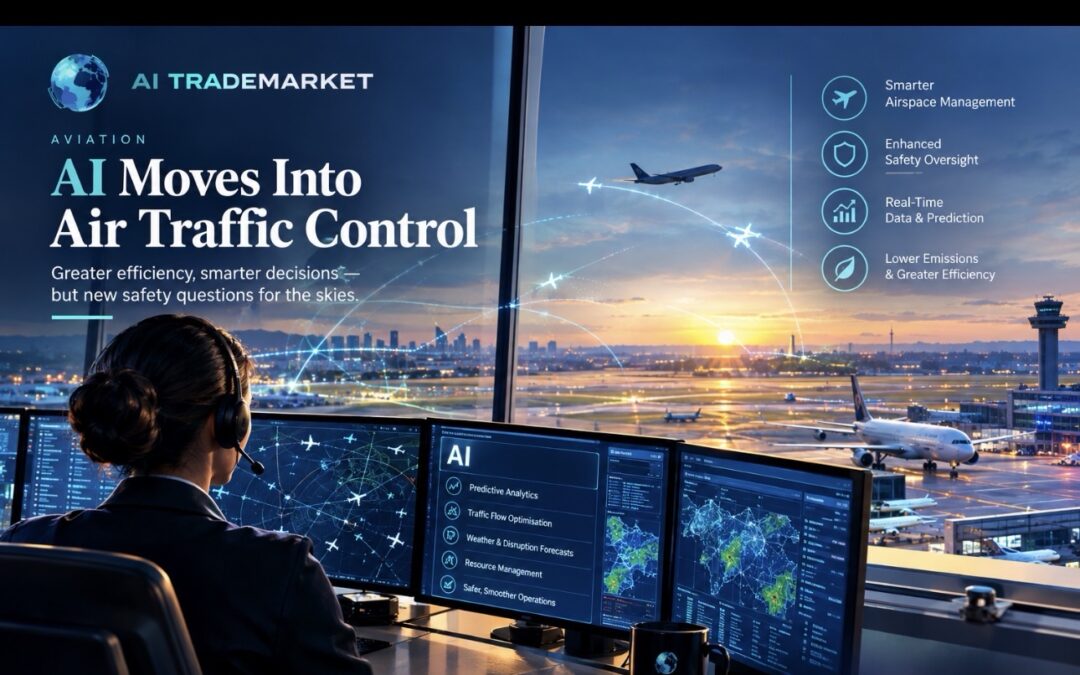
The aviation industry is approaching a pivotal moment in its adoption of artificial intelligence. From predictive maintenance and airport operations to flight planning and air traffic management, AI is moving beyond experimental applications into systems that can influence real-world decisions.
A major development emerged on 13 October 2026, when more than two dozen US lawmakers called on the Federal Aviation Administration (FAA) to pause the use of a new AI-enabled flight management tool in the Washington, DC area, citing concerns about safety evaluations, staff training and transparency. The system, known as Strategic Management of Airspace, Routes, and Trajectories (SMART), is designed to analyse aviation data and help controllers manage traffic more efficiently. It does not directly control aircraft.
The debate illustrates the central challenge facing aviation leaders: how to realise AI’s operational benefits without compromising the industry’s uncompromising safety requirements.
From Predictive Analytics to Operational Decision-Making
Modern aviation generates enormous volumes of data. Flight schedules, weather forecasts, airport capacity, aircraft movements, maintenance records and airspace restrictions all influence how efficiently an airline or airport operates.
AI can analyse these variables simultaneously, identify patterns and forecast potential disruptions faster than conventional manual processes. In air traffic management, that could mean anticipating congestion, identifying scheduling conflicts and helping controllers respond to weather-related disruption before delays cascade across an entire network.
The FAA’s SMART initiative draws on more than 200 data streams to forecast traffic flows and operational constraints, producing recommendations for aviation personnel. Its initial deployment focuses on improving the management of disrupted flights, with potential applications extending to wider coordination of flight schedules and trajectories.
The commercial implications are significant. Even relatively small improvements in aircraft utilisation, turnaround times and disruption management can affect fuel consumption, crew costs, passenger satisfaction and airline profitability.
AI is also being explored across predictive maintenance, baggage handling, airport resource allocation and customer operations. The UK Civil Aviation Authority is developing its understanding of aviation AI, including how existing regulatory frameworks apply to emerging systems and where further guidance may be required.
Why Safety and Human Oversight Remain Central
Aviation has always depended on layers of engineering, procedures, regulation and human judgement. AI introduces new possibilities, but it also creates questions about how recommendations are generated, validated and challenged.
A system may produce a statistically convincing recommendation while overlooking an unusual operational condition, relying on incomplete data or failing to account for an unexpected event. In a safety-critical environment, the consequences of an error can extend well beyond the immediate decision.
The current US debate does not establish that SMART is unsafe. Rather, lawmakers are questioning whether its safety evaluations, training arrangements and transparency are sufficiently established for its deployment. US officials have emphasised that human controllers retain authority over airspace decisions.
For aviation executives, the distinction between decision support and decision authority is crucial. An AI system that advises a qualified professional presents a different risk profile from one permitted to execute actions autonomously.
The European Union Aviation Safety Agency is also developing guidance for increasingly advanced aviation AI, including applications involving human-AI cooperation and more advanced automation. Its work reflects the need to establish appropriate levels of trustworthiness, oversight and assurance as the technology develops.
The Business Case: Efficiency, Resilience and Competitive Advantage
For airlines, airports and aerospace suppliers, the immediate opportunity may lie less in replacing established operational roles than in improving the quality and speed of decisions.
Consider an airline facing severe weather disruption. An AI-enabled system could combine aircraft locations, crew availability, passenger connections, airport restrictions and forecast conditions to compare recovery options. Better recommendations could help reduce cancellations, protect connections and improve the use of aircraft and personnel.
Similar approaches could support maintenance planning by identifying emerging component problems before they cause costly groundings. Airports could use predictive analytics to coordinate gates, ground crews, baggage operations and passenger flows.
However, commercial value must be measured against the cost of implementation, integration with legacy systems, staff training, cyber security and ongoing validation. A technically impressive system is not necessarily an economically successful one.
Executives should also examine vendor claims carefully. Aviation operators need evidence of reliability under realistic conditions, defined escalation procedures and clear accountability when an AI recommendation is wrong.
What Aviation Leaders Should Do Now
Three priorities deserve board-level attention.
First, establish a clear risk framework. Classify AI applications according to their operational consequences. A customer-service assistant should not face the same approval requirements as software influencing flight operations.
Second, demand evidence before deployment. Testing should include unusual conditions, degraded data, system failures and scenarios in which AI recommendations conflict with professional judgement. Training must help personnel understand both the capabilities and limitations of the tools they use.
Third, preserve accountability. Organisations should know who approves a system, who monitors it, who can override its recommendations and who is responsible when something goes wrong. Cyber-security controls and contingency arrangements must also reflect the possibility of compromised or unavailable AI systems.
The objective is not to slow innovation indiscriminately. It is to ensure that adoption is proportionate to risk and that efficiency gains are supported by demonstrable operational performance.
AI TRADEMARKET INSIGHT
Aviation offers a revealing example of the wider challenge facing industries adopting increasingly capable AI. The technology can improve forecasting, resource allocation and operational resilience, but its value depends on the quality of the decisions it supports and the safeguards surrounding its use.
For aviation businesses, the emerging opportunity extends beyond AI software itself. It includes data infrastructure, predictive maintenance, operational analytics, assurance services, cyber security and workforce training.
The FAA debate is a reminder that deploying AI in a safety-critical industry requires more than technical capability. It demands evidence, transparency, human oversight and clearly defined responsibility.
The winners in aviation’s AI transition will not necessarily be the organisations that automate fastest, but those that convert automation into measurable efficiency without weakening the trust on which aviation depends.
AI TradeMarket
Tracking how artificial intelligence is changing business, industries and markets.