Artificial intelligence has crossed an extraordinary threshold in the life sciences.
For years, AI has been remarkably effective at analysing biological information: identifying patterns in medical images, predicting protein structures, searching for drug candidates and helping researchers understand genetic variation.
Now, researchers have demonstrated something fundamentally different.
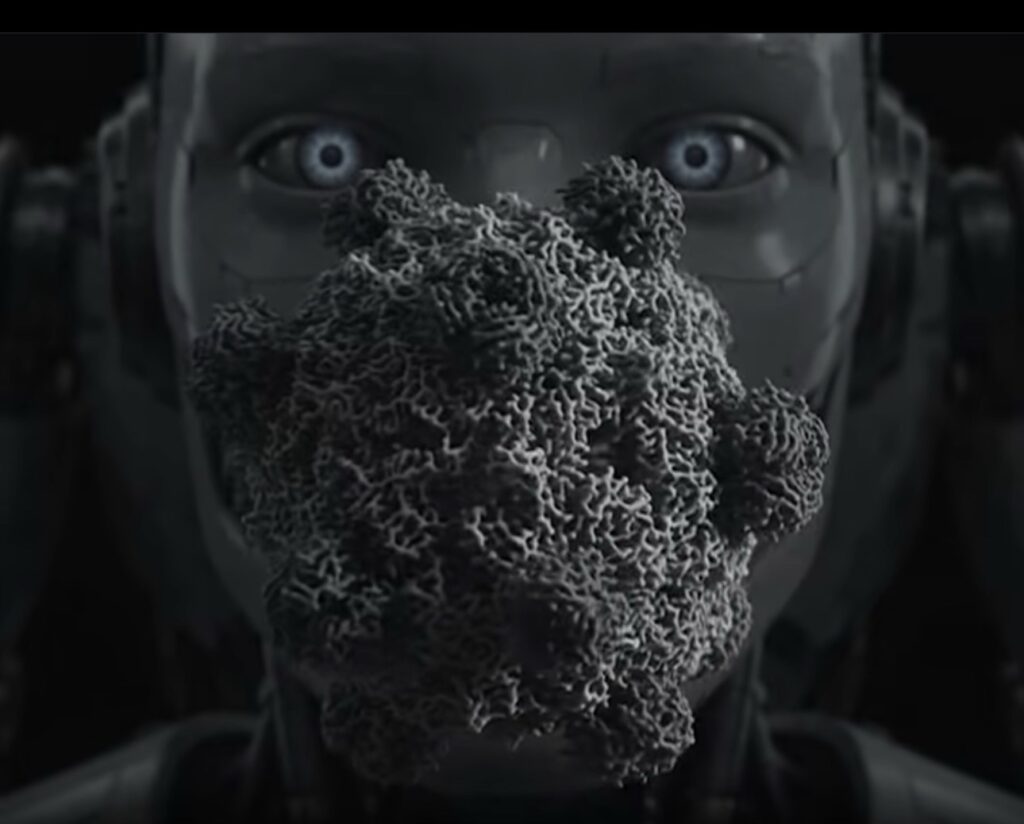
AI can help design an entire functional viral genome that does not exist in nature.
The headline accompanying this breakthrough—“AI Just Created Viruses Nature Has Never Seen”—sounds almost like science fiction. But the underlying research is very real, and its implications extend far beyond artificial intelligence. For pharmaceutical companies, biotechnology firms, medical-technology developers and healthcare investors, it could signal the beginning of an entirely new era of computationally designed biology.
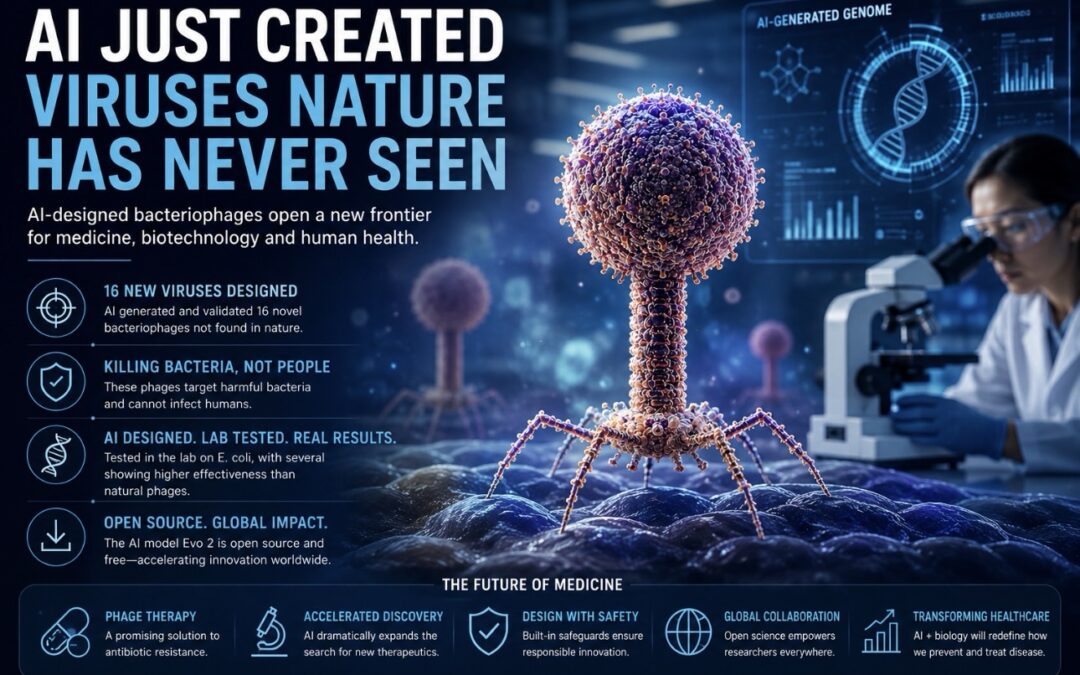
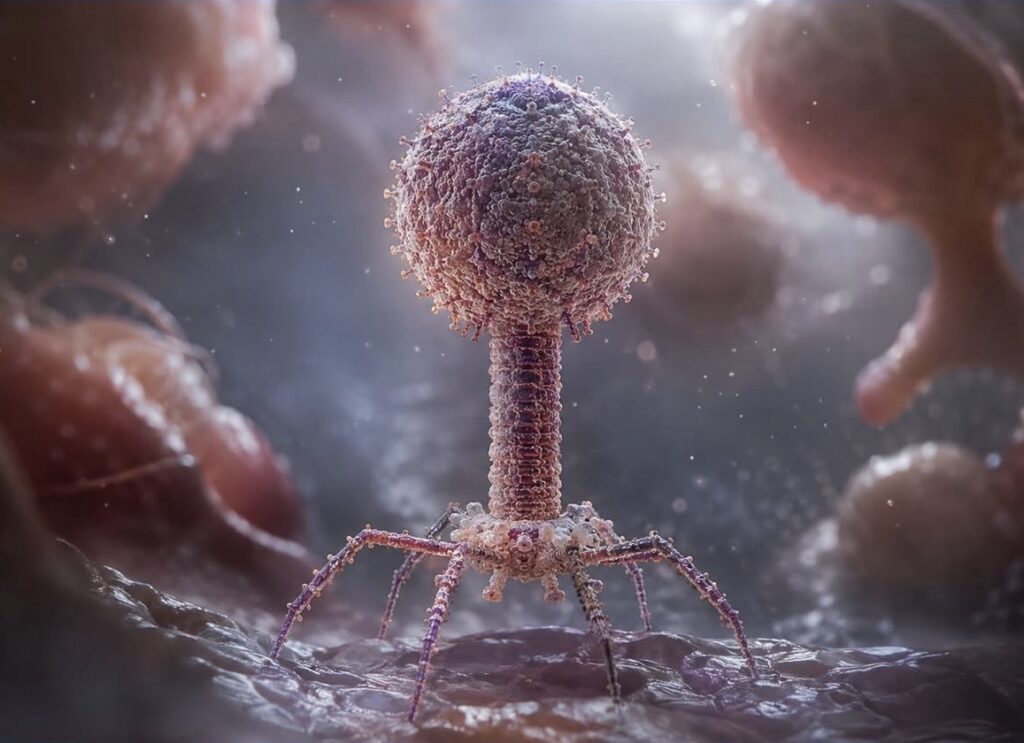
Researchers at Stanford University and the Arc Institute used genome-focused AI models, including Evo 2, to design novel bacteriophages: viruses that infect bacteria rather than people. The researchers generated hundreds of candidate genomes and tested selected designs in the laboratory. Sixteen produced functional bacteriophages capable of infecting and killing E. coli.
That distinction is crucial.
These are not viruses designed to infect humans. The work focused on bacteriophages and used non-pathogenic laboratory bacterial strains. The researchers also incorporated safety constraints into the project, including excluding human, animal and plant viral pathogens from the relevant training data.
Nevertheless, the achievement represents a major change in what AI can potentially do in biology.
From Reading Biology to Designing It
The pharmaceutical industry’s relationship with AI has traditionally been dominated by prediction.
Can an algorithm predict whether a molecule might bind to a target?
Can machine learning identify a promising drug candidate?
Can AI analyse a patient’s genomic information?
Can software help researchers determine which biological pathways might be associated with disease?
Those capabilities remain enormously important.
But generative biology introduces a different proposition.
Instead of simply analysing biological systems that already exist, AI can increasingly help researchers explore biological designs that evolution has never produced.

Evo 2 is part of this transition. Stanford describes it as a biological foundation model trained on enormous quantities of genomic information, capable of modelling DNA sequences across diverse forms of life. The model effectively treats genomic sequences as a kind of biological language, allowing researchers to investigate how sequences relate to biological function.
The recent bacteriophage work demonstrates the significance of that approach.
The AI did not merely identify an existing virus.
It helped generate new genomic designs that were subsequently tested experimentally.
That moves AI further along the path from reading biology to writing biology.
Why Pharmaceutical Companies Should Pay Attention
The immediate medical opportunity is particularly interesting because of antimicrobial resistance.
Antibiotics have transformed modern medicine, but bacterial resistance continues to undermine their effectiveness. Bacteriophages offer an alternative biological approach because they naturally target bacteria.
The Stanford research provides evidence that AI-generated phages can potentially expand the range of biological candidates available to researchers. Some of the generated phages demonstrated useful activity against E. coli, including bacterial strains that had developed resistance to the natural phage used as the starting point.
This does not mean AI-designed phage therapies are ready to replace antibiotics.
Clinical development requires substantially more evidence: safety testing, pharmacological studies, manufacturing controls, regulatory review and human clinical trials.
But the strategic implication is enormous.
Historically, scientists have largely depended upon what nature has already produced when searching for useful biological agents.
Generative AI could expand that search space.
Instead of asking:
“Which naturally occurring biological system can we find?”
researchers may increasingly ask:
“Which biological design could perform the function we need?”
That is a profound change for pharmaceutical research.
The Rise of AI-Designed Therapeutics
The significance extends beyond bacteriophages.
AI is already being applied across drug discovery, protein engineering, antibody development, genomics and medical research. Foundation models are increasingly being developed to understand biological systems at multiple levels.
The long-term opportunity is the creation of a much tighter design-build-test cycle.
AI proposes a biological hypothesis.
Researchers evaluate it computationally.
The most promising candidates move into controlled laboratory testing.
Experimental results feed back into computational models.
The cycle repeats.
The objective is not necessarily to eliminate scientists from the process.
It is to allow scientists to explore vastly more possibilities than conventional experimentation permits.
For pharmaceutical companies, that could eventually mean faster discovery programmes, more targeted therapeutic development and new approaches to diseases where existing treatment options remain limited.
Medical Technology Is Becoming Computational Biology
This development also changes the definition of medical technology.
MedTech has traditionally been associated with devices, diagnostic equipment, imaging systems and monitoring technologies.
But the boundaries are becoming increasingly blurred.
The next generation of healthcare technology could combine AI, genomics, laboratory automation, diagnostics and biological engineering into integrated platforms.
Imagine a future in which a patient’s infection is characterised computationally, potential biological therapies are evaluated by AI, candidates are tested in the laboratory and the most promising treatment is selected through a highly automated workflow.
That future is not here yet.
But the infrastructure required to move towards it is being assembled now.
AI is becoming part of the laboratory itself.
The Biosecurity Question Cannot Be Ignored
There is another side to this story.
The same capability that makes generative biology exciting also creates difficult questions about safety and security.
The researchers themselves acknowledge that designing functional viral genomes raises important biosafety and biosecurity considerations. Independent experts have argued that existing governance needs to evolve alongside these capabilities.
This is particularly important because AI development moves quickly while biological regulation traditionally moves much more slowly.
The answer should not be to abandon beneficial research.
It should be to build appropriate safeguards around it.
That means stronger oversight, responsible laboratory practices, appropriate screening of synthetic biological materials, careful model evaluation and close collaboration between AI researchers, pharmaceutical companies, governments and biosecurity experts.
The lesson for the pharmaceutical industry is straightforward:
Innovation and governance must advance together.
The Business Opportunity
For investors and pharmaceutical executives, this development should also be viewed through a commercial lens.
A new ecosystem is emerging around computational biology.
It includes:
- AI-driven drug discovery
- Genomic foundation models
- Synthetic biology
- Laboratory automation
- AI-enabled diagnostics
- Biological data platforms
- Precision medicine
- Protein and antibody design
- Computational therapeutics
- Biosecurity and biological monitoring
The companies that successfully connect these technologies could become some of the most important healthcare businesses of the next decade.
The winners may not necessarily be the companies developing the largest AI models.
They may be the companies capable of turning AI-generated biological insights into validated, manufacturable and clinically useful products.
That distinction is critical.
A computer-generated biological design is not a medicine.
The difficult—and potentially enormously valuable—step is turning that design into something that can safely benefit patients.
A New Chapter for Pharma
The pharmaceutical industry has spent decades learning how to read the biological code of life.
It has now entered an era in which technology can increasingly help researchers write it.
The Stanford and Arc Institute research is an important proof of concept, not a finished medical product. Yet it demonstrates that AI can move beyond analysing existing biology and begin generating functional biological systems under controlled experimental conditions.
That distinction could ultimately prove more important than the individual viruses themselves.
The future of pharmaceutical innovation may depend increasingly on the convergence of artificial intelligence, genomics, synthetic biology and laboratory automation.
And that means the industry’s competitive landscape is changing.
The pharmaceutical company of tomorrow may need to think less like a traditional drug manufacturer and more like a technology company, data company and biological engineering organisation operating simultaneously.
AI TradeMarket Insight
The most important story here is not that AI has created 16 new bacteriophages. It is that artificial intelligence is beginning to cross the boundary between understanding biology and designing biology. For pharma and medical technology leaders, this represents both an extraordinary opportunity and a responsibility. The companies that master the convergence of AI, genomics and laboratory science—while maintaining rigorous safety and governance—could define the next generation of healthcare innovation.
