Artificial intelligence has entered a new phase of maturity. As of March 2026, the narrative is no longer defined by experimental breakthroughs, but by disciplined execution at scale. AI is being embedded into the operating core of organisations—reshaping how decisions are made, how services are delivered, and how risk is managed.
However, this transition is unfolding against a far more volatile global backdrop. The ongoing conflict in the Middle East is not just a geopolitical concern; it is materially influencing how AI is being prioritised and deployed across industries.
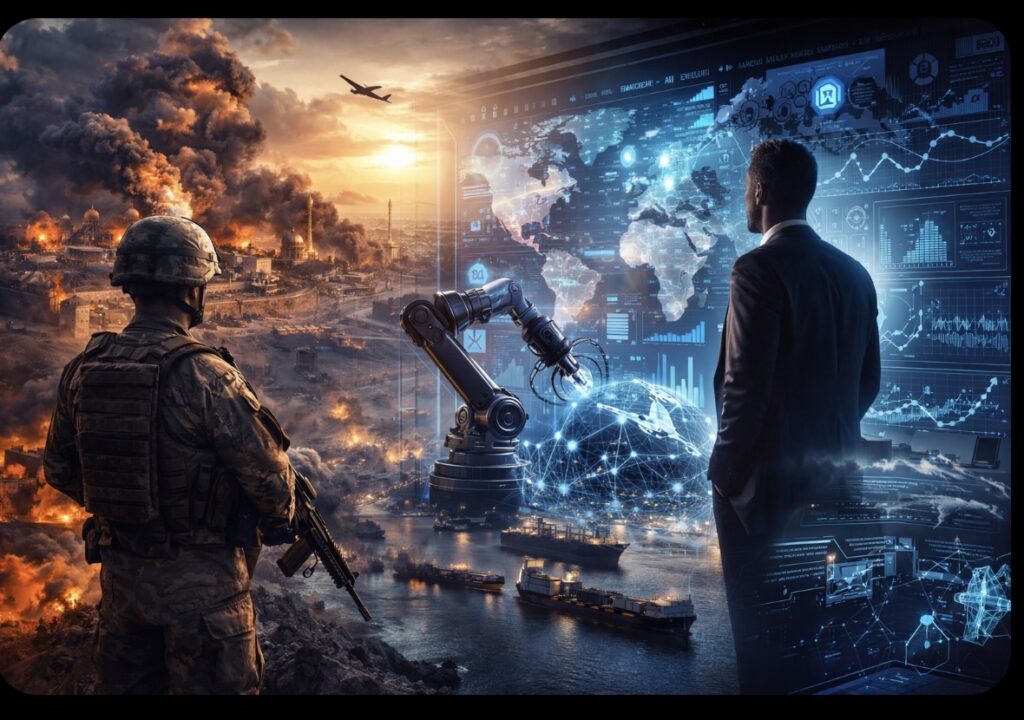
The most immediate impact is on supply chains and energy markets. Disruptions to critical shipping routes and rising energy price volatility are forcing organisations to rethink operational resilience. In response, AI is being rapidly deployed for real-time supply chain visibility, predictive logistics, and dynamic rerouting. What was previously viewed as optimisation is now mission-critical risk mitigation. CEOs are increasingly treating AI-driven supply chain intelligence as a board-level capability.
In financial services and fintech, geopolitical instability is amplifying fraud risk, sanctions complexity, and cross-border transaction scrutiny. AI systems are evolving into continuous monitoring platforms—capable of detecting anomalies, ensuring compliance, and adapting to shifting regulatory environments in real time. Trust, identity, and verification are becoming strategic assets, with AI forming the backbone of secure digital ecosystems.
Telecommunications and critical infrastructure are also being redefined. The convergence of AI with next-generation networks is enabling autonomous, self-healing systems that can operate under stress conditions. In a world where physical infrastructure may be disrupted, software-defined resilience becomes paramount. AI is now central to maintaining continuity, whether in communications, utilities, or national infrastructure.
In automotive, aviation, and advanced manufacturing, the emphasis is shifting toward simulation and scenario planning. AI-powered digital twins are allowing organisations to model geopolitical shocks—such as supply interruptions or cost surges—before they occur. This capability is reducing exposure to uncertainty while accelerating innovation cycles. The result is a more adaptive, responsive industrial base.
Meanwhile, healthcare and pharmaceuticals are experiencing a parallel transformation. AI is being used not only to accelerate drug discovery and personalise treatment, but also to ensure continuity of care in uncertain environments. Remote diagnostics, intelligent triage systems, and automated administrative processes are reducing dependency on strained human resources—an increasingly important factor in times of global instability.
Overlaying all of this is a tightening regulatory environment. Governments are accelerating efforts to define the boundaries of AI usage, particularly in high-risk sectors. Transparency, auditability, and accountability are becoming non-negotiable. At the same time, nations are investing heavily in sovereign AI capabilities, recognising that technological independence is now closely tied to economic and national security.
The strategic implication for CEOs and C-suite leaders is clear: AI is no longer simply a driver of efficiency—it is a cornerstone of resilience.
Organisations that integrate AI deeply into their operating models will be better positioned to navigate volatility, respond to disruption, and capture emerging opportunities. Those that delay risk being exposed—not only to competitive pressures, but to systemic shocks that increasingly define the global landscape.
AI is now both a growth engine and a stabilising force. In an era shaped by uncertainty, its role has never been more central—or more urgent.
