
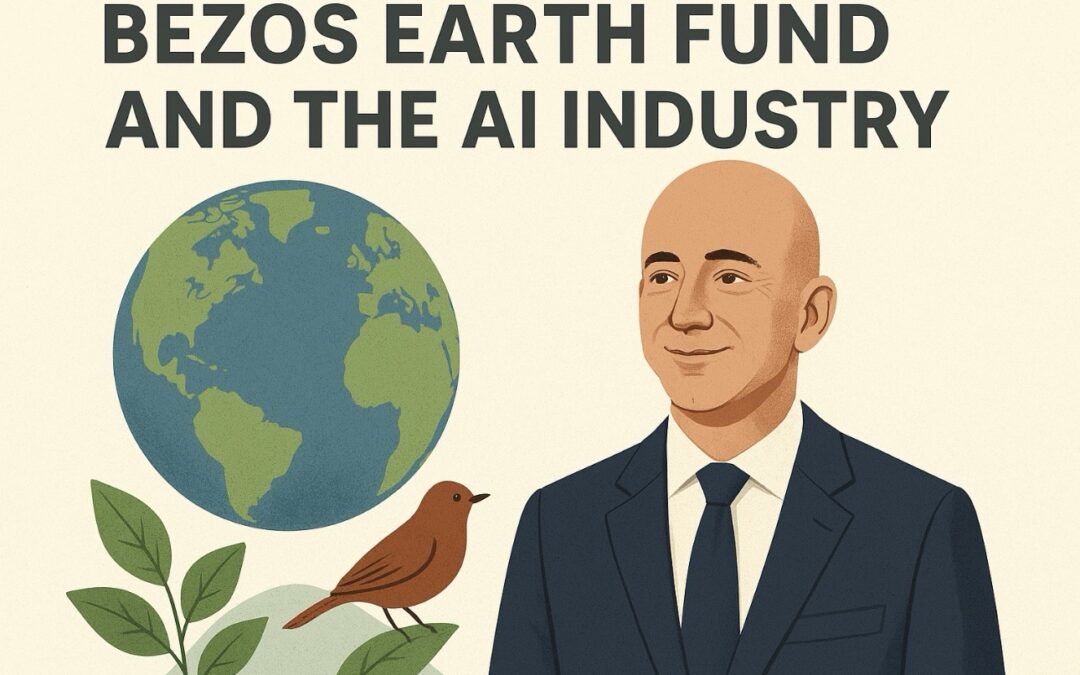
In a world increasingly shaped by artificial intelligence, one of the most intriguing and hopeful intersections is between AI and environmental sustainability. The Bezos Earth Fund, founded by Amazon’s Jeff Bezos in 2020, has emerged as a critical player in this space — using cutting-edge technology and scientific collaboration to address some of the planet’s most urgent challenges. Its latest $30 million AI Grand Challenge marks a significant turning point, aligning artificial intelligence with ecological restoration and climate resilience in ways the tech industry can no longer ignore.
At its core, the Bezos Earth Fund was established to combat climate change and protect biodiversity through strategic philanthropy. But its recent initiatives show an evolution beyond traditional environmentalism — toward a tech-driven model that sees AI not as a business tool, but as a planetary ally. The new funding will support projects that harness artificial intelligence to decode animal communication, map ecosystems, and monitor species at risk. Imagine neural networks that can translate the songs of endangered birds or machine-learning models that can instantly identify plant species from satellite imagery — these are no longer science fiction; they are the types of research the Fund is backing.
This represents a philosophical shift in how AI is being deployed. Until recently, much of the AI industry focused on commercial applications — automating processes, optimizing logistics, and personalizing digital experiences. The Bezos Earth Fund is redirecting that energy toward solving global-scale environmental problems, giving AI a moral and ecological dimension. In doing so, it challenges other players in the industry — from OpenAI and Google DeepMind to smaller sustainability startups — to explore the “AI for Earth” agenda.
The implications are profound. AI offers unmatched speed in analyzing massive data sets — from climate models to satellite imagery — which can reveal environmental patterns invisible to human eyes. Yet, these capabilities also raise important questions about governance, access, and bias. The Bezos Earth Fund’s initiatives emphasize transparency, cross-sector collaboration, and responsible AI use. The message is clear: the future of environmental AI must be ethical as well as innovative.
From a macroeconomic standpoint, this blending of AI and environmental science could birth new industries altogether — in green tech, regenerative agriculture, and carbon accounting. It could also reshape how nations approach sustainability, shifting emphasis from human-led observation to continuous, AI-driven insight. At the micro level, it encourages researchers, technologists, and even citizen scientists to participate in climate solutions — democratizing access to environmental data and amplifying impact.
Critics may question whether a billionaire-led fund can truly balance technology and conservation. But regardless of where one stands, it’s undeniable that the Bezos Earth Fund is pushing the conversation forward. It is redefining what “progress” means in the AI era — not just faster computation or smarter systems, but a deeper alignment between intelligence, both human and artificial, and the natural world that sustains us.
In short, the Bezos Earth Fund’s latest move signals that the AI revolution doesn’t have to come at Earth’s expense. It can, and must, serve as a tool for regeneration.
