
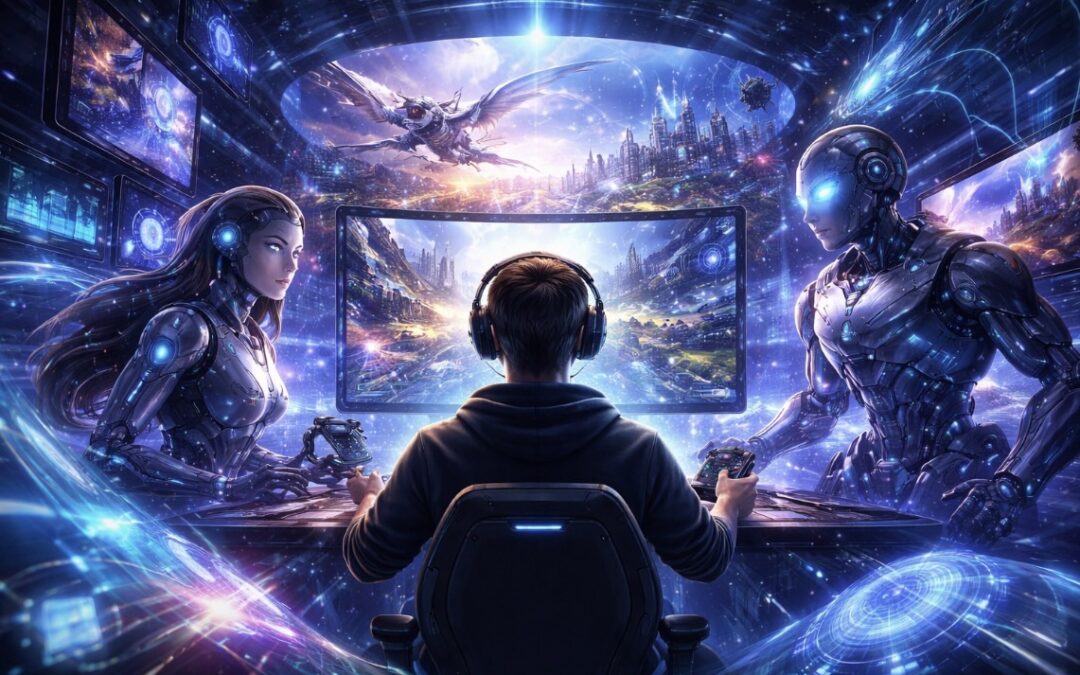
In 2026, artificial intelligence (AI) is no longer a fringe enhancement in gaming — it is firmly at the heart of how games are created, played, and experienced. Over the past few years, the industry has rapidly embraced AI to power smarter systems, richer worlds, and more personal interactions, fundamentally redefining what players can expect from both single-player and multiplayer games.
One of the most visible advancements in 2026 is in non-player character (NPC) behavior and interaction. Gone are static dialogue trees and repetitive patterns; AI-driven NPCs now learn from players’ decisions, exhibit dynamic responses, and remember past encounters, offering realistic, psychologically rich interactions that feel genuinely alive. Some systems even allow players to talk to companions using natural language — issuing complex tactical commands that AI interprets and executes in real time, bringing a new level of immersion to cooperative play.
Procedural content generation — where AI creates game environments, quests, and scenarios — has matured significantly. Instead of replaying identical maps, players can explore landscapes, dungeons, and cities that evolve based on their actions and playstyles. This technology can analyze behavioral data to shape terrain, weather patterns, and encounters, making each playthrough feel unique and tailored. Thanks to cloud-based AI processing, these dynamic worlds are now available at scale, synchronizing experiences seamlessly across global servers.
Another striking leap forward is AI-assisted narrative design. Traditional scripts are giving way to flexible story engines that adapt plotlines around player choices, emotional cues, and interaction history. These systems can generate side stories and character arcs on the fly, ensuring that no two players’ journeys are the same. This kind of living storytelling transforms games into personalized adventures rather than fixed scripts.
AI is also enhancing personalization and adaptive gameplay. Machine learning models analyze how players behave — from reaction times to preferred strategies — and adjust game difficulty, enemy responses, and even soundtrack intensity in real time. This means players stuck on a tough boss might get more intelligent hints or scaled challenges, while veterans may face fiercer opposition tailored to their skill.
However, the industry’s relationship with AI isn’t without debate. Some creators resist overreliance on generative tools to preserve handcrafted artistic vision, even banning AI in certain production areas to safeguard creative authenticity. Yet in many studios, AI is viewed as a co-creator that amplifies human creativity while automating repetitive tasks like bug detection, optimization, and procedural asset generation.
Looking at interaction possibilities, emerging technologies are pushing boundaries beyond traditional screens. At CES 2026, companies showcased AI-powered holographic assistants for gamers — virtual companions that react with facial expressions, offer real-time support, and bridge daily life with gameplay experiences. Moreover, AI teammates in competitive games are being tested that listen, learn, and fight beside human players with natural voice and text commands, creating hybrid co-op experiences where AI feels like a true ally.
As AI continues to mature through 2026 and beyond, gaming is shifting from passive entertainment to dynamic co-creative ecosystems. The future promises worlds that grow with players, characters that think and feel, and experiences tailored to individual playstyles — transforming not just how we play games, but how we live them.
