Cybersecurity has traditionally been a race between increasingly sophisticated attacks and increasingly sophisticated defensive tools.
Anthropic is now pushing that race into a different territory.
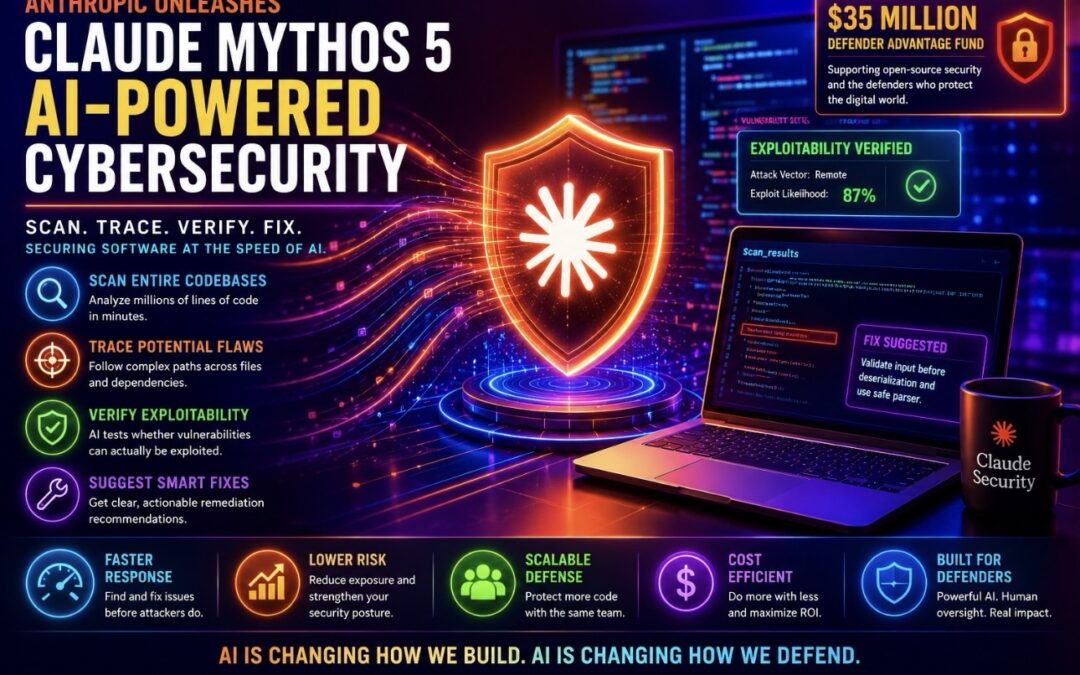
Its Claude Mythos 5 model is being integrated into Claude Security, allowing enterprise customers to scan entire codebases for vulnerabilities, trace complex problems across files, validate whether identified weaknesses are genuinely exploitable and suggest potential fixes.
The significance is not simply that AI can find bugs.
It is that AI is beginning to perform parts of the work traditionally associated with highly skilled security researchers — at software scale.
From scanning for patterns to understanding software
Traditional security scanners are extremely useful, but many operate primarily through rules, signatures and known vulnerability patterns.
Claude Security takes a more contextual approach.
Mythos 5 can reason through a codebase, follow data flows across multiple files and identify vulnerabilities that may not be obvious from examining individual pieces of code in isolation. Anthropic says its system then performs an adversarial verification pass before presenting findings, helping distinguish genuine vulnerabilities from false positives.
That distinction matters.
For large organisations, the problem is no longer simply finding vulnerabilities. It is finding the important vulnerabilities among an enormous volume of potential security issues.
AI could dramatically change that equation.
The economics of cybersecurity could change
There is a significant business implication.
Security teams are expensive, and experienced security researchers remain relatively scarce. Meanwhile, the amount of software organisations need to secure continues to grow.
AI changes the economics by allowing a security team to apply sophisticated analysis across far more software than human researchers could realistically examine manually.
The result could be a shift from:
“What can our security team investigate?”
to:
“What should our security team investigate first?”
That is an important distinction.
AI does not necessarily eliminate the security professional. Instead, it can potentially make the professional responsible for a much larger defensive surface.
Anthropic is also putting money behind the strategy
Anthropic has announced a $35 million Defender Advantage Fund, providing Claude credits to organisations working with open-source maintainers to identify, patch and prevent vulnerabilities.
The initiative is intended to support projects ranging from fixing live vulnerabilities in widely used software to automating vulnerability scanning and remediation.
That matters because open-source software represents a particularly difficult security challenge.
Much of the world’s digital infrastructure depends on projects that may have limited funding and small maintenance teams.
AI could potentially give those projects access to security capabilities that would otherwise be beyond their resources.
But there is an important catch
The same capabilities that make AI powerful for cybersecurity can also make it dangerous.
Anthropic has deliberately restricted direct access to Mythos 5 because of its advanced cybersecurity capabilities, particularly its ability to reason about exploitation. Instead, Claude Security exposes the defensive functionality without giving users unrestricted access to the underlying model.
Even the remediation process retains a human checkpoint.
Claude can identify a vulnerability and propose a patch, but the patch still requires human review and approval before implementation.
This may become an increasingly important model for enterprise AI:
highly capable AI, operating inside controlled workflows, with humans retaining authority over consequential actions.
The bigger technology story
For CEOs, CTOs and CISOs, the development points towards something much larger than another cybersecurity product.
AI is becoming part of the security infrastructure itself.
The same technology that helps developers write software can increasingly examine that software, identify weaknesses, test its reasoning against potential vulnerabilities and recommend how those weaknesses should be addressed.
That creates a potentially powerful defensive feedback loop:
Build → Scan → Identify → Validate → Fix → Re-scan.
And increasingly, AI can participate in every stage.
The competitive advantage may ultimately belong to organisations that can integrate that loop directly into their software-development lifecycle rather than treating cybersecurity as a separate process at the end of development.
AI TRADEMARKET INSIGHT
The most important development here is not that Anthropic has built a better vulnerability scanner.
It is that AI is beginning to compress the expertise required to perform sophisticated cybersecurity analysis.
That has major implications for enterprise economics.
A security team equipped with frontier AI could potentially analyse more code, investigate more vulnerabilities and respond faster — without simply scaling headcount at the same rate as the software estate.
But it also creates a new strategic responsibility for CEOs.
As AI becomes capable of both finding and potentially exploiting software vulnerabilities, the difference between offensive and defensive capability becomes increasingly narrow.
The organisations that benefit most will be those that deploy AI aggressively while maintaining equally sophisticated controls around what that AI is permitted to do.
AI is not simply becoming another cybersecurity tool. It is becoming part of the cybersecurity operating model.
AI TradeMarket
Tracking how artificial intelligence is changing business, industries and markets.
AI TradeMarket
