For years, the commercial AI conversation has centred on what machines can produce: text, images, software, analysis and increasingly sophisticated decisions.
The next phase is about what AI can do.
Artificial intelligence is moving beyond screens and into the physical world, combining perception, reasoning and increasingly sophisticated motor control. Humanoid robotics is emerging as one of the most consequential applications of this transition.
For business leaders, this is not simply a robotics story. It could become a new productivity story.
From Software Intelligence to Physical Intelligence
Traditional robotics has largely depended on highly structured environments and carefully programmed instructions.
That model works extremely well when the environment is predictable.
The real world isn’t.
A warehouse changes. A production line encounters an unfamiliar object. A hospital presents unexpected circumstances. A household contains thousands of objects in constantly changing positions.
AI potentially provides the missing layer: the ability to interpret an environment and respond dynamically.
Humanoid robots are particularly interesting because they are being designed around environments already constructed for humans. Doors, stairs, shelves, tools and workstations do not need to be redesigned specifically for the machine.
The economic proposition therefore becomes much larger than simply building a better robot.
It is about deploying adaptable intelligence into existing physical infrastructure.
The Economics of Learning
One of the most important developments in physical AI is the move from explicit programming towards learning through demonstration.
The traditional robotics model effectively requires organisations to specify how a machine should perform a task.
The emerging model increasingly asks a different question:
Can the machine observe the task, understand the objective and learn how to perform it?
That distinction has enormous implications for scalability.
If every new task requires specialist programming, deployment becomes expensive and slow.
If robots can learn new behaviours from relatively small amounts of demonstration data, the marginal cost of deploying them could fall substantially.
The competitive advantage may consequently shift from possessing robots to possessing the data, AI models and infrastructure that allow robots to learn.
A New Productivity Layer
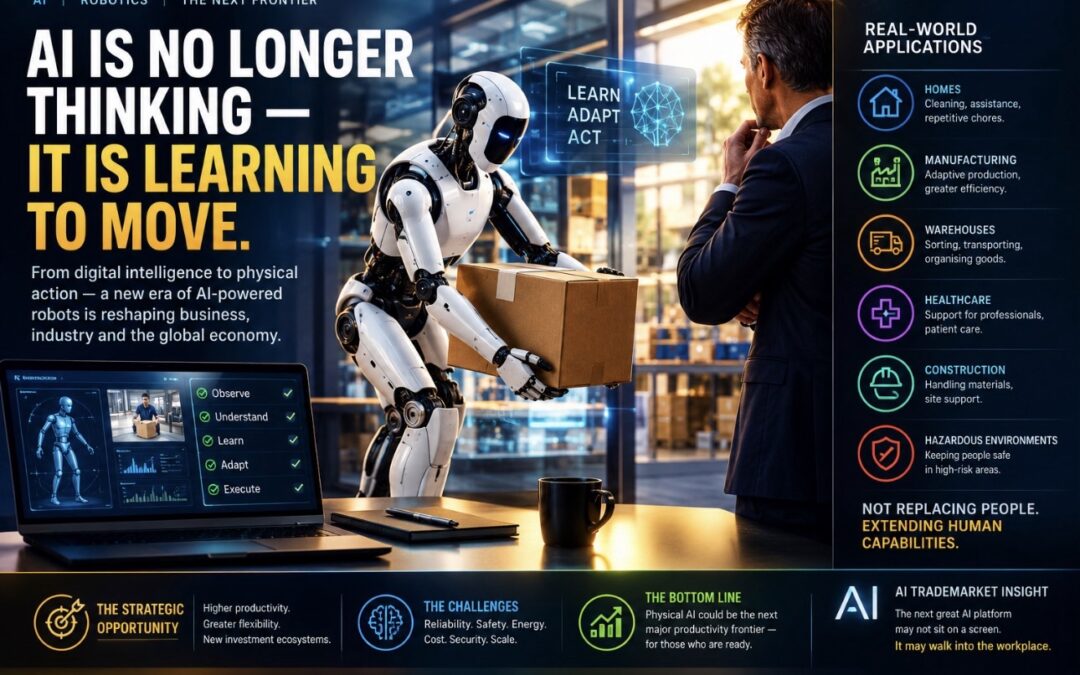
The potential applications extend across manufacturing, logistics, warehousing, healthcare, construction and eventually consumer markets.
Consider a warehouse where an employee can simply demonstrate how a new product should be sorted rather than waiting for engineers to reprogram the robotic system.
Or a manufacturing environment where machines can adapt to product variations without extensive reconfiguration.
The strategic attraction is obvious: increased utilisation of physical assets, greater flexibility and potentially lower labour costs for repetitive or hazardous activities.
But the more interesting possibility may be human-machine collaboration.
The objective doesn’t necessarily have to be replacing workers.
A robot capable of handling physically repetitive tasks could allow people to concentrate on supervision, judgement, customer interaction, technical work and decision-making.
The Investment Question
Physical AI also creates an entirely new investment ecosystem.
The opportunity extends beyond robot manufacturers.
It potentially encompasses semiconductors, sensors, batteries, actuators, simulation platforms, AI models, cloud infrastructure, industrial automation and the software required to manage fleets of intelligent machines.
That makes physical AI potentially analogous to the early development of cloud computing: a technological shift capable of creating value across an entire ecosystem rather than within a single product category.
There are, however, substantial barriers.
Reliability, safety, energy consumption, hardware costs, cybersecurity and the ability to operate consistently in unpredictable environments remain significant challenges.
A robot that performs brilliantly in a controlled demonstration is not necessarily ready for a 24-hour commercial operation.
AI Trademarket Insight
The significance of physical AI may ultimately be measured not by how impressive a robot looks, but by how much economic activity it can perform reliably.
The transition from AI that generates information to AI that can execute physical tasks could create an entirely new productivity frontier.
For CEOs and financial executives, the question is therefore becoming less about whether humanoid robotics is technologically interesting and more about when physical AI becomes economically viable at scale — and who will be positioned to benefit when it does.
The next great AI platform may not sit on a screen.
It may walk into the workplace.
