For years, personalised cancer treatment has been one of medicine’s most ambitious objectives: identify what makes an individual patient’s cancer unique and design a treatment specifically around it.
The latest Phase 3 results from Moderna and Merck suggest that this concept is moving another significant step closer to reality.
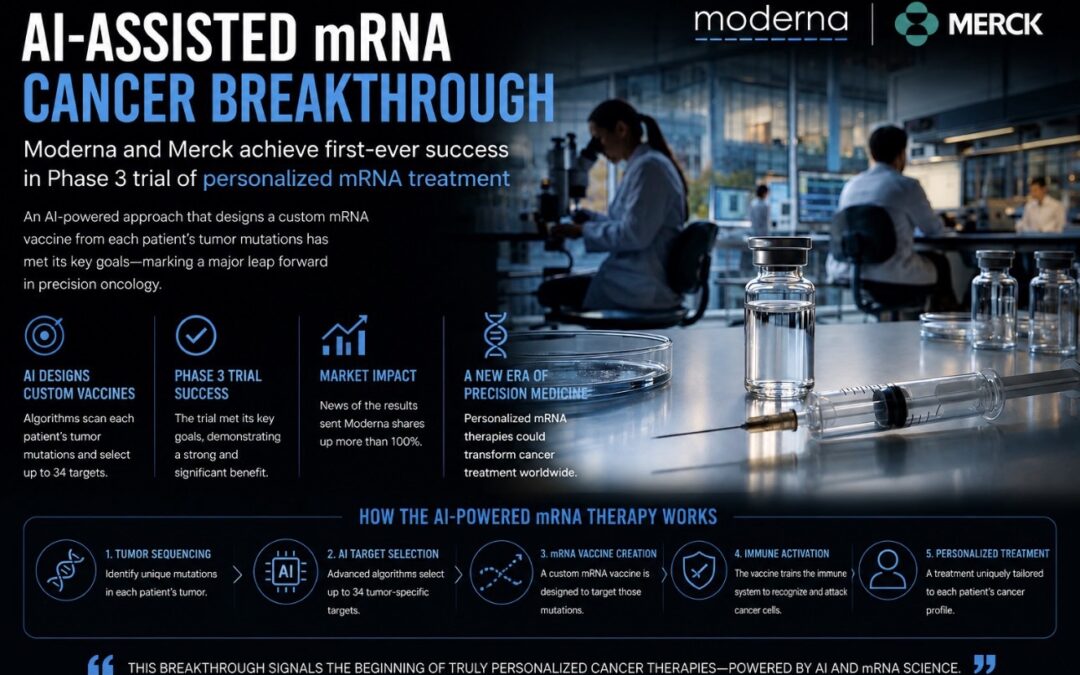
Their personalised mRNA cancer treatment, intismeran autogene, has met its primary and key secondary endpoints in a Phase 3 trial involving patients with high-risk melanoma. The treatment combines a patient-specific mRNA therapy with Merck’s Keytruda immunotherapy.
What makes this particularly significant for the medical technology sector is the role of AI and computational analysis in turning individual tumour data into a potential treatment strategy.
From tumour sequencing to treatment design
Cancer is not a single disease with a single genetic signature.
Every tumour contains its own collection of mutations. The challenge is identifying which of those mutations provide the most useful targets for the immune system.
That is where computational algorithms become increasingly important.
The Moderna/Merck approach analyses the patient’s tumour and identifies relevant mutations, with the personalised mRNA therapy designed to encode up to 34 neoantigens — targets associated with the individual tumour.
In practical terms, this represents a very different model of drug development.
Instead of developing one identical medicine for millions of patients, the technology is moving towards a model in which patient data becomes part of the manufacturing process.
That is a profound change.
AI becomes part of the clinical pipeline
The most interesting development may therefore not be the mRNA molecule itself.
It is the emerging infrastructure connecting:
Patient → tumour sequencing → computational analysis → target selection → personalised treatment → clinical response
AI can potentially accelerate several of these stages, particularly the analysis of enormous volumes of genomic information.
For healthcare companies, this creates an entirely new technology layer sitting between diagnostics and therapeutics.
The competitive advantage may increasingly belong to organisations capable of combining AI, genomics, laboratory automation, mRNA technology and clinical data into a single operating platform.
The economics of personalised medicine
There is also a major commercial question.
Personalised medicine has historically faced a fundamental problem: customisation is expensive.
Manufacturing a conventional medicine at enormous scale is fundamentally different from manufacturing a treatment designed around an individual patient’s tumour.
The more AI, automation and advanced manufacturing can compress the time and cost involved in that process, the more commercially viable personalised medicine becomes.
This could ultimately change the economics of oncology.
Instead of asking whether personalised treatment is technically possible, the industry increasingly has to ask:
How efficiently can we personalise it?
That is an AI question as much as it is a pharmaceutical one.
From medicine to medical technology
For CEOs and investors, this development should therefore be viewed beyond the immediate success of a single cancer treatment.
It points towards a broader convergence between pharmaceuticals and technology.
The pharmaceutical company of the future may increasingly resemble a technology company in some aspects of its operations — using machine learning, genomic datasets, automated laboratories and computational biology to develop and manufacture increasingly precise therapies.
And the medical technology companies that provide the infrastructure for that transformation could become just as strategically important as the drug developers themselves.
The bigger AI opportunity
The significance of this development extends well beyond melanoma.
Moderna and Merck are already investigating the personalised mRNA approach across additional cancer types, including lung, bladder, kidney, pancreatic and other cancers.
If the model proves scalable, the long-term opportunity is potentially much larger than a single therapy.
AI could become the decision-making layer that connects a patient’s biological data to a personalised therapeutic response.
That is a fundamentally different proposition from using AI simply to automate administrative tasks or improve conventional drug discovery.
It suggests a future in which the treatment itself could be partially defined by computational intelligence.
AI Insight
The important story here is not simply that AI helped develop another cancer treatment.
It is that AI is beginning to sit inside the architecture of personalised medicine — connecting biological data, genomic analysis, therapeutic design and manufacturing.
For the pharmaceutical, biotechnology and medical technology industries, that creates a new strategic question:
Who will own the intelligence layer connecting patient data to personalised treatment?
The companies that solve that problem at scale could help define the next generation of healthcare.
AI TRADEMARKET INSIGHT
The important story here is not simply that AI helped develop another cancer treatment.
It is that AI is beginning to sit inside the architecture of personalised medicine — connecting biological data, genomic analysis, therapeutic design and manufacturing.
For the pharmaceutical, biotechnology and medical technology industries, that creates a new strategic question:
Who will own the intelligence layer connecting patient data to personalised treatment?
The companies that solve that problem at scale could help define the next generation of healthcare.
AI TradeMarket
Tracking how artificial intelligence is changing business, industries and markets.
AI TradeMarket
AI TradeMarket — AI intelligence for the markets, technologies and industries being reshaped by artificial intelligence.
