AI Is Moving From Security Assistant to Security Operator
Cybersecurity has traditionally depended on teams of highly skilled engineers identifying vulnerabilities, assessing their severity, testing whether they can actually be exploited, and then developing appropriate fixes.
That model is now beginning to change.
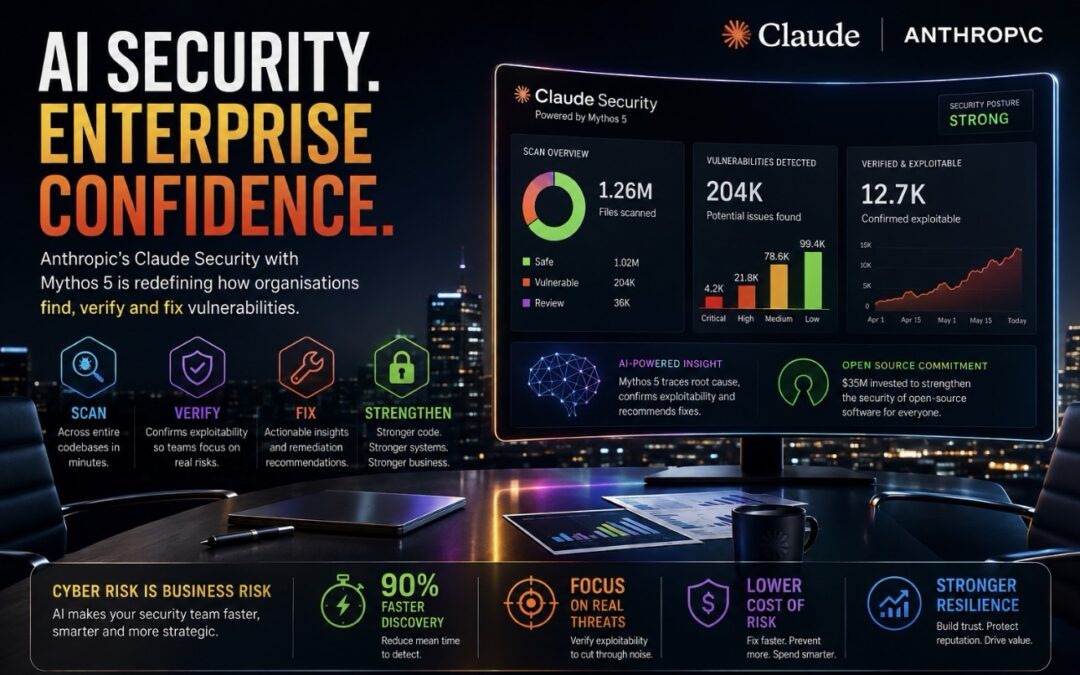
Anthropic’s latest move with Claude Security signals a significant shift in how artificial intelligence could participate in the cybersecurity lifecycle. Rather than simply helping developers write or review code, AI can increasingly examine entire codebases, trace potential vulnerabilities, determine whether weaknesses are genuinely exploitable, and recommend remediation.
For CEOs and technology leaders, the significance extends well beyond another product announcement.
The real issue is scale.
Modern enterprises operate enormous software estates containing millions of lines of code, third-party dependencies, APIs, cloud infrastructure and continuously changing applications. Security teams are expected to protect all of this while facing increasingly sophisticated attacks.
AI potentially changes the economics of that equation.
From Detection to Autonomous Security
The important distinction is that AI-assisted security is moving beyond identifying suspicious code.
A system capable of investigating a vulnerability, establishing whether it can actually be exploited and suggesting a solution is beginning to perform work that previously required multiple stages of human analysis.
That creates the possibility of dramatically accelerating vulnerability management.
For enterprises, this could mean shorter periods between vulnerability discovery and remediation. It could also allow security teams to focus more heavily on strategic risks rather than spending their time investigating thousands of individual findings.
But this capability also introduces a new responsibility for executives.
AI must itself become part of the organisation’s security architecture.
Companies cannot simply give an AI system access to proprietary source code and assume that the security problem has been solved. Governance, permissions, auditability, data protection and human oversight become increasingly important as AI systems gain access to critical development environments.
The Open-Source Implications
Anthropic’s reported $35 million commitment toward strengthening open-source software security is particularly significant.
Open-source software forms an enormous part of the modern technology ecosystem. Enterprises routinely depend on libraries and frameworks maintained by communities and organisations with vastly fewer resources than the companies consuming them.
AI-assisted vulnerability discovery could potentially provide those projects with security capabilities that would otherwise be prohibitively expensive.
That could have consequences throughout the technology supply chain.
A vulnerability discovered in a widely used open-source component can ultimately affect thousands of businesses. Improving the security of those components therefore isn’t simply a developer concern; it is an enterprise risk-management issue.
The CEO Question
The strategic question for executives is no longer simply:
“How can we use AI to improve productivity?”
It is increasingly:
“How can we use AI to make the organisation fundamentally more resilient?”
Cybersecurity may become one of the clearest demonstrations of that value.
The companies that successfully integrate AI into security operations could potentially reduce detection times, accelerate remediation and gain greater visibility across increasingly complex technology environments.
But the winners will not necessarily be those deploying the most AI.
They will be the organisations establishing the strongest combination of AI capability, human judgement, governance and accountability.
AI Trademarket Insight
AI is becoming infrastructure for cybersecurity rather than merely another security tool. For CEOs and financial executives, the opportunity is compelling: better security can increasingly become a measurable business advantage rather than simply an unavoidable cost.
The strategic objective should therefore be clear — deploy AI where it can compress the distance between vulnerability, understanding and action, while maintaining the governance necessary to ensure that greater automation does not create greater risk.
