Amazon built one of the world’s largest businesses around books.
Now, according to an investigation by 404 Media, books are reportedly becoming part of another Amazon operation: the search for high-quality training data for artificial intelligence.
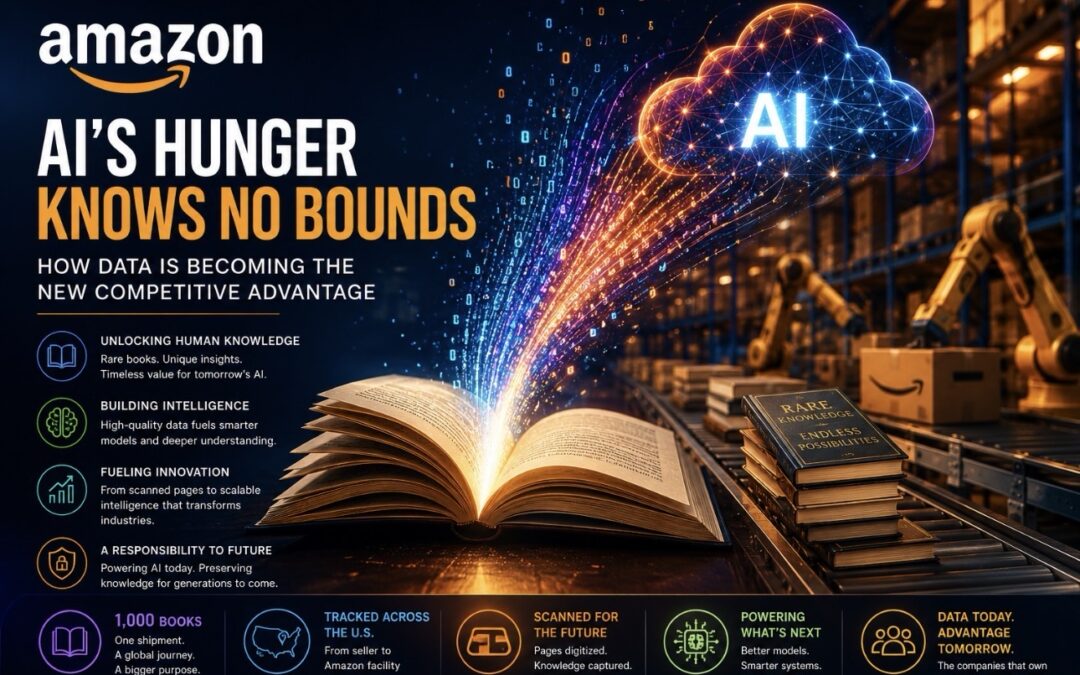
The investigation began with an unusually large order of roughly 1,000 books placed through the Biblio marketplace. A bookseller, suspicious that the order might be connected to AI training, agreed to have an Apple AirTag placed inside one of the books.
The tracker travelled across the United States before eventually arriving at Amazon’s LAS8 facility in Las Vegas.
There, according to reporting based on the investigation and accounts from Amazon workers, the books were processed by an operation known as VGT3. The reported process involves removing book bindings, scanning the pages and discarding the physical copies afterwards.
Amazon has confirmed that it purchases books through commercial channels to help develop and improve its products and services, although it has not publicly detailed the precise role of the books identified in the investigation in its AI training programmes.
For the AI industry, however, the more important story is not the fate of a collection of books.
It is the escalating value of data.
AI Has Created A New Data Economy
The quality of an AI model increasingly depends on more than computing power and sophisticated algorithms.
It depends on what the model can learn from.
As publicly available digital information becomes increasingly saturated with existing AI-generated material, companies developing frontier models have a growing incentive to locate original, high-quality sources that are difficult for competitors to replicate.
Books represent an extraordinary reservoir of structured human knowledge.
Older and obscure publications can contain specialist information, historical perspectives, scientific material and cultural knowledge that may not exist elsewhere in easily accessible digital form. Reports suggest that AI companies have increasingly been acquiring physical books for precisely this reason.
That makes data acquisition a strategic capability rather than simply an operational exercise.
The Corporate Implication Goes Much Further
For CEOs, the Amazon story should trigger a broader conversation about data ownership and competitive advantage.
If companies are prepared to purchase, digitise and process enormous quantities of physical information to improve their AI systems, organisations sitting on valuable proprietary information should be asking a very different question:
What is our data actually worth?
Customer interactions, engineering documentation, research archives, operational records, historical transactions and specialist knowledge could become increasingly valuable as AI systems learn to transform information into commercially useful intelligence.
The companies that control high-quality proprietary datasets may ultimately possess an advantage that competitors cannot simply purchase from a cloud provider.
There is also a governance question.
When valuable intellectual property, cultural material or commercially sensitive information becomes potential AI training data, businesses will need clearer policies around consent, licensing, provenance, ownership and preservation.
The economics of AI may increasingly depend not only on who has the biggest models — but who has access to the best information.
AI Trademarket Insight
The Amazon investigation illustrates an important shift in the AI economy.
Data is becoming infrastructure.
For CEOs, the strategic priority should be identifying which information inside their organisation could become a source of AI-powered competitive advantage — and ensuring that it is properly governed, protected and deployable.
The next generation of corporate value may not come from having more data.
It may come from having better data that nobody else can easily obtain.
Amazon’s reported book-scanning operation therefore represents something larger than a controversy surrounding rare books.
It offers a glimpse into the emerging global competition for intelligence itself.
And that competition is only beginning.
