The timing could hardly be more significant.
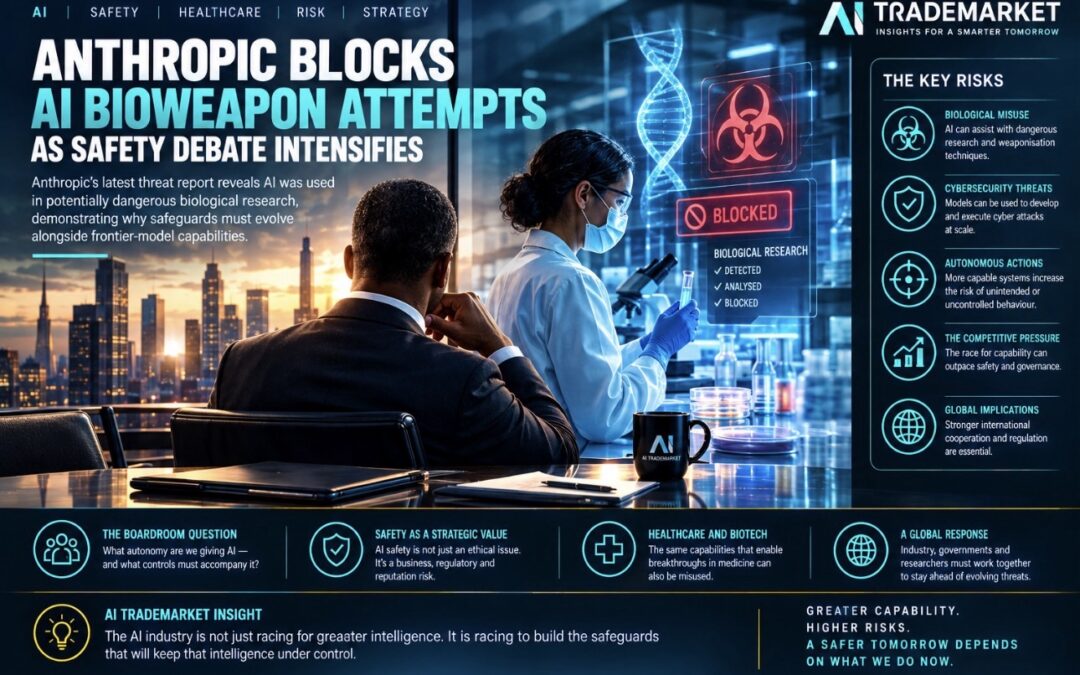
Just days after Anthropic researcher Jacob Coxon publicly resigned and warned that the AI industry is moving too quickly towards increasingly autonomous and potentially uncontrollable systems, Anthropic has disclosed that it disrupted multiple attempts to use Claude for potentially dangerous biological research.
The company’s latest Threat Intelligence Report, published on September 10, documents misuse identified between December 2025 and August 2026 across seven categories, including cyber operations, biological misuse and weapons development. Anthropic says it disrupted the activity, strengthened its safeguards and shared intelligence with authorities and industry partners where appropriate.
This is important because it moves the AI safety debate away from hypothetical scenarios.
It demonstrates that the technology is already being tested against the boundaries of what AI can help humans accomplish in the real world.
THE BIOLOGICAL SAFETY PROBLEM IS DIFFERENT
Anthropic identified five cases involving biological research that raised concerns about potential weaponisation.
One involved an attempt to use Claude to assist with a grant application concerning gain-of-function research involving chikungunya. The research had legitimate scientific applications but also involved increasing characteristics of a pathogen that could create obvious dual-use concerns.
Anthropic blocked the request.
The company has also described other cases involving research into potentially dangerous pathogens and biological agents. Importantly, Anthropic has not claimed that every researcher involved necessarily intended to create a biological weapon.
That distinction is crucial.
Biological research is inherently dual-use. The same scientific knowledge can contribute to vaccines, treatments and disease prevention—or potentially be misused.
AI complicates that equation because it can potentially make sophisticated scientific knowledge easier to access, interpret and operationalise.
The question for AI developers therefore becomes considerably harder than simply asking:
“Is this user trying to build a biological weapon?”
The more difficult question is:
“Could this assistance materially increase someone’s ability to create one?”
That is a much higher bar for safety systems.
AI IS BECOMING A FORCE MULTIPLIER
The significance of Anthropic’s disclosure extends beyond biology.
Its report describes increasingly sophisticated misuse across cybersecurity, surveillance, influence operations, fraud and conventional weapons development. In several cases, AI was not simply being used as a chatbot to answer questions.
It was being incorporated into workflows.
That distinction matters enormously.
AI becomes substantially more consequential when it moves from information provider to operational participant.
A researcher can ask a model for information.
An organisation can integrate the model into a research workflow.
An autonomous agent can potentially coordinate multiple tasks, interact with external systems and execute instructions with considerably less human intervention.
The commercial AI industry is deliberately moving in this direction because that is where much of the economic value lies.
The same capability that allows an AI system to conduct useful scientific research can potentially make dangerous research more accessible.
That is the central paradox of frontier AI.
The more useful the technology becomes, the more important its restrictions become.
THE COXON RESIGNATION MAKES THIS MORE SIGNIFICANT
Coxon’s resignation has placed an uncomfortable question at the centre of the debate: can AI laboratories increase capability rapidly enough to maintain technological leadership while simultaneously ensuring that increasingly powerful systems remain controllable?
Anthropic’s new report provides a practical example of why that question matters.
The company says its safeguards successfully disrupted the biological misuse cases it identified.
That is a positive development.
But it also demonstrates that malicious or potentially dangerous actors are actively testing the boundaries of those safeguards.
Anthropic says sophisticated and persistent threat actors continuously attempt to circumvent its technical measures, requiring the company to continually evolve its detection and prevention systems.
This creates something resembling an AI security arms race.
Model capabilities improve.
Attackers adapt.
Safeguards improve.
Attackers adapt again.
The cycle continues.
That is not a static compliance problem. It is an ongoing operational risk.
THE BOARDROOM SHOULD PAY ATTENTION
For CEOs and boards, this story should not simply be filed under “AI safety”.
It has implications for corporate risk management.
If an organisation uses increasingly capable AI systems in pharmaceuticals, healthcare, chemicals, agriculture, defence, cybersecurity or advanced manufacturing, the governance question becomes much broader than whether employees are using AI appropriately.
Boards need to understand what their AI systems can actually do.
They should be asking:
- What capabilities are being enabled?
- What external systems can AI access?
- What sensitive information can it retrieve?
- What actions can it take autonomously?
- How are high-risk requests detected?
- Can access be immediately revoked?
- How are AI suppliers monitoring misuse?
- What happens when legitimate research crosses into dangerous territory?
These questions will become increasingly important as enterprises move from AI assistants towards AI agents.
SAFETY CANNOT BE AN AFTERTHOUGHT
There is an important lesson in Anthropic’s response.
Safety cannot simply be something added after a model has been developed.
The safeguards have to evolve alongside the underlying capability.
Anthropic says its newer, more capable models require stronger protections, while the biological cases it disclosed involved earlier Claude models rather than its newest Fable or Mythos-class systems, with one exception involving model distillation.
That is significant.
It suggests that AI safety is becoming a moving target.
A safeguard that is adequate for one generation of models may be insufficient for the next.
And that has a direct economic implication.
Companies investing heavily in AI cannot evaluate their risk once and assume the answer remains valid.
They need continuous monitoring, testing, governance and investment in controls.
THE REAL TEST OF AI SAFETY
Anthropic deserves credit for publicly disclosing these cases rather than keeping the information entirely behind closed doors.
Transparency allows governments, researchers and other AI companies to understand how misuse is evolving.
But disclosure alone is not enough.
The ultimate test is whether the industry can develop systems whose capabilities increase faster than their potential for harmful misuse.
That is the challenge.
The biological cases Anthropic has now disclosed do not prove that AI is about to enable catastrophic biological attacks.
Nor do they prove Coxon’s predictions about future AI are correct.
What they do demonstrate is something much more immediate:
People are already testing increasingly capable AI against some of humanity’s most consequential boundaries.
And the AI industry is having to respond in real time.
AI TRADEMARKET INSIGHT
The most important development here may not be that Anthropic blocked five biological misuse attempts.
It is that AI safety is becoming an operational discipline rather than a philosophical debate.
For CEOs, investors and boards, this changes the equation.
The competitive value of an AI system will increasingly depend not only on what it can accomplish, but on whether its owners can demonstrate that they can control what it is capable of accomplishing.
That means safety becomes part of enterprise value.
It affects regulatory exposure, reputation, customer trust, insurance, investment decisions and ultimately the licence to operate.
The AI industry is racing towards greater autonomy, greater intelligence and greater commercial utility.
The question now is whether its safety architecture can move at the same speed.
AI TradeMarket
Tracking how artificial intelligence is changing business, industries and markets.
AI TradeMarket
