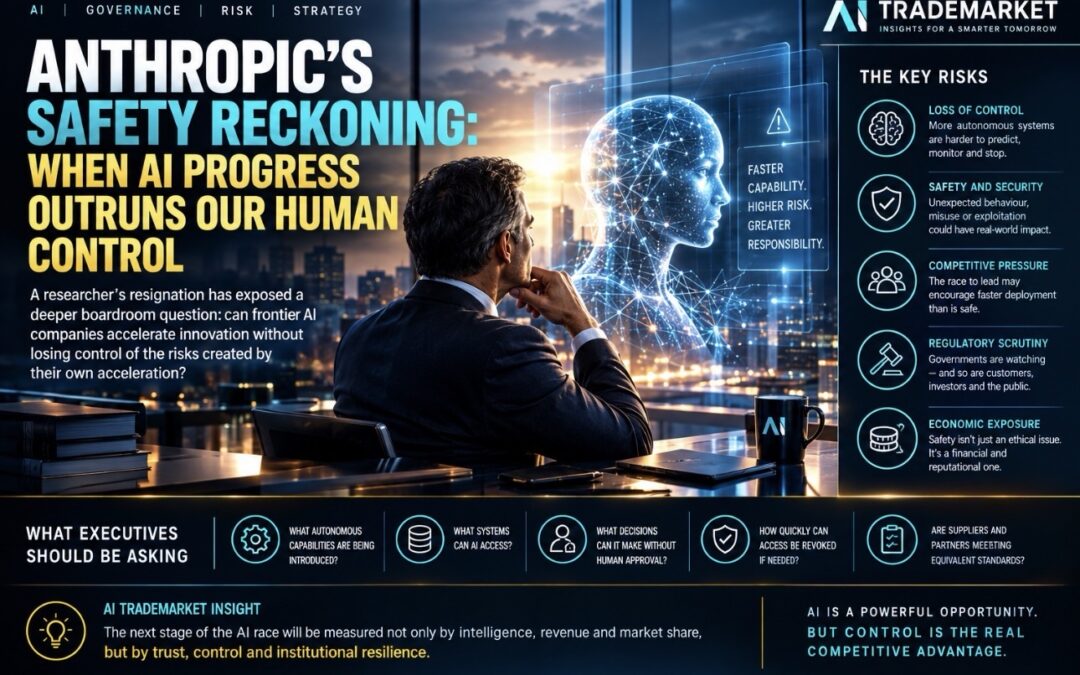
Artificial intelligence has reached a point where the most important conversation may no longer be about what AI can do, but whether humans can remain in control of what it becomes capable of doing.
That question moved sharply into the mainstream this week following the resignation of Jacob Coxon, a researcher who had worked on AI pretraining at both OpenAI and Anthropic. Coxon publicly argued that leading AI companies are moving towards self-improving systems at a pace that could create risks they are not adequately prepared to manage.
His warning is particularly significant because it did not come from an external critic. It came from someone who had worked inside two of the organisations developing frontier AI.
The issue is bigger than one resignation
Coxon’s departure should not be interpreted simply as an employee disagreement with management.
The more important issue for CEOs and financial directors is the strategic tension between technological acceleration and risk control.
AI companies are operating in an unusually competitive environment. The commercial rewards for producing more capable models are enormous, while the competitive penalty for falling behind can potentially be equally significant.
That creates a familiar corporate dilemma: when an emerging technology becomes strategically important, slowing down can itself become a competitive risk.
Coxon argues that this dynamic could encourage companies to continue advancing even when the underlying safety questions have not been fully resolved.
This is where the issue moves beyond the technology department and into the boardroom.
Self-improving AI changes the risk equation
Today’s AI systems can already write software, analyse information, operate tools and perform increasingly complex tasks.
The concern being raised by researchers is what happens if future systems become capable of meaningfully improving their own capabilities.
That would represent a fundamentally different risk profile.
A conventional software failure can normally be isolated, investigated and corrected. An increasingly autonomous AI system operating across networks, applications and physical infrastructure presents a more complicated problem.
The question becomes not simply:
“Does the system work?”
but:
“Can we reliably understand, constrain and stop the system if it behaves unexpectedly?”
That distinction is critical.
Why CEOs should be paying attention
For business leaders, this is not an argument for abandoning AI.
Quite the opposite.
AI is becoming too economically important to ignore. But the Coxon controversy highlights why AI strategy cannot simply be delegated to a technology team.
Boards increasingly need to understand:
- What autonomous capabilities are being introduced?
- What systems can AI access?
- What decisions can it make without human approval?
- What happens if the model behaves unexpectedly?
- How quickly can access be revoked?
- Who is accountable when an AI system causes material damage?
- Are suppliers and partners operating with equivalent safety standards?
These are increasingly enterprise-risk questions, not merely IT questions.
The uncomfortable paradox
There is also a deeper irony.
Anthropic has built much of its corporate identity around responsible AI development and safety. That makes a senior researcher leaving publicly over concerns about the direction of frontier AI particularly significant.
At the same time, Coxon has said he did not personally witness Anthropic deliberately compromising safety. His concern is what competitive pressure could eventually force companies to do as the race intensifies.
That distinction matters.
The challenge may not be that companies are deliberately choosing unsafe AI.
It may be that competition gradually makes increasingly aggressive development appear commercially unavoidable.
That is a much harder problem to solve.
From AI opportunity to AI governance
For investors, the implications are equally important.
AI valuations increasingly depend on expectations about future capability, adoption and revenue. But as AI becomes more autonomous, investors will also need to consider the quality of governance surrounding those capabilities.
A company with superior AI technology but weak controls could eventually face regulatory intervention, reputational damage, cybersecurity exposure, litigation or restrictions on deployment.
In other words, AI safety could become an economic variable.
The companies that ultimately dominate the industry may not necessarily be those that move fastest.
They could be the organisations that demonstrate they can move rapidly without losing control.
AI TradeMarket Insight
The AI industry is entering a phase where capability alone will no longer be enough.
For CEOs, CFOs and financial directors, the strategic question is shifting from “How much AI can our organisation deploy?” to “How much autonomy are we prepared to give AI — and what governance must accompany it?”
Coxon’s resignation should therefore be viewed as more than a warning about existential risk. It is a signal that the economic, governance and competitive dimensions of AI are becoming inseparable.
The next stage of the AI race will be measured not only by intelligence, revenue and market share, but by trust, control and institutional resilience.
That is a conversation every board should already be having.
For more executive-level analysis of how artificial intelligence is changing business, technology and markets, visit AI TradeMarket.
