
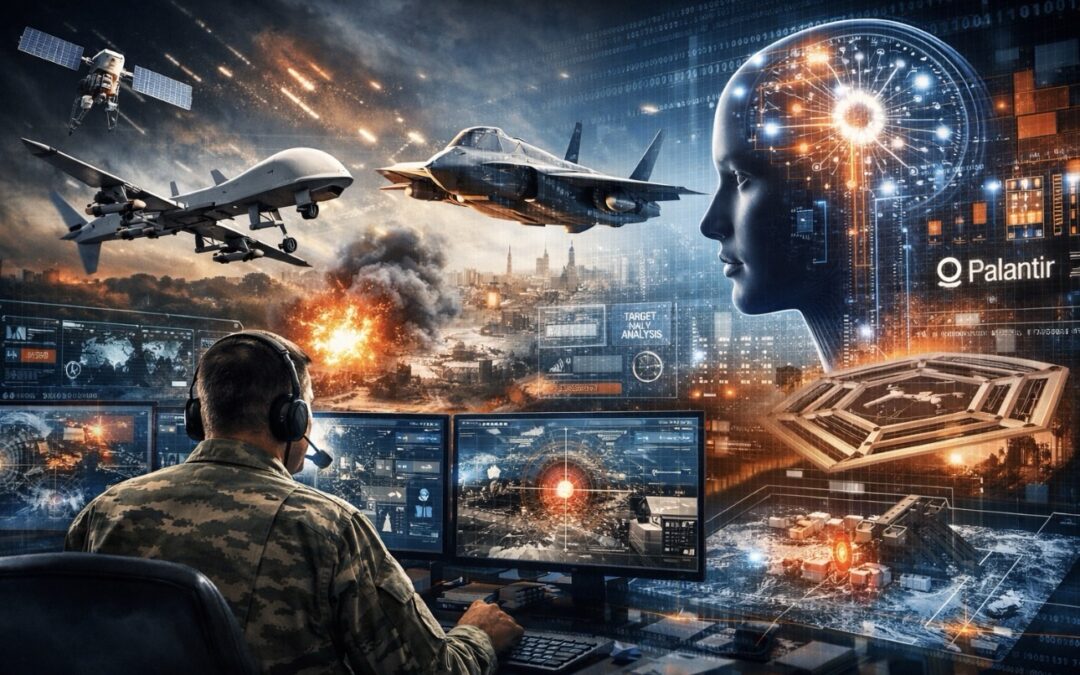
The ongoing conflict between the United States, Israel, and Iran — now widely dubbed the first AI war — marks a watershed in the intersection of military operations and artificial intelligence. What began on 28 February 2026 quickly showcased how AI is no longer a niche analytics tool but an integral component of real‑world combat operations, reshaping how wars are planned, fought, and potentially how accountability is assigned.
At the center of this shift are advanced platforms that ingest and analyze massive data streams in real time. One such system is the Maven Smart System, developed by Palantir Technologies and now formalized as a core part of U.S. military infrastructure under multi‑year Department of Defense contracts worth billions. Maven fuses satellite imagery, drone feeds, signals intelligence, and other sensor data into a single operational picture and applies AI models to identify potential targets faster than traditional workflows could manage.
This capability came to global attention during the first 24 hours of the Iran campaign, when U.S. forces struck more than 1,000 targets — a tempo far faster than historic air operations such as the 2003 shock and awe campaign in Iraq. Analysts credited AI‑enabled systems with compressing what used to be hours of analysis and cross‑referencing into seconds, allowing commanders to sift through staggering volumes of data and make decisions at a pace unmatched by conventional intelligence processes.
Behind Maven, many of these AI functions rely on large language models similar to those developed by companies such as Anthropic, whose Claude model has reportedly been embedded into classified military workflows for target identification, prioritization, and action recommendations. The level of autonomy here does not mean machines are “pulling triggers” — officially there is still a human in the loop for final authorizations — but in practice the AI’s outputs shape and drive those decisions.
Proponents argue this shift is simply the military adapting to the information era. The Pentagon has clearly signaled an “AI‑first doctrine,” treating machine intelligence as critical infrastructure that speeds decision‑making and gives commanders a real‑time edge in contested environments. Investors and markets have taken notice: startups such as Shield AI now command multibillion‑dollar valuations for autonomous systems that operate in contested spaces like GPS‑denied environments, showing commercial interest in defense AI is booming.
Yet this integration raises profound ethical, legal, and strategic questions. Even with humans formally present in decision loops, critics warn that high‑speed automation can erode meaningful oversight — operators who merely approve algorithmically generated recommendations may be as detached from consequences as systems with full autonomy. Recent tragic events in Iran, including the bombing of a girls’ school that killed over 160 civilians, have fueled debate over whether AI systems inadvertently elevate the risk of targeting errors and civilian harm — and whether the rhetoric of “AI recommending” obscures deeper problems in human judgment and military strategy.
There are also broader geopolitical implications. AI’s role in this conflict has prompted lawmakers to consider new guardrails and oversight frameworks explicitly for military AI, highlighting concerns about delegation of force decisions to algorithms and the risk of escalation if adversaries adopt similar systems. Beyond immediate battlefield utility, the integration of AI into the kill chain could redefine deterrence, operational tempo, and strategic deterrence in future wars — accelerating not only strikes but also the pace of escalation.
Looking forward, the first AI war may prove less an anomaly and more a preview of what next‑generation conflict looks like: a world where machine intelligence processes sensory data at scale, informs split‑second decisions, and sits at the heart of combat operations. How nations regulate, govern, and ensure accountability in such systems will be one of the defining questions of global security in the decades to come.
