
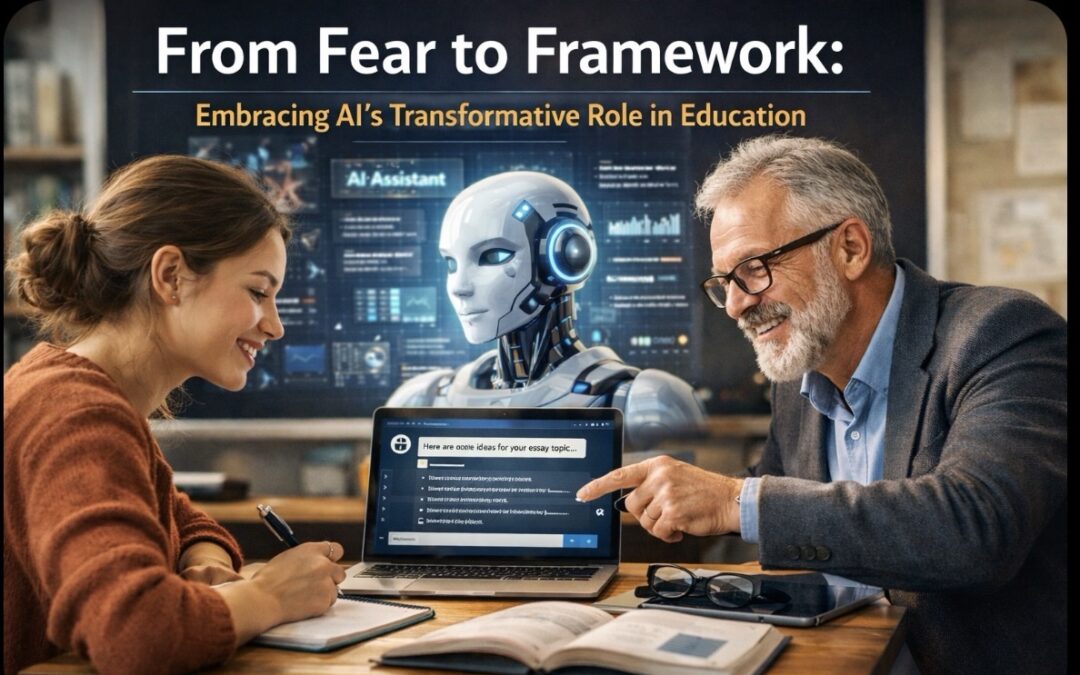
A few years ago, artificial intelligence in education was something of a bogeyman. Educators feared that generative AI tools like ChatGPT would lead to rampant cheating, diminishing student effort, eroding academic honesty, and undermining core learning outcomes. Traditional essays, take-home assignments, and projects were suddenly vulnerable to instantaneous AI-generated responses that sounded professional and complete. Educators increasingly worried that students would simply outsource their thinking to machines, leaving schools to grapple with a new form of academic misconduct.
These concerns weren’t unfounded. High school and college teachers observed widespread use of AI tools by students to generate essay content or answers, prompting a rethinking of what counts as academic integrity and how to assess student learning. In some districts and universities, bans were placed on specific AI tools, and instructors required pen-and-paper assignments or in-class essays to curb misuse.
Yet, as the technology matured and discourse advanced, an inverted opinion has emerged among many educators, policymakers, and researchers. The narrative has shifted from outright resistance to cautious acceptance — the idea that instead of waging a futile battle against AI, education should incorporate it thoughtfully and deliberately into teaching and learning. This shift isn’t about naively accepting every AI output as correct, but about harnessing the potential benefits while mitigating risks through guidance and education.
Today’s proponents of AI in education emphasize that tools like large language models can serve as valuable assistants — helping students brainstorm ideas, refine writing, and provide instant feedback. Rather than being redundant, spell-checkers and grammar editors have evolved into robust learning companions that can help students focus on higher-order skills such as critical thinking, structuring arguments, and effectively evaluating information.
The argument goes beyond convenience: in a world where AI will be ubiquitous in future workplaces, students need to learn how to use it responsibly and creatively, not simply hide from it. The best educators advocate for AI literacy — teaching students to question AI outputs, verify facts, recognize biases, and integrate AI into a critical problem-solving process. These skills are more aligned with real-world expectations than simply memorizing facts or composing boilerplate essays.
This pedagogical evolution reflects a broader mindset shift. Rather than treating AI as a threat to integrity, it’s now often framed as a tool that, when used with thoughtful constraints, can democratize access to information, provide personalized support, and level the playing field for learners with diverse needs. Educators are exploring ways to redesign assessments to reflect this reality — for example, incorporating AI into assignments, focusing on in-class activities that require human interpretation, and blending AI assistance with human judgment.
Of course, risks still exist. Students may over-rely on AI, leading to weaker memory retention or lower critical engagement if tools are misused. There are also ongoing debates about academic integrity and how to distinguish human original work from assisted contributions. But these concerns underscore the need for clear guidelines and structured education about AI use rather than blanket bans.
The conversation has matured: AI in education is no longer a looming threat, but a powerful, if imperfect, partner in learning. By teaching students how to collaborate with AI — as editors, collaborators, and critical thinkers — educators can help prepare learners for a future where human creativity and machine intelligence intersect rather than clash.
