
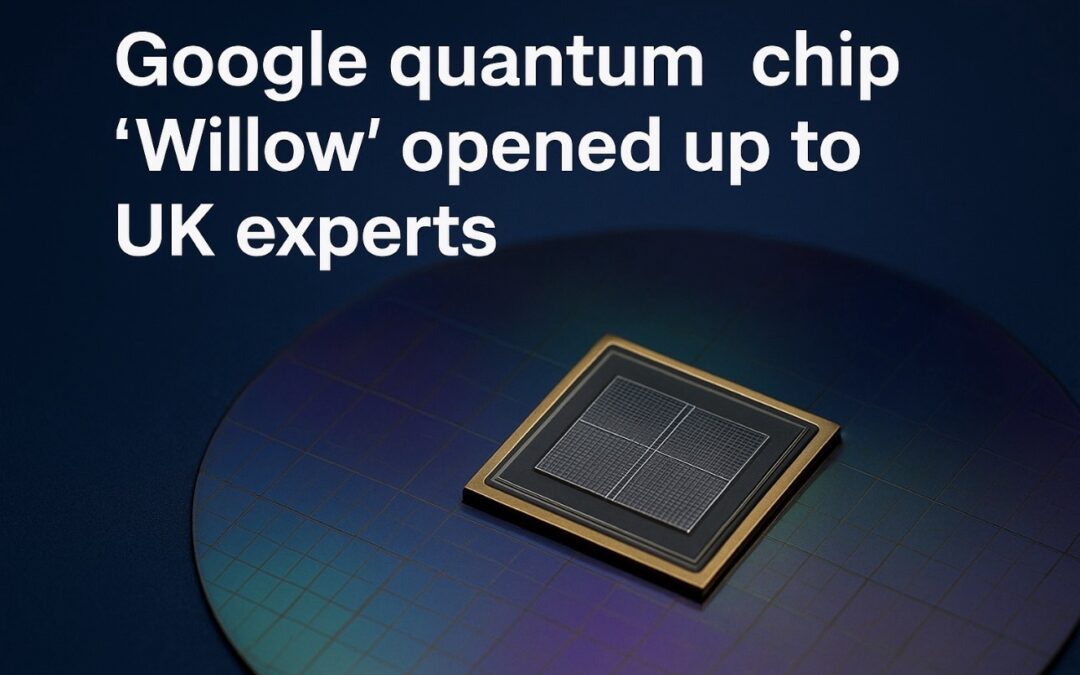
When Google announced that its experimental quantum processor, ‘Willow’, would be made available to researchers and industry experts in the UK, it signalled a major shift in the global quantum landscape. Until now, access to cutting-edge quantum hardware—especially processors with error-corrected qubit architectures—has been tightly controlled by the handful of tech giants developing them. ‘Willow’ represents one of Google’s latest milestones on the road toward practical quantum computing, and this move could pull the UK much closer to the front of the global race.
A leap for industrial applications
In practical terms, access to Willow gives UK researchers and companies a working platform to test error-correction strategies, run early-stage quantum algorithms, and evaluate what near-term quantum advantage might look like within industrial settings.
Industries that stand to benefit most include:
Pharmaceuticals and life sciences – modelling molecular interactions and protein folding far beyond the reach of classical supercomputers. Energy and materials – simulating new battery chemistries, superconductors, and catalysts with atomic precision. Finance and logistics – optimising complex portfolios, supply chains, and risk scenarios, currently limited by classical computational bottlenecks. Cybersecurity – testing post-quantum cryptography and understanding real-world threat timelines.
These sectors have been preparing for quantum disruption for years, but without direct access to hardware, much of the work has remained theoretical. Willow changes that: it provides a bridge between lab research and deployable quantum workflows. By experimenting on an actual quantum chip, engineers can determine which problems are realistic candidates for early quantum advantage—and which still require further advancements.
The realistic timescale
A common misconception is that quantum breakthroughs arrive overnight. Willow should be viewed not as a finished product, but as a testbed for scalable, fault-tolerant quantum systems. The timeline looks something like this:
0–3 years: Exploration and prototyping
UK teams will run experiments, refine algorithms, and stress-test error-correction schemes. Expect early demonstrations of niche quantum advantage in tightly defined industrial tasks.
3–7 years: Early commercialisation
As error rates fall and qubit counts rise, hybrid classical-quantum workflows will emerge for materials design, energy modelling, finance optimisation, and pharma R&D. This is when businesses will begin to integrate quantum routines into existing high-performance computing environments.
7–12 years: Scalable fault-tolerant quantum computing
If Google’s roadmap holds, Willow’s successors could reach the threshold where genuinely transformative applications become possible: large-scale molecular simulation, secure quantum communication systems, and real-time optimisation of enormous datasets.
This is not science fiction—it is a staged engineering process. Willow places the UK at the beginning of that curve with hands-on influence.
Transformative implications for the UK and beyond
Access to Willow enhances the UK’s position as one of the world’s leading quantum ecosystems. It strengthens collaborations between academia, startups, and big industry, and helps shape standards and innovation frameworks long before quantum computing becomes mainstream.
Perhaps most importantly, it lays the groundwork for quantum-ready industries. Companies that learn how to integrate, design for, and strategically adopt quantum methods today will be the ones that dominate their sectors tomorrow.
The opening of Willow is more than a technology milestone—it is an invitation for the UK to help shape the coming quantum era.
