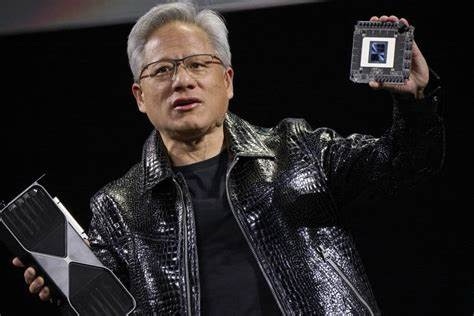
At CES Las Vegas today, Nvidia CEO Jensen Huang once again reminded the technology world why the company sits at the centre of the artificial intelligence revolution. Taking the stage before a packed audience, Huang unveiled Nvidia’s latest AI platform for self-driving cars, developed in close collaboration with Mercedes-Benz. The announcement underscored a clear message: autonomous driving is no longer a distant vision but an engineering challenge being solved in real time.
The newly revealed technology builds on Nvidia’s long-running DRIVE platform, combining advanced AI models, powerful in-vehicle computing, and sophisticated simulation tools. According to Huang, the next generation of autonomous vehicles will depend not just on sensors and cameras, but on AI systems capable of understanding the world, predicting behaviour, and continuously learning from experience. Nvidia’s solution aims to be the “brain” of the car, processing enormous volumes of data instantly while meeting the strict safety requirements of automotive manufacturers.
Mercedes-Benz’s involvement gives the announcement particular weight. Unlike many experimental partnerships in autonomous driving, Mercedes brings decades of manufacturing expertise, global scale, and a reputation for safety engineering. The collaboration focuses on integrating Nvidia’s AI stack directly into Mercedes vehicles, enabling advanced driver assistance systems today and paving the way for higher levels of autonomy tomorrow. Rather than treating autonomy as an add-on, the approach embeds AI at the core of vehicle design.
A key theme of Huang’s presentation was “end-to-end autonomy.” Nvidia’s platform spans data collection, training, simulation, and deployment. Vehicles collect real-world driving data, which is then used to train AI models on powerful Nvidia systems. Those models are tested in vast simulated environments—effectively digital twins of real roads—before being deployed back into cars. This loop allows rapid improvement while reducing risk, a crucial factor for regulators and consumers alike.
Las Vegas itself served as a fitting backdrop. A city built on reinvention and spectacle, it mirrors the transformation underway in the automotive industry. Self-driving technology promises to reshape not just how we drive, but how cities manage traffic, safety, and energy use. Nvidia and Mercedes framed autonomy not as a futuristic luxury, but as a practical solution to reducing accidents, easing congestion, and improving mobility.
However, challenges remain. Regulatory approval, public trust, and edge-case safety are still significant hurdles. Huang acknowledged this indirectly by emphasizing validation, simulation, and transparency—signals that Nvidia understands autonomy is as much a societal challenge as a technical one.
In unveiling this new AI technology at CES, Jensen Huang positioned Nvidia not merely as a chipmaker, but as a foundational platform company for the autonomous future. With Mercedes-Benz as a partner, the announcement suggests that self-driving cars are moving steadily from concept to production reality. The road ahead may still be complex, but the direction is now unmistakably clear.
