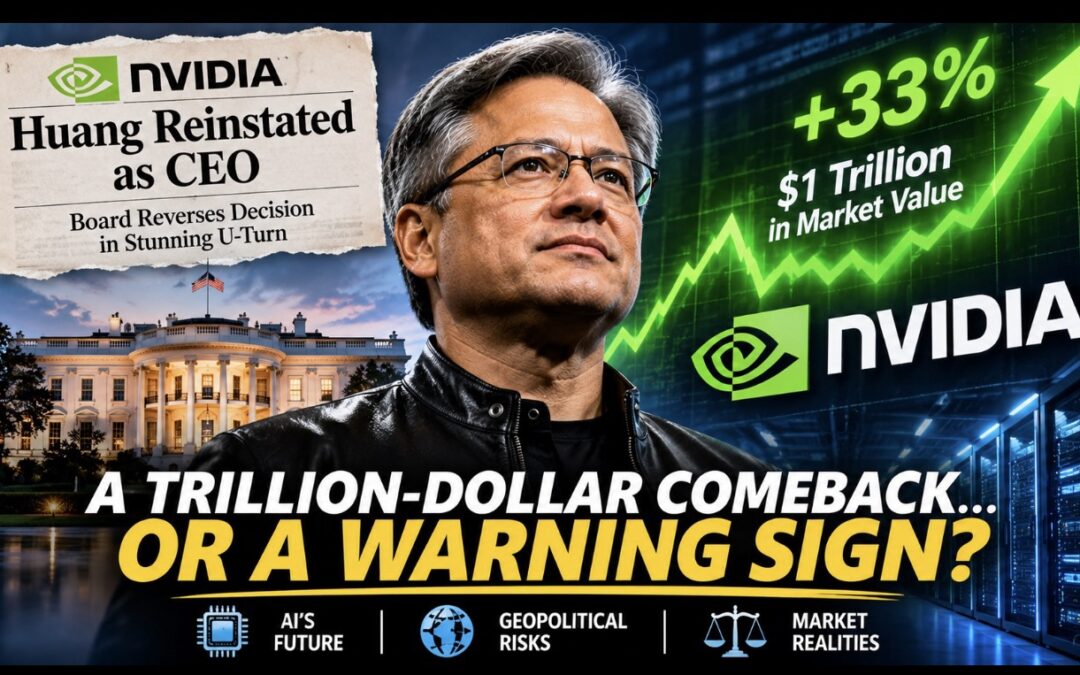
The artificial intelligence industry has witnessed one of its most extraordinary corporate reversals. Jensen Huang, the co-founder and former chief executive of Nvidia, has been reinstated as President and CEO following a unanimous decision by the company’s board on 23 November 2026.
The announcement immediately transformed market sentiment. Nvidia shares surged by approximately 33% in early trading, briefly adding close to $1 trillion to the company’s market capitalisation as investors responded to the return of the individual most closely associated with its extraordinary rise.
For a company already central to the global AI economy, the market reaction was remarkable.
But this is not simply a story about an influential founder returning to his desk. It is a story about the relationship between corporate power, national security, geopolitics and the financial markets — and what happens when one individual becomes so important to a company that his departure can unsettle an entire industry.
A remarkable reversal in less than two weeks
Huang resigned on 12 November following revelations about his personal conduct, including an alleged relationship with a businesswoman suspected by US authorities of having links to Chinese intelligence.
Huang acknowledged making serious personal mistakes and said he had not lived up to the standards expected within Nvidia.
The allegations created an uncomfortable situation for a company whose technology is central to America’s strategic competition with China.
The board initially accepted his resignation and appointed chief financial officer Colette Kress as interim CEO. On 17 November, chairman Harvey C. Jones went further, telling investors that the board did not intend to reinstate Huang.
That position has now been completely reversed.
On 23 November, the board announced that it had unanimously agreed to reinstate Huang as President, CEO and a member of the board, effective immediately.
It said discussions with Huang had satisfied directors about his candour and ability to lead the business. Crucially, the board also confirmed that it had received input from senior levels of the US government and was confident that his reinstatement posed no national security risk.
The speed of this reversal is extraordinary. It suggests that the board’s assessment of the company’s leadership requirements changed considerably in a very short period.
The White House and the power of political influence
The political dimension cannot be ignored.
President Donald Trump had publicly supported Huang’s return after the board initially rejected the possibility. His intervention placed additional pressure on a company whose business is deeply intertwined with American technology policy.
Trump subsequently welcomed the board’s decision, describing it as the correct and proper outcome.
There is an important distinction here. The board has stated that it received input from senior US government officials. That is not the same as saying that the government has taken over the company’s decision-making process, nor does it mean every investigation involving Nvidia or Huang has been concluded.
Nevertheless, the episode demonstrates the extent to which Nvidia has become a matter of national economic and strategic importance.
The company is not simply another semiconductor manufacturer. Its processors underpin the data centres, AI infrastructure and advanced computing systems being developed by governments and businesses around the world.
The United States has a considerable interest in ensuring that Nvidia remains commercially successful, technologically competitive and compliant with national security requirements.
The difficulty is that these objectives do not always point in the same direction.
China: Nvidia’s greatest commercial opportunity and strategic dilemma
One of the most contentious aspects of Huang’s leadership has been his position on selling advanced AI chips to China.
Huang has consistently argued that restricting American technology companies from the Chinese market could ultimately weaken America’s competitive position.
His argument is that if Chinese developers are denied access to American technology, they will accelerate the development of their own semiconductor and AI ecosystems. In doing so, the United States could gradually lose both commercial influence and technological leverage.
There is an economic logic to this argument.
China represents an enormous technology market, with major companies investing heavily in artificial intelligence. Access to that market could provide Nvidia with substantial revenue and help maintain the global influence of American computing platforms.
But national security officials have a different perspective.
Advanced AI processors are not ordinary consumer electronics. They can support military research, intelligence analysis, surveillance, autonomous systems and other strategically sensitive applications.
Allowing China access to powerful American processors could therefore accelerate capabilities that Washington considers a national security concern.
This is not a disagreement that can be resolved simply by looking at quarterly sales figures.
It is a fundamental debate about whether commercial engagement creates strategic influence or transfers technological advantages to a geopolitical competitor.
Huang has made his position clear in the past. Whether his reinstatement changes the administration’s approach to export controls remains to be seen.
The $1 trillion market reaction: what investors are really saying
The immediate share-price reaction deserves particular attention.
Nvidia’s shares rose by approximately 33% following the announcement, briefly lifting its market capitalisation from around $3 trillion towards $4 trillion.
That represents close to $1 trillion in additional market value at the point of the sharpest initial reaction.
It is an extraordinary response to a leadership announcement.
Investors were not simply celebrating the return of a familiar chief executive. They were reacting to the restoration of confidence in the person they believe is uniquely capable of directing Nvidia’s strategy, maintaining relationships with its largest customers and navigating the increasingly complicated political environment surrounding advanced semiconductors.
Huang has become closely identified with Nvidia’s technological roadmap and its relationships across the global AI ecosystem.
His influence extends well beyond the company’s boardroom.
However, the market reaction also raises a more uncomfortable question: how dependent has Nvidia become on one individual?
If the return of a CEO can apparently add close to $1 trillion to a company’s market value within minutes, investors are effectively assigning an enormous premium to that individual’s leadership.
That may reflect confidence in Huang. It may also expose a significant concentration of corporate risk.
A business of Nvidia’s size should be capable of demonstrating institutional strength beyond the personality of its founder.
The investigations have not disappeared
It would be a mistake to interpret Huang’s reinstatement as the conclusion of the controversies surrounding Nvidia.
The company has confirmed that an independent board committee will continue investigating reports that Huang was the target of a foreign intelligence effort.
Nvidia has also established a National Security and Export Control Committee, made up entirely of independent directors, to oversee trade compliance and national security risks.
In addition, the company is beginning a search for a new Chief Compliance Officer, who will report to the board’s Nominating and Corporate Governance Committee.
Reuters has also reported that Nvidia faces ongoing US investigations and inquiries, including matters involving potential accounting issues and alleged chip smuggling.
These matters remain separate from the board’s decision to reinstate Huang.
The distinction is important. A board can conclude that an individual is suitable to resume executive leadership without every investigation involving the company or that individual having reached its conclusion.
The reinstatement should not be confused with a blanket clearance of all outstanding concerns.
AI has become too important to be treated as an ordinary industry
Perhaps the most significant lesson from this episode is how closely the future of artificial intelligence is now connected to national economic strategy.
Nvidia supplies the processors that power a substantial proportion of the world’s advanced AI infrastructure. Its customers include major cloud providers, technology companies, research organisations and governments.
Its commercial success has helped finance the expansion of the entire AI ecosystem.
Consequently, instability at Nvidia has consequences that extend beyond its shareholders.
A prolonged leadership crisis could affect investment decisions, customer confidence, infrastructure planning and the competitive position of American technology companies.
This helps explain why the return of Huang has generated such an extraordinary reaction.
But it also raises questions about the relationship between private corporate governance and national interests.
If a company becomes strategically indispensable, how much independence can its board realistically exercise when political and national security considerations become involved?
And if investors believe that a particular founder is indispensable, does that make the board more accountable or less willing to challenge him?
These are questions that Nvidia’s shareholders, regulators and the wider technology industry will need to confront.
AI TradeMarket Insight
Jensen Huang’s reinstatement is an important moment in the development of the global AI industry.
It demonstrates that the semiconductor business is no longer simply about manufacturing faster processors. It has become a strategic contest involving national security, international trade, energy infrastructure, financial markets and geopolitical influence.
For business leaders, there are three important implications.
First, the concentration of AI infrastructure creates significant strategic dependencies. Companies building their operations around a small number of technology suppliers need to consider what happens if commercial, political or regulatory circumstances change.
Second, access to advanced computing is becoming a matter of national competitiveness. The disagreement over Nvidia’s Chinese market illustrates how export controls can influence not only corporate revenues but also the global distribution of technological capability.
Third, leadership and governance matter enormously in an industry moving at this speed. Huang’s return may restore confidence, but Nvidia must demonstrate that its institutional structures, compliance systems and succession planning are strong enough to protect the company beyond the influence of its founder.
There is also a wider lesson for investors. A dramatic share-price recovery does not resolve every underlying risk. The investigations continue, export-control questions remain and the company’s dependence on a single individual deserves scrutiny.
The return of Jensen Huang may be good news for Nvidia’s immediate commercial prospects. Whether it is equally good news for corporate governance and America’s long-term national security interests is a much more complicated question.
The AI revolution is now so strategically important that decisions made inside a technology company’s boardroom can move global markets and attract the attention of the White House.
That is the real significance of today’s announcement.
