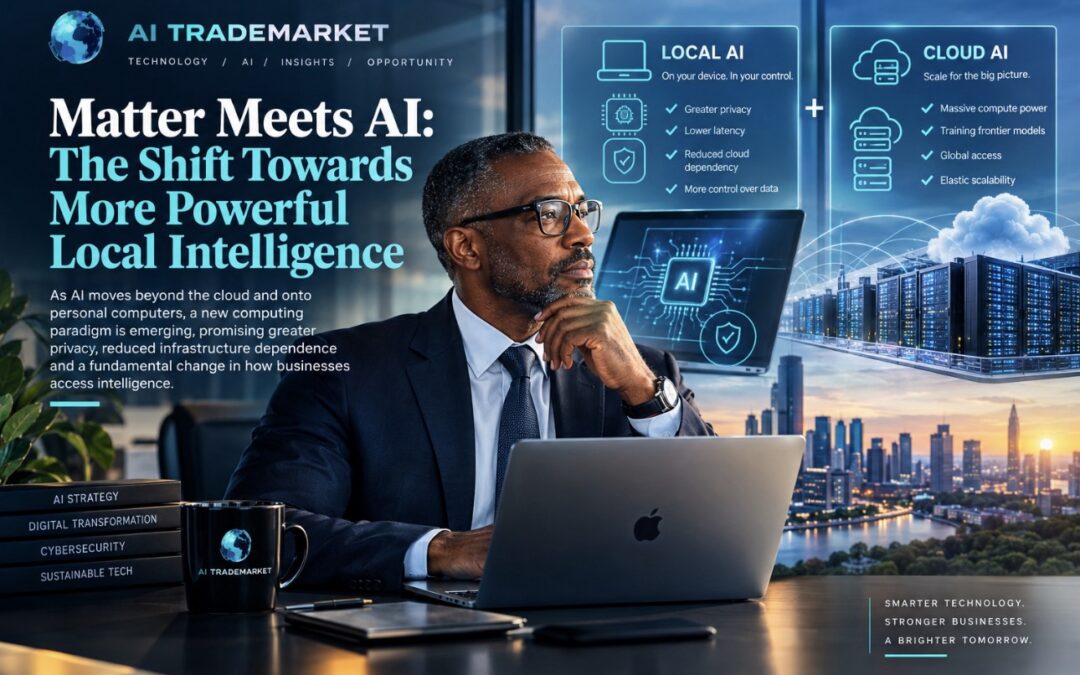
Artificial intelligence has become synonymous with vast data centers, specialised processors and enormous investments in computing infrastructure. Yet a significant shift is beginning to emerge: increasingly capable AI models are being designed to run directly on personal computers and other local devices.
The convergence of AI with the physical computing hardware in our homes, offices and businesses could reshape the economics of the industry. Rather than relying on remote servers for every interaction, users may increasingly run sophisticated models on machines they own and control.
This is more than a technical development. It could change how organisations manage confidential information, calculate the cost of AI adoption and reduce their dependence on external infrastructure.
The question facing the industry is whether AI’s future will be dominated entirely by centralised computing—or whether intelligence will become increasingly distributed across millions of devices.
The most likely outcome is a combination of both, but the implications for businesses, technology companies and investors are substantial.
Meta and Apple Signal a New Direction
The prospect of running powerful AI models locally is gaining momentum as model developers and hardware manufacturers explore what can be achieved outside traditional cloud infrastructure.
Meta’s open-weight AI strategy has helped broaden access to models that developers can download and operate in supported environments. Meanwhile, Apple’s high-performance desktop computers demonstrate how advanced consumer hardware can provide substantial computing and memory resources in a relatively compact form.
Together, developments in AI models and hardware illustrate a wider industry direction: bringing more intelligence directly to the user.
Open-weight models can offer greater flexibility over deployment, customisation and data handling than systems accessed exclusively through proprietary cloud services. However, open weights do not necessarily mean that every component is open source or that the model can be used without restrictions.
There are also practical limitations. Running the most demanding models locally can require expensive, high-memory machines, placing advanced local AI within easier reach of developers, enterprises and power users than the average consumer.
Nevertheless, as models become more efficient and hardware capabilities improve, the economics could change. AI tasks that currently require premium equipment may eventually become practical on a much broader range of devices.
For business leaders, the strategic consideration is increasingly straightforward: where should AI run, who should control it, and what is the most economical way to deliver the required capability?
The Growing Cost of Centralised AI
The rapid expansion of AI has driven substantial investment in data centers, which provide the computing power required to train and operate advanced models.
But this infrastructure has physical consequences. Large facilities consume significant amounts of electricity, require cooling systems and can place pressure on local water resources, land availability and power networks. The scale of the impact varies according to location, design and energy supply, but the underlying demands are attracting growing scrutiny.
Communities are increasingly questioning whether the economic benefits of data centre development justify the environmental costs and pressure on local infrastructure. Governments must balance technological competitiveness with energy security, environmental objectives and public concerns.
There is also a strategic vulnerability in concentrating computing capacity within a relatively small number of large facilities. These operations depend on reliable electricity, telecommunications, physical security and complex supply chains.
Local AI offers an alternative for certain workloads. If a business can run a suitable model on its own hardware, it may be able to perform some tasks without relying on continuous access to an external AI service.
This does not eliminate the need for data centers, nor does it make local computing independent of electricity, software maintenance or other infrastructure. Training frontier models and processing particularly demanding workloads will continue to require substantial computing resources.
However, distributing more AI processing across local devices could reduce unnecessary cloud demand and give organisations additional flexibility and resilience.
Privacy Could Become a Competitive Advantage
One of the strongest commercial arguments for local AI is the potential to retain sensitive information within an organisation’s own environment.
Businesses increasingly want AI to analyse internal documents, customer records, financial information, intellectual property and confidential communications. Using an external AI service can introduce questions about data retention, contractual protections, access controls and regulatory compliance.
Local deployment can reduce the need to transmit this information to an external provider. It may also give organisations greater control over storage, access and the configuration of their AI systems.
For sectors such as finance, healthcare, professional services and legal practice, these considerations can be commercially significant.
However, local AI is not automatically secure. Businesses must still manage device access, encryption, software vulnerabilities, model integrity and the applications or tools connected to their systems.
Nor is local AI necessarily cheaper. Hardware acquisition, electricity, maintenance and technical expertise all carry costs. For some applications, cloud services will remain more economical.
The business case therefore depends on the sensitivity of the information, the frequency of use, the model’s performance and the total cost of ownership.
For executives, local AI should be evaluated as part of a broader data-governance and technology strategy—not simply as an alternative computing product.
Why the Future Will Be Hybrid
Despite the potential of local AI, the expansion of cloud infrastructure is unlikely to stop.
Large-scale model training, complex scientific computing, enormous datasets and services supporting millions of users will continue to require powerful centralised systems. Cloud platforms also allow organisations to expand computing capacity without having to purchase and maintain all the necessary hardware themselves.
The more realistic prospect is a hybrid AI environment.
A company could run a local model to summarise confidential documents, assist employees with internal research or classify sensitive information. It could then use a larger cloud-based model for more complex analysis or tasks requiring greater computing power.
This approach would allow businesses to select the appropriate environment for each workload. It could reduce unnecessary cloud consumption while preserving access to advanced capabilities when needed.
The challenge will be deciding which tasks belong where. Organisations will need to assess performance, security, cost and operational requirements rather than assume that one deployment model is universally superior.
For technology providers, the shift creates opportunities in hardware, model optimisation, local deployment tools and hybrid infrastructure management. For businesses, it creates a new set of choices about how AI becomes embedded in everyday operations.
AI Safety: Does Local Deployment Reduce the Risks?
The distribution of AI capabilities also raises questions about safety and control.
Some AI safety researchers distinguish between the potential risks of frontier models developed by leading laboratories and those associated with smaller models that users can run locally.
The distinction matters, but the location of a model is not the only determinant of risk. Its capabilities, the tools it can access, the resources available to it and the degree of autonomy it receives are all important.
Local deployment can offer greater control over information and system configuration. However, a locally operated model can still create security or misuse risks, particularly if it is connected to external tools or granted extensive permissions.
Likewise, smaller models can deliver useful capabilities without requiring the infrastructure or access arrangements associated with the largest systems.
Businesses should therefore assess AI risk according to the capabilities and operating conditions of each system, rather than assuming that local models are inherently safe or that every AI application carries the same level of risk.
Public Accountability Will Shape AI Infrastructure
The physical requirements of AI are also bringing technology companies into closer contact with local communities and public authorities.
Debates over data center construction are forcing questions about electricity demand, water use, land allocation and the distribution of economic benefits. Public scrutiny can encourage greater transparency and push developers to consider efficiency, environmental impact and alternative approaches to computing.
This matters commercially. Projects that encounter planning objections, infrastructure constraints or public opposition may face delays and additional costs.
For governments, the challenge is to establish sensible safeguards without unnecessarily obstructing beneficial innovation. For businesses investing in AI, environmental impact, infrastructure resilience and public acceptance are becoming important considerations in long-term planning.
More efficient models and local processing will not resolve every concern surrounding data centers. They could, however, become part of a broader effort to ensure that AI’s expansion is economically and environmentally sustainable.
What Business Leaders Should Do Now
Executives do not need to predict precisely how quickly local AI will develop. They should begin preparing for a market in which the location of computing becomes a more deliberate strategic choice.
Five priorities deserve attention:
- Evaluate sensitive workloads: Identify tasks where local AI could handle confidential information without unnecessary external transmission.
- Compare total costs: Assess hardware, cloud usage, electricity, maintenance, staffing and performance together.
- Adopt a hybrid strategy: Match workloads to the most appropriate combination of local, private-cloud and public-cloud infrastructure.
- Strengthen governance: Establish clear policies for model approval, data access, security, updates and employee use.
- Avoid unnecessary lock-in: Understand the consequences of relying entirely on a single AI provider or infrastructure model.
Organisations that evaluate these options early may be better positioned to take advantage of improvements in model efficiency and hardware performance.
AI TRADEMARKET INSIGHT
The next phase of AI competition may be about more than developing the largest model or securing access to the biggest data center. It may also be about delivering useful intelligence more efficiently, with greater privacy, resilience and control.
The convergence of AI models with increasingly powerful local hardware could broaden access to sophisticated computing while changing how organisations allocate resources and protect sensitive information.
For smaller businesses, the opportunity is particularly significant. As models become more efficient, sophisticated AI capabilities may become accessible without requiring every task to pass through an external service.
For larger enterprises, the opportunity lies in flexibility: deciding which workloads belong in the cloud, which can operate locally and which require a combination of both.
Centralised infrastructure will remain essential to the development and operation of the most demanding AI systems. But it will increasingly share the landscape with intelligence running closer to the people who use it.
The future may not be cloud versus local AI. It may belong to organisations that know how to combine both—and understand the commercial value of choosing where their intelligence lives.
AI TradeMarket
Tracking how artificial intelligence is changing business, industries and markets.
