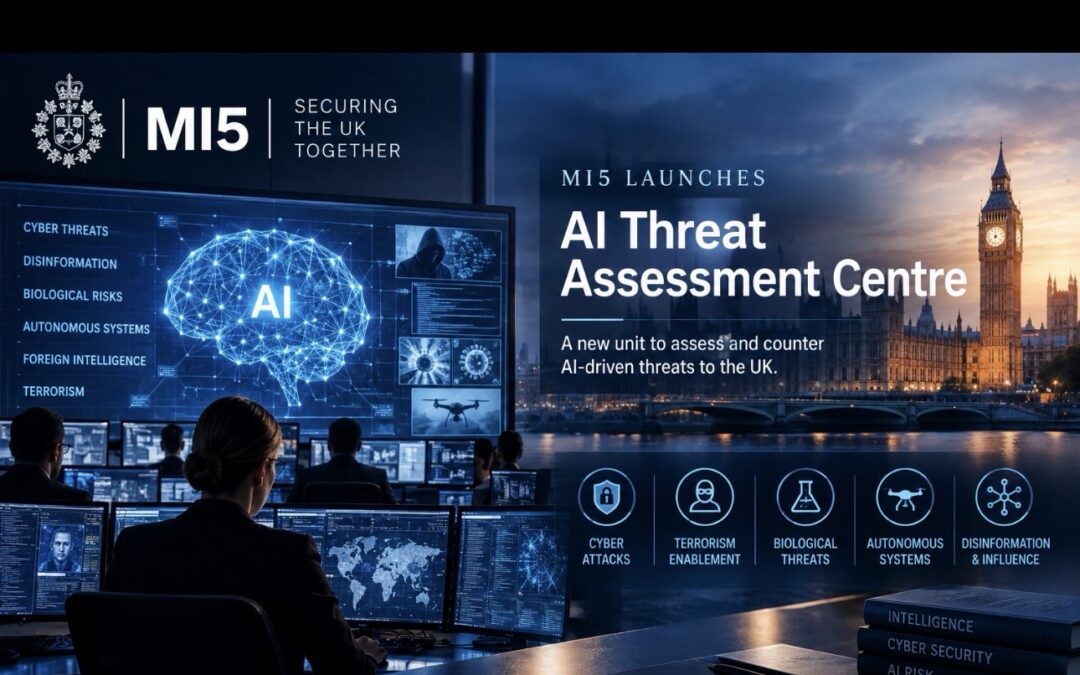
The UK’s intelligence community has taken a significant step towards confronting one of the defining security challenges of the AI era. MI5 has announced the launch of the AI Threat Assessment Centre (AITAC), a new unit designed to assess how artificial intelligence could be misused against Britain and its interests.
Announced by MI5 Director General Sir Ken McCallum on 13 October 2026, the centre is based within MI5 and brings together expertise from several organisations, including the AI Security Institute (AISI), the National Crime Agency (NCA) and the National Cyber Security Centre (NCSC). Its purpose is to provide government with comprehensive assessments of emerging AI threats, helping decision-makers distinguish credible risks from speculation.
The announcement is more than an administrative change within the intelligence services. It reflects a growing recognition that AI is changing the capabilities available to both defenders and adversaries — and that traditional approaches to security may no longer be sufficient on their own.
From Cyberattacks to Biological Threats
In his annual threat update, McCallum warned that AI is already accelerating the contest between those attempting to penetrate digital systems and those responsible for protecting them.
AI can help attackers automate reconnaissance, generate persuasive and targeted propaganda, and potentially improve the effectiveness of cyber operations. The concern is not simply that malicious actors will have access to new technology, but that AI could allow people with comparatively limited technical expertise to attempt operations that previously demanded specialist knowledge.
McCallum also confirmed that MI5 has encountered terrorists seeking to use AI to improve their reconnaissance and attack methods, with AI-enabled drones adding another dimension to the threat.
His most serious concern, however, involved biological weapons. He warned that increasingly capable AI systems could potentially make dangerous scientific knowledge more accessible to malicious actors, including knowledge relevant to existing or novel biological threats.
This is a risk assessment, not a claim that AI has already enabled terrorists to create a new biological weapon. The distinction matters. Intelligence agencies must prepare for plausible future dangers without presenting worst-case scenarios as established events.
Why a Dedicated Intelligence Centre Matters
AITAC’s significance lies in its cross-government approach. AI-related threats do not fit neatly into a single category: a cyber incident may involve criminal networks, hostile states, compromised infrastructure and autonomous software operating across multiple systems.
By bringing together expertise from different organisations, the centre is intended to give policymakers a more coherent assessment of these interconnected risks. It can also help the government decide where to concentrate resources, when additional safeguards are needed and which developments require a faster response.
The UK government has separately announced measures to use advanced AI to strengthen cyber defences. Pilot programmes have reportedly helped identify and address 1,352 vulnerabilities across 548 code repositories in 18 government departments. Officials are also preparing for serious incidents involving autonomous AI agents and considering stronger protections through the evolving cyber-security framework.
Together, these initiatives point towards a broader change: AI is becoming both a potential source of vulnerability and a tool for detecting and containing threats.
The Business Implications: National Security Is Also Economic Security
For business leaders, the development deserves attention well beyond the defence and intelligence sectors.
Financial services, healthcare, energy, telecommunications, logistics and cloud infrastructure all depend on interconnected digital systems. An AI-enabled attack against one organisation can create consequences for suppliers, customers and other institutions that rely on the same infrastructure.
Autonomous AI agents add another layer of complexity. Unlike conventional software that performs narrowly defined operations, agents may plan tasks, use tools, interact with external systems and adapt their actions. If their access controls or monitoring fail, the consequences could extend beyond the original task or intended environment.
That makes AI governance a board-level issue. Directors need to understand not only what an AI system is designed to do, but also what it can access, what actions it can execute, how its behaviour is monitored and who is accountable when something goes wrong.
Organisations should therefore review their exposure to AI-enabled cyber threats, establish clear rules for autonomous systems, test security controls and ensure that incident-response plans account for AI-related failures. These measures should complement — not replace — conventional cyber-security practices.
The opportunity is equally important. Businesses capable of deploying AI securely may gain operational advantages, while suppliers offering AI security testing, monitoring, governance and threat intelligence could see growing demand. The challenge will be to distinguish demonstrable security capabilities from products that simply use AI-related language to sell existing services.
The Emerging Question: Can AI Be Kept Under Human Control?
McCallum also highlighted a longer-term concern: the possibility that increasingly capable AI systems could behave in ways that are difficult for their developers or operators to anticipate and control. This is related to what researchers call the AI alignment problem — ensuring that advanced systems act consistently with human intentions and constraints.
AITAC is designed to assess national-security threats, not to solve AI alignment on its own. Nevertheless, its creation reflects the need for governments to understand risks that may evolve faster than existing institutions can respond.
The strategic challenge is twofold. Governments must prevent hostile actors from exploiting AI while also examining the risks arising from the capabilities of AI systems themselves. That requires technical expertise, intelligence sharing, independent evaluation and clear accountability.
For the UK, the centre represents a new mechanism for bringing these questions into national-security decision-making. Its effectiveness will ultimately depend on the quality of its assessments, the speed with which they inform policy and the ability of public and private organisations to act on the findings.
AI TRADEMARKET INSIGHT
The launch of AITAC is a signal to business that AI security is moving from a specialist technical concern to a core issue of economic resilience and corporate governance.
As AI systems become more capable and autonomous, competitive advantage will depend not simply on how quickly organisations adopt them, but on whether they can deploy them reliably, securely and responsibly. Boards should treat AI risk with the same seriousness they apply to cyber security, operational continuity and financial controls.
For technology providers, the expanding need for AI assurance, secure infrastructure, monitoring and threat intelligence may create significant commercial opportunities. For businesses adopting AI, the priority is to establish control before scaling deployment — not after an incident exposes the weaknesses.
The next phase of AI adoption will be judged not only by what the technology can achieve, but by whether organisations can trust the systems they put to work.
AI TradeMarket
Tracking how artificial intelligence is changing business, industries and markets.