
For years, the AI race was primarily about models.
Who had the most capable system? Who could train the largest model? Who could deliver the biggest leap in reasoning, coding or multimodal intelligence?
That equation is changing.
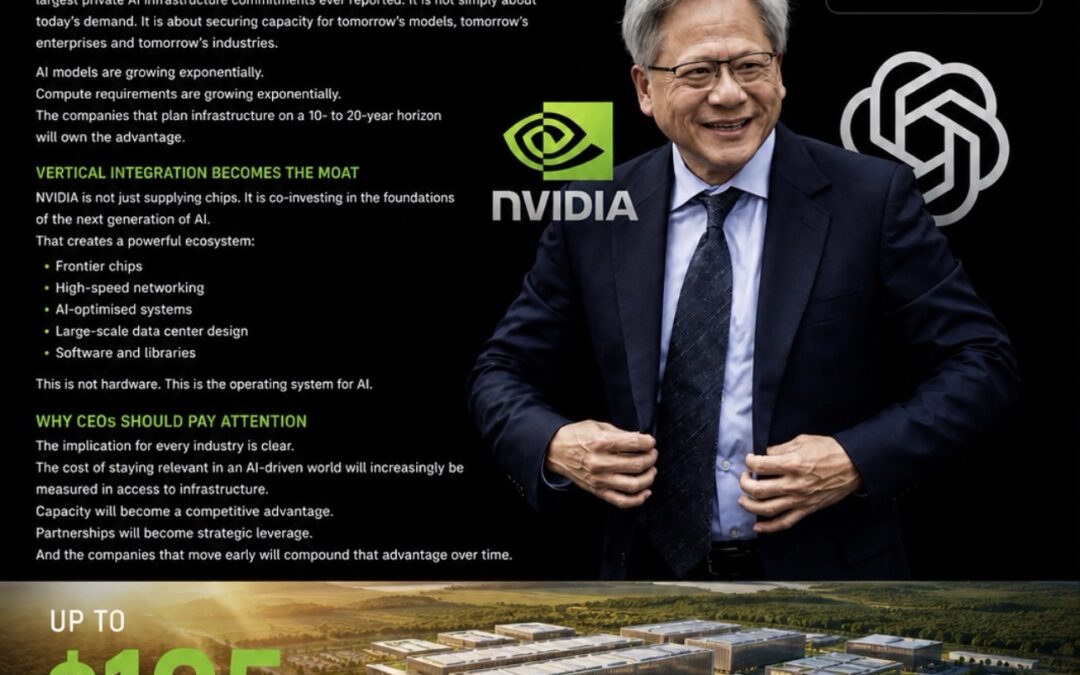
NVIDIA’s reported commitment of up to $105 billion behind OpenAI’s next major data-centre buildout is a powerful indication that the next phase of the AI race will be fought as much in infrastructure as it is in software.
The reported arrangement includes NVIDIA guaranteeing OpenAI’s 20-year lease for a massive AI campus in Ohio, alongside a further $1.5 billion investment in the company developing the project.
For CEOs and CFOs, the headline number matters.
But the strategic implication matters considerably more.
AI infrastructure is becoming strategic capital
The computing requirements behind frontier AI are extraordinary — and they are not declining.
As models become larger, workloads become more sophisticated and AI moves from experimentation into everyday enterprise operations, demand for computing capacity will continue to increase.
This makes infrastructure less like an IT expense and increasingly like strategic productive capacity.
Companies that secure access to the right compute, energy, networking and data-centre capacity may have an advantage over competitors who discover that infrastructure has become a bottleneck.
That is a profound change in how executives should think about AI investment.
NVIDIA is moving beyond the chip
Perhaps the most significant aspect of the relationship is NVIDIA’s broader positioning.
Its influence already extends beyond GPUs into networking, software, systems and the architecture required to operate enormous AI workloads.
By participating in the infrastructure ecosystem surrounding OpenAI, NVIDIA is effectively strengthening its position across multiple layers of the AI stack.
The strategic lesson for other industries is clear:
The winners of the AI economy may be those that control critical infrastructure — not simply those that consume it.
The CFO’s AI question is changing
For financial executives, the conversation is moving beyond “What will AI cost us?”
The more important questions are becoming:
How much computing capacity will we require?
Where will that capacity come from?
What happens to our economics if demand for AI infrastructure continues to rise?
Should we build, lease, partner or consume?
And perhaps most importantly — what happens if our competitors secure capacity before we do?
These are no longer purely technology questions.
They are capital-allocation questions.
AI Trademarket Insight
NVIDIA’s reported $105 billion commitment illustrates something fundamental about the AI economy.
AI is becoming an infrastructure industry.
The competitive advantage will increasingly extend beyond algorithms and applications to the physical systems underneath them — data centres, chips, networking, energy and the enormous capital required to connect them.
For CEOs, this means AI strategy cannot remain confined to the technology department.
It belongs in the boardroom, alongside capital expenditure, supply-chain resilience, competitive positioning and long-term growth strategy.
The companies that understand this shift early may find themselves with something considerably more valuable than access to AI.
They may have the infrastructure required to scale it.
