It is entirely possible to be late to a technology story and still arrive at precisely the right moment.
That may be where we are with AI-powered smart glasses.
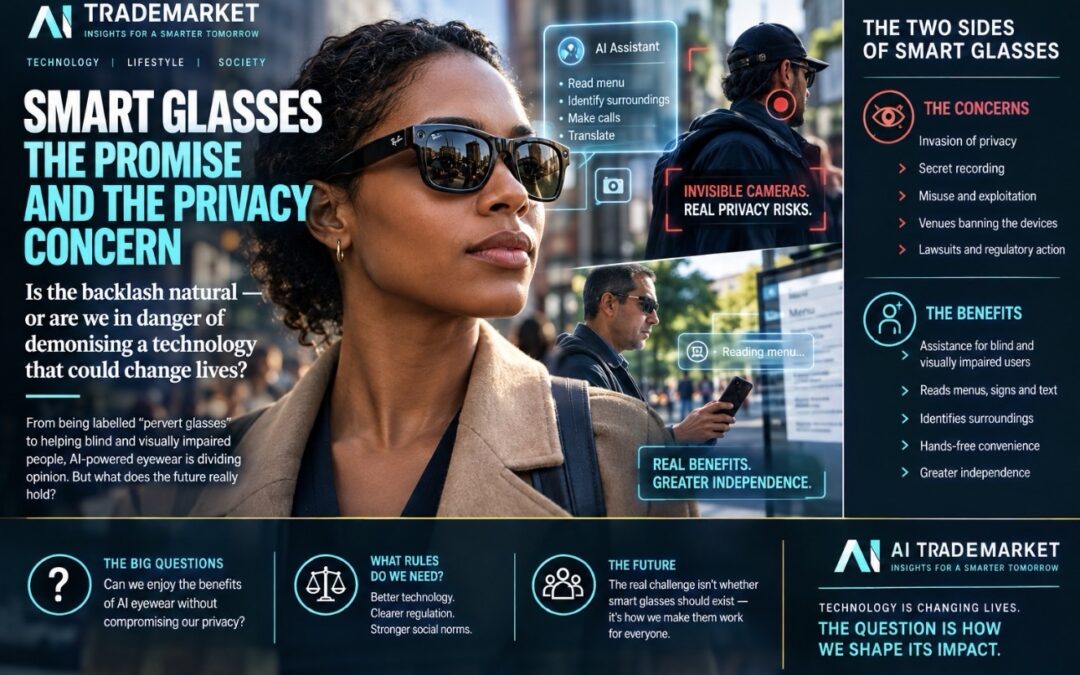
The technology has moved considerably further than many people realise. Meta and EssilorLuxottica reportedly sold more than seven million smart glasses in 2025 alone, more than triple the previous year’s figure. What began as an interesting experiment in wearable technology is becoming a genuine consumer category.
But the more successful these glasses become, the more uncomfortable the questions surrounding them have become.
In the UK, pubs, restaurants, theatres and other venues have introduced restrictions over concerns about people being recorded without their knowledge. Even courts in England and Wales have prohibited Meta smart glasses from being brought into judicial buildings.
The glasses have acquired some deeply unflattering nicknames.
Yet reducing them to “spy glasses” risks missing something equally important.
For people who are blind or have low vision, the same technology can be profoundly useful.
WHEN YOUR GLASSES CAN SEE FOR YOU
The fundamental breakthrough is not really the glasses themselves.
It is the combination of camera + microphone + AI + hands-free interaction.
The wearer can ask the system about what is around them, read text, translate signs, identify objects or receive information without reaching for a smartphone.
For someone with limited or no vision, that can change everyday experiences.
Meta has demonstrated the technology with blind and low-vision communities, while organisations supporting visually impaired people have highlighted applications including reading menus, documents and signs and describing surroundings.
The Royal National Institute of Blind People is now offering demonstrations of Ray-Ban Meta glasses through its Low Vision Centre, specifically highlighting functions such as reading menus and departure boards and connecting users with visual-assistance services.
That is not a trivial benefit.
A person who previously needed another human being to read a restaurant menu could potentially access that information independently.
A person trying to identify an object, read a label or understand a sign can ask an AI system directly.
Technology that provides that degree of independence should not be dismissed simply because the same technology creates legitimate concerns elsewhere.
THE PRIVACY PROBLEM IS REAL
But neither should those concerns be dismissed.
The fundamental problem is that smart glasses make the act of recording less socially visible.
When somebody raises a smartphone and points it at you, the behaviour is relatively obvious.
When somebody wearing apparently ordinary sunglasses looks in your direction, it may be impossible to know whether they are simply looking at you, listening to music, asking an AI assistant a question or recording video.
That distinction is increasingly important.
Recent reporting in the UK has documented cases in which women were allegedly filmed without their knowledge by men wearing smart glasses, with some of that material subsequently appearing on social media. The resulting concern has contributed to venues restricting the devices.
Meta has attempted to address this with a visible recording LED and anti-tampering technology designed to prevent users from simply covering the indicator while recording.
But technology cannot solve every social problem.
A flashing light may technically indicate recording.
The person being recorded may not notice it.
And even when they do, they may have no practical ability to control what happens to the footage afterwards.
That is the real privacy challenge.
WE HAVE SEEN THIS MOVIE BEFORE
There is a broader lesson here for the technology industry.
Google Glass encountered a similar cultural problem more than a decade ago.
The technology arrived before society had established comfortable rules governing it.
Smart glasses are different because the underlying technology is now substantially more capable.
They are not merely cameras attached to spectacles.
They are becoming AI interfaces to the physical world.
That makes them potentially far more useful — and potentially far more intrusive.
The camera provides the AI with visual information.
The microphone provides context.
The AI interprets what it sees and hears.
The smartphone or cloud infrastructure provides connectivity and processing.
Put those components together and the glasses become a persistent interface between a person and their environment.
That is a very different proposition from wearing headphones.
SHOULD WE BE AFRAID OF THE TECHNOLOGY?
There is a temptation to answer this question with either “yes” or “no”.
Both answers are inadequate.
The technology itself is neither inherently sinister nor inherently benign.
Its impact depends on who is using it, what it can access and what rules govern its use.
The same camera that helps a visually impaired person read a menu can potentially be used to record another person without consent.
The same AI that describes an unfamiliar environment can potentially process sensitive information in that environment.
The same hands-free convenience that makes the glasses attractive can make inappropriate recording easier.
This is precisely why responsible technology development cannot focus solely on what a product enables its owner to do.
It must also consider the rights of everyone around the owner.
THE NEXT WEARABLE PLATFORM?
From a technology and business perspective, this is where the story becomes particularly interesting.
Smart glasses may represent one of the most credible attempts yet to move AI off the smartphone and into everyday life.
The smartphone requires us to look down at a screen.
Glasses allow AI to accompany us while we walk, work, travel, shop, exercise and communicate.
That creates enormous commercial possibilities.
It also creates an entirely new privacy economy.
Companies will need to establish clear rules around recording, consent, data retention, biometric information, workplace usage and sensitive environments.
Restaurants and entertainment venues may develop their own policies.
Hospitals, schools, financial institutions and government buildings could impose restrictions.
Employers may need to decide whether employees can wear AI glasses at work.
And regulators will eventually have to determine whether existing privacy legislation is sufficient for an era in which sophisticated cameras can be worn almost invisibly.
THE REAL QUESTION IS NOT WHETHER SMART GLASSES SHOULD EXIST
They are already here.
Millions of people are buying them.
The more important question is whether society can establish acceptable boundaries for wearable AI before the technology becomes ubiquitous.
We should be particularly careful about demonising technology that can give millions of people greater independence.
But accessibility cannot become an excuse for ignoring privacy.
Equally, privacy concerns should not become an excuse for preventing useful innovation.
The challenge is to design an environment where both can exist.
That will require better technology, clearer rules and, importantly, better social norms.
Because ultimately, the biggest change created by AI glasses may not be what they allow the wearer to see.
It may be the fact that everyone around the wearer now has to reconsider what it means to be seen.
AI TRADEMARKET INSIGHT
Smart glasses demonstrate something increasingly important about the AI economy: the technology is moving from the screen into the physical world.
That creates an extraordinary opportunity for accessibility, productivity and convenience.
But it also changes the relationship between technology and society.
For businesses, the lesson is straightforward.
The next generation of successful AI products will not be judged purely on intelligence or functionality. They will also be judged on trust.
If consumers believe a product makes them safer, more independent and more capable, adoption can accelerate dramatically.
If they believe it turns every public interaction into a potential recording, resistance will accelerate just as quickly.
The winners in wearable AI will therefore need to solve two problems simultaneously:
How do we make AI useful enough that people want it — and trustworthy enough that everyone else is comfortable living alongside it?
That may ultimately be the real test of smart glasses.
AI TradeMarket
Tracking how artificial intelligence is changing business, industries and markets.
AI TradeMarket
