
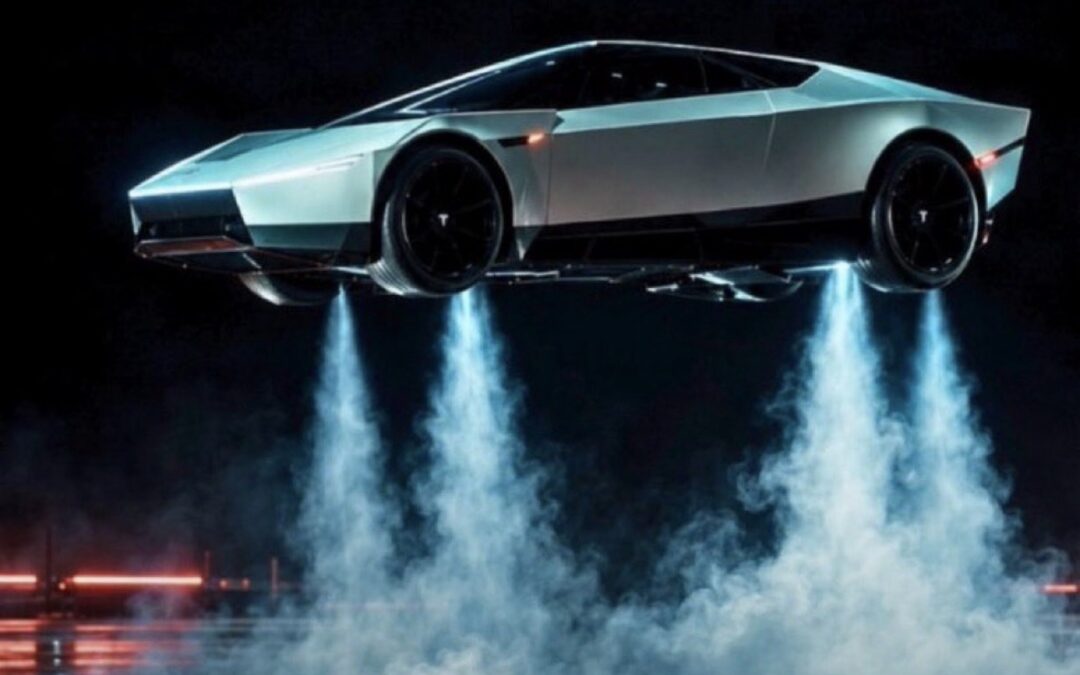
Tesla has reignited the flying-car debate with a spectacular demonstration of its long-awaited next-generation Roadster. Unveiled on 15 October 2026 at a SpaceX facility in Texas, the electric sports car performed an airborne manoeuvre using propulsion technology developed in collaboration with Musk’s rocket company.
The demonstration was dramatic. The vehicle travelled up a curved ramp, briefly inverted, launched into the air, performed a mid-air rotation and landed back on its wheels. Tesla also showcased a separate acceleration demonstration, claiming the car could reach 60 mph in less than a second.
But while the spectacle has attracted global attention, an important distinction needs to be made: this is not yet a conventional flying car capable of sustained flight between destinations. It is a road-going electric sports car with rocket-inspired capabilities designed to produce brief airborne manoeuvres.
For the aviation industry, however, the announcement raises questions that extend well beyond one extraordinary vehicle.
The Technology: Where Automotive Engineering Meets Rocket Propulsion
The Roadster’s headline feature is its use of high-pressure gas and directional thrusters, developed with SpaceX engineering expertise. Tesla has also demonstrated a suction system designed to hold the vehicle against an inverted surface during a stunt.
The approach differs fundamentally from that of an aircraft or electric vertical take-off and landing (eVTOL) vehicle. Conventional aircraft generate lift through wings, while eVTOL designs typically use powered rotors or other aerodynamic systems to achieve controlled flight and transition between hovering and forward movement.
The Roadster’s demonstrated airborne capability is much more limited. The event showed a brief, controlled manoeuvre, not a vehicle sustaining flight, navigating through airspace or landing at an airport or vertiport. The practical limits of its flight system, including endurance, payload, controllability and performance in adverse conditions, remain important unanswered questions.
Tesla has indicated that production is planned for 2028. Its rocket-equipped version is described as invitation-only, and Tesla’s own information says this version is not approved for public-road use. The demonstration should therefore be regarded as a technological showcase rather than evidence of an immediately available transport solution.
Why the Aviation Industry Should Pay Attention
The most significant implication may not be that Tesla has solved the flying-car problem. It is that the boundaries between automotive, aerospace, software and propulsion engineering are becoming increasingly fluid.
Companies traditionally associated with cars are exploring autonomy, advanced sensors, robotics and artificial intelligence. Aerospace companies are developing electric propulsion, autonomous flight systems and new approaches to urban mobility. Partnerships between these sectors could accelerate innovation, although they do not eliminate the engineering and regulatory challenges involved.
Tesla and SpaceX offer an especially visible example of how expertise can cross company boundaries. Rocket propulsion, high-performance materials, software control and sophisticated simulation may have applications across several industries. But transferring technology between environments is not straightforward: a system designed for a short demonstration must meet very different requirements before it can carry passengers routinely.
For aviation manufacturers, suppliers and investors, this creates both an opportunity and a competitive challenge. Advances in propulsion control, lightweight materials, batteries, sensors and autonomous systems could influence future aircraft development, even where the original technology was designed for a different purpose.
The Commercial Reality: Demonstrations Are Not Business Models
The excitement surrounding the Roadster must be separated from its potential commercial value.
A viable flying vehicle needs more than the ability to leave the ground. It must provide predictable performance, acceptable operating costs, reliable propulsion, practical range, manageable noise and a compelling reason for customers to use it instead of conventional transport.
It must also satisfy the relevant safety and certification requirements. In the United States, the Federal Aviation Administration regulates civil aviation, while road vehicles are subject to separate regulatory frameworks. A vehicle intended to operate in both environments could face complex questions concerning certification, operating permissions, infrastructure and liability.
The economics present another hurdle. A specialist, rocket-equipped sports car with limited availability is a very different proposition from an affordable air taxi serving regular routes. The former may generate enormous publicity and appeal to wealthy enthusiasts; the latter requires repeatable operations, high utilisation, dependable maintenance and a scalable customer proposition.
Tesla’s new Roadster is therefore best understood as a potential halo product: a vehicle designed to showcase engineering ambition and strengthen a brand’s technological image. Reuters reported that analysts viewed the unveiling largely in those terms, rather than as a product likely to transform Tesla’s finances in the near term.
Artificial Intelligence Could Be the Missing Link
AI may ultimately prove more consequential to the future of flying vehicles than any single propulsion demonstration.
Advanced control systems can help interpret sensor data, optimise energy use, monitor component condition and support navigation. In autonomous aviation, software must also manage changing weather, obstacles, communications, emergency procedures and interactions with other aircraft.
These are demanding requirements. AI cannot simply be added to an experimental vehicle and assumed to make it safe. Systems need rigorous testing, clearly defined operating limits, fallback mechanisms and human oversight appropriate to their intended use.
For aviation businesses, this points towards opportunities in simulation, digital twins, predictive maintenance, flight-control software, cyber security and AI assurance. Companies able to demonstrate reliability and satisfy regulators may have a stronger long-term position than those competing primarily on spectacle.
What Comes Next?
The Roadster’s unveiling will intensify public interest in flying vehicles, but the industry should judge progress by measurable milestones: validated flight performance, safety evidence, regulatory approval, practical operating costs and successful deployment beyond controlled demonstrations.
For now, Tesla has demonstrated an extraordinary engineering stunt. It has not demonstrated a replacement for conventional aviation or an alternative form of everyday urban transport.
That distinction does not diminish the significance of the event. Breakthroughs often begin with experiments that appear impractical. The challenge is determining which elements can evolve into commercially useful technology and which remain impressive demonstrations.
AI TRADEMARKET INSIGHT
Tesla’s flying Roadster is a reminder that the next generation of mobility will increasingly be shaped by convergence between automotive engineering, aerospace, robotics and AI.
For aviation executives and investors, the opportunity lies in looking beyond the headline. Propulsion systems, advanced materials, autonomous control, simulation and safety assurance may create meaningful commercial opportunities even if rocket-assisted road cars never become a mainstream transport category.
The critical questions are whether the technology can be made safe, repeatable, affordable and certifiable — and whether customers will pay for the resulting capability.
The future of aviation will not be determined by how spectacularly a vehicle can take off once, but by how safely, reliably and economically it can operate every day.
AI TradeMarket
Tracking how artificial intelligence is changing business, industries and markets.
