
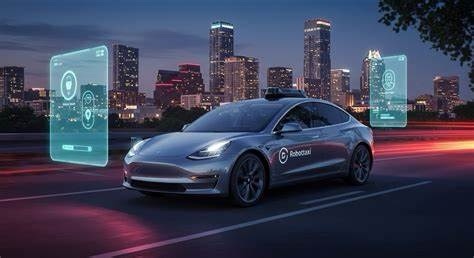
Tesla CEO Elon Musk’s recent statements at the 2026 World Economic Forum in Davos have reignited global debate about the future of autonomous vehicles, as he reiterated that Tesla’s robotaxi network will be “very, very widespread” across the United States by the end of 2026. This bold forecast, if realised, could significantly reshape the automotive, technology and urban mobility landscapes as we know them.

From EV Assembly to Autonomous Production:
Tesla’s robotaxi initiative builds on its electric vehicle manufacturing base. Traditional automotive production lines have long prioritized scale, modular assembly and lean inventory management. For robotaxis — especially purpose-built models such as the two-seater Cybercab — Tesla must integrate bespoke production techniques into its Gigafactories. The Cybercab platform is designed with fewer structural parts than conventional EVs, reducing complexity and capitalizing on high-volume automation — a strategy reminiscent of consumer electronics manufacturing.
The challenge for Tesla’s manufacturing engineers is twofold: first, incorporating autonomous-specific hardware (redundant sensors, advanced compute units, thermal management for AI processors) into the EV architecture; and second, maintaining the production flexibility that has allowed rapid iteration on models like the Model Y. Achieving high throughput on novel hardware — particularly for vehicles without traditional controls like steering wheels or pedals — requires rethinking assembly stations, robotic automation and quality assurance protocols. This is core industrial engineering work that CEOs must understand: mass production at scale doesn’t just reduce cost, it enables service ubiquity.
AI at the Core of Autonomy:
At the heart of the robotaxi mission is Tesla’s Full Self-Driving (FSD) software — a deep-learning-driven AI stack that interprets raw visual data from cameras and sensors to make real-time driving decisions. Unlike many competitors that rely on lidar and radar, Tesla’s approach emphasizes vision-only autonomy, leveraging massive datasets aggregated from its fleet of consumer vehicles and robotaxi pilot programs. The continuous feedback loop of real-world driving data is used to train neural networks, improve perception and reduce edge-case failures.
This infusion of AI into automotive systems marks a significant departure from traditional automotive control architectures. Instead of rule-based logic and predetermined parameters, Tesla’s autonomy relies on probabilistic reasoning, reinforcement learning components and high-performance AI inference processors integrated into the vehicle’s onboard compute platform. For decision-makers, this underscores a shift: future vehicles will be judged less by mechanical engineering alone and more by software capability and data scale.
Industry and Societal Implications:
If Tesla fulfills Musk’s timeline, the automotive industry would confront an accelerated shift toward autonomous mobility. Legacy OEMs (original equipment manufacturers) will face heightened competition not just from incumbent rivals like Waymo and Zoox, but from non-traditional automakers that leverage AI-first design. According to recent industry data, Waymo already operates thousands of robotaxis and millions of rides annually — a benchmark for scaling autonomous services.
For society, widespread autonomous taxi services promise reduced congestion, lower transportation costs, and new urban design paradigms. However, they also raise questions about labour displacement in driving sectors, regulatory frameworks for safety and liability, and equitable access across cities and rural areas. CEOs must plan for the economic and ethical dimensions of deploying AI at scale, ensuring that technological progress aligns with public trust and regulatory acceptance.
In conclusion, Musk’s robotaxi vision is ambitious, and while timelines may shift — as they often have with emerging technologies — the underlying convergence of advanced manufacturing and AI-driven autonomy is unmistakable. Strategic leadership, robust manufacturing execution and transparent safety validation will determine whether 2026 becomes the inflection point for autonomous mobility.
