By Jim Ajayi
In just a few short years, generative AI has evolved from an experimental technology into a major economic catalyst. Today, it is redefining how businesses operate, how workers create, and how nations grow. From start-ups using AI to scale faster to governments integrating it into national productivity strategies, this technology is transforming both the microeconomic and macroeconomic landscapes.
The Microeconomic Revolution: Productivity and Innovation Redefined
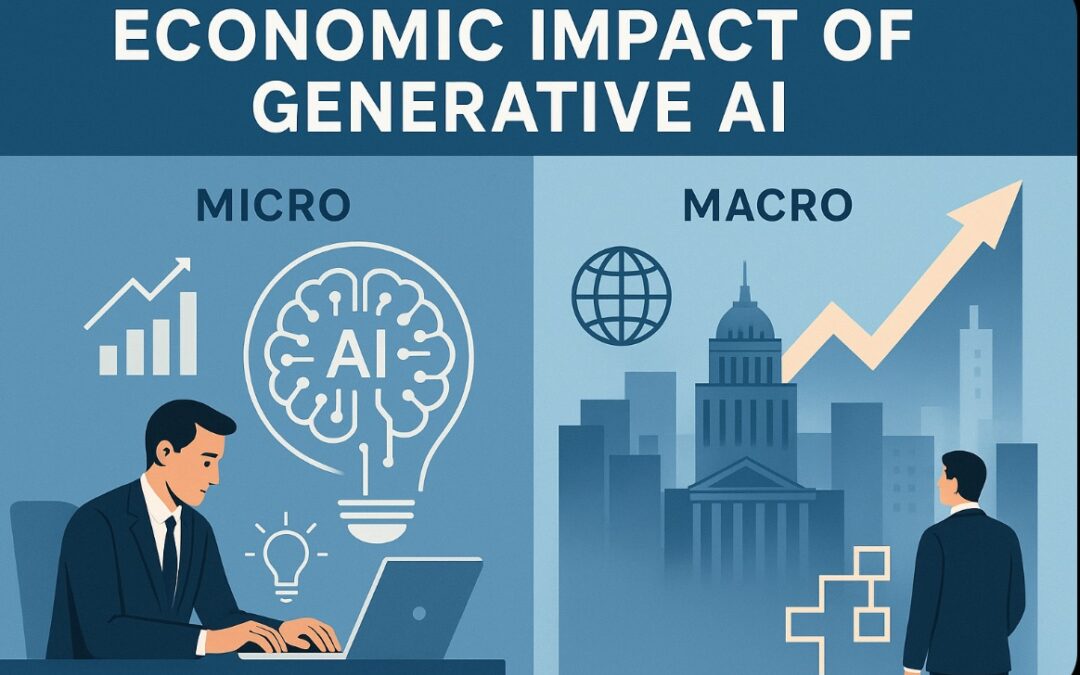
At the micro level, generative AI is reshaping the fundamentals of business productivity. Companies are no longer relying solely on traditional automation; they’re leveraging AI tools such as ChatGPT, Claude, Midjourney, and Synthesia to enhance creativity, accelerate decision-making, and reduce costs.
For small and medium-sized enterprises (SMEs), this represents a profound levelling of the playing field. Tasks that once required large teams—such as content creation, market analysis, or product design—can now be performed with AI assistance at a fraction of the cost. Startups can use generative AI to prototype products, create marketing campaigns, and analyze customer data, allowing them to compete with much larger organizations.
In industries such as manufacturing, healthcare, and finance, AI-powered simulations and generative design tools are improving efficiency and enabling faster innovation. Healthcare professionals, for instance, use AI models to predict patient outcomes and even discover new drugs, while manufacturers use generative algorithms to optimize supply chains or design new materials.
This widespread AI integration is not just about automation—it’s about augmentation. Generative AI acts as a “co-pilot,” empowering employees to focus on higher-value, strategic, and creative work. However, as adoption becomes ubiquitous, the real differentiator will not be who uses AI, but how intelligently and ethically it is used. Businesses must now develop strong AI governance frameworks to handle challenges around data privacy, bias, and intellectual property.
The Macroeconomic Shift: Growth, Labor, and Policy Evolution
At the macroeconomic level, generative AI is emerging as a new driver of global productivity and GDP growth. Analysts estimate that by 2030, AI could contribute trillions of dollars to the world economy. Yet this growth comes with both opportunities and challenges.
AI is fundamentally changing the structure of labor markets. While it automates some routine roles, it also creates entirely new ones—such as prompt engineering, AI ethics management, and data governance. Economies that invest in AI skills development, digital literacy, and infrastructure will capture the most value, while those that lag may face widening inequalities in productivity and income.
Data is becoming the new economic resource—a form of capital in its own right. Countries and companies that control high-quality datasets and advanced computing capabilities are emerging as the new economic powerhouses. As a result, governments are beginning to focus on AI sovereignty, national data strategies, and responsible innovation policies to ensure growth remains inclusive and sustainable.
Globally, we may see the emergence of a “two-speed economy.” Developed economies are already leveraging AI to optimize industries like healthcare, manufacturing, and finance, while developing economies are exploring how AI can help them leapfrog traditional infrastructure barriers and foster entrepreneurship. The policy challenge will be balancing innovation with regulation to ensure AI serves the broader public good.
A New Factor of Production
Generative AI is not merely another productivity tool—it represents a new factor of production, comparable in significance to the introduction of electricity or the internet. Its impact is systemic, influencing how value is created and shared across all levels of society.
As AI continues to integrate into every business process, the question for leaders is no longer whether to adopt it, but how to adopt it responsibly. Success in this new era will depend on strategic vision, ethical leadership, and a commitment to human-centered innovation.
Generative AI isn’t replacing the economy—it’s becoming the economy. And those who learn to harness it intelligently will define the next chapter of global growth.
