
The structure of modern warfare is evolving in ways that are as much economic as they are technological. Historically, military advantage was closely tied to scale—large defence budgets, extensive industrial bases, and the ability to field expensive platforms such as advanced aircraft, cruise missiles, and space-based intelligence systems.
Recent conflicts, including the Russo-Ukrainian War and lessons that continue to emerge from the Iraq War, highlight the emergence of a different model. Rather than relying exclusively on a small number of high-cost assets, modern military architecture increasingly combines lower-cost autonomous systems, AI-assisted targeting, commercial satellite intelligence, resilient communications networks, integrated sensors, and cyber capabilities.
The most significant shift may be economic. The mathematics of warfare is changing.
Cost Efficiency and Autonomous Systems
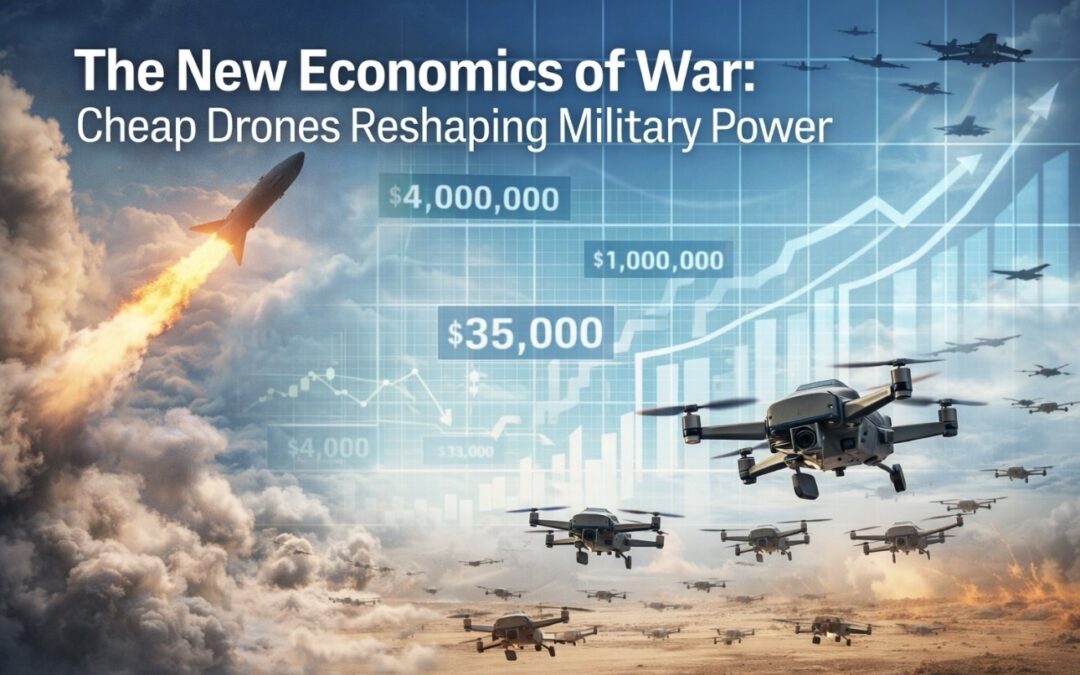
Precision strike capabilities historically came at significant cost. A single cruise missile strike—such as one launched from a platform like the Tomahawk cruise missile—can cost several million dollars per weapon. These systems remain highly effective, but their cost naturally limits how frequently they are deployed.
Autonomous drones introduce a different equation. Many tactical drones now cost in the range of tens of thousands of dollars rather than millions. A single drone might cost approximately $35,000. For the cost of one traditional cruise missile, a military could deploy dozens or even hundreds of drones.
This changes operational thinking. Instead of relying on a small number of expensive precision weapons, forces can deploy larger numbers of lower-cost systems. Redundancy increases, operational flexibility improves, and the ability to absorb losses without significant financial impact becomes possible.
From a purely mathematical perspective, the relationship between cost and capability is shifting.
AI-Assisted Targeting
Artificial intelligence further strengthens this transformation by accelerating decision cycles. AI systems can process satellite imagery, sensor feeds, and battlefield data far faster than traditional intelligence processes.
The result is a shortened “sensor-to-decision” timeline. Targets can be identified, validated, and acted upon more quickly, allowing forces to respond to changing conditions with greater speed and accuracy.
Importantly, this capability is becoming more widely available as AI tools mature and computing power becomes less expensive.
Commercial Satellite Intelligence
Another major development is the rise of commercial satellite imagery. Historically, high-resolution space-based intelligence was the domain of major powers with national reconnaissance programs.
Today, commercial satellite operators provide detailed imagery and data services to governments, companies, and institutions. This expands access to situational awareness and provides smaller states with capabilities that previously required large national space programmes.
Commercial space infrastructure is therefore becoming an important component of modern defence ecosystems.
Resilient Communications
Modern military systems increasingly depend on robust communications networks. Autonomous systems, remote sensors, and command centres must remain connected even in contested environments.
Technologies such as satellite-based internet, distributed communications networks, and mobile battlefield connectivity platforms help maintain operational continuity. Resilience in communications ensures that data flows reliably between sensors, decision makers, and operational units.
Integrated Sensors and Cyber Capabilities
The effectiveness of this new military architecture depends on integration. Sensors on drones, satellites, ground systems, and electronic intelligence platforms increasingly feed into shared operational networks.
This fusion of data creates a more comprehensive picture of the operational environment. At the same time, cyber capabilities add another dimension—allowing states to influence information flows, disrupt systems, or protect critical infrastructure.
Strategic Implications
Taken together, these developments do not eliminate the importance of traditional military power. Large platforms, advanced aircraft, and high-end missile systems remain important components of national defence strategies.
However, the balance is evolving. Military effectiveness increasingly depends on the integration of networks, data, and scalable technologies rather than simply the number of expensive weapons systems deployed.
In practical terms, this means more states now have access to capabilities that were once concentrated among a small number of global powers. For policymakers, defence planners, and industry leaders, the key insight is straightforward: modern military advantage is becoming as much about efficiency, connectivity, and technological integration as it is about scale.
The mathematics of warfare is changing—and understanding that shift is essential for navigating the security environment of the decades ahead.
