
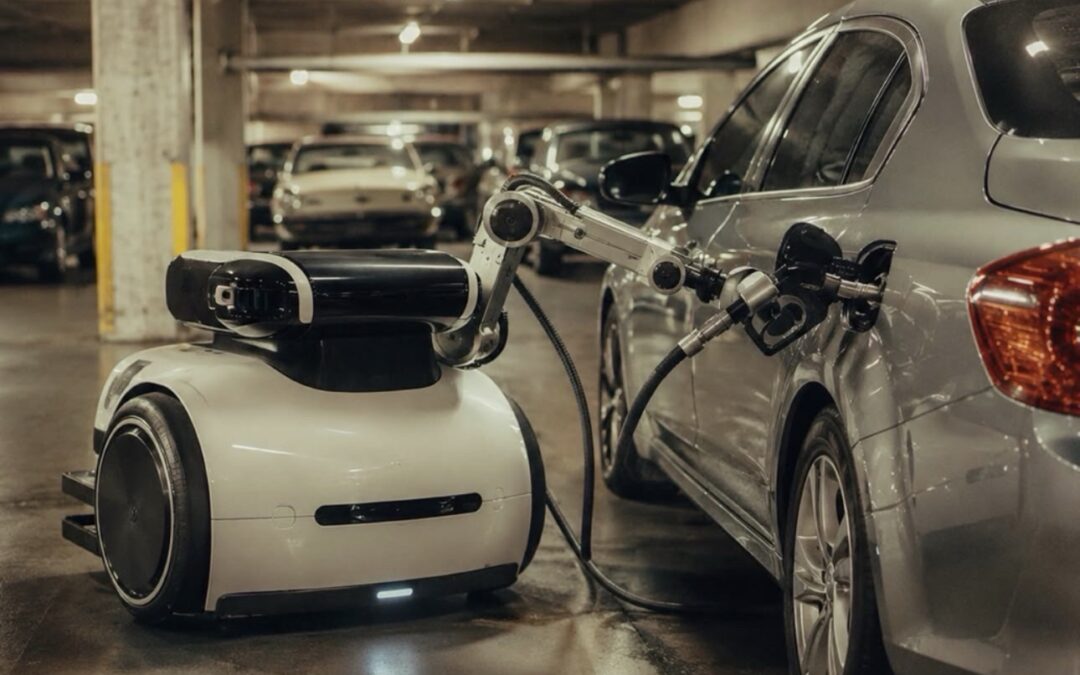
The automotive industry has spent the last decade making vehicles smarter.
Cars can now recognise road markings, assist with parking, monitor driver attention, navigate traffic and increasingly make decisions on behalf of their occupants.
But what happens when the vehicle reaches the end of its journey?
Today, the driver still has to find a parking space, locate a charging point or fuel pump, position the vehicle correctly and physically connect it to an energy source.
Toyota appears to be exploring a future in which even that final interaction becomes automated.
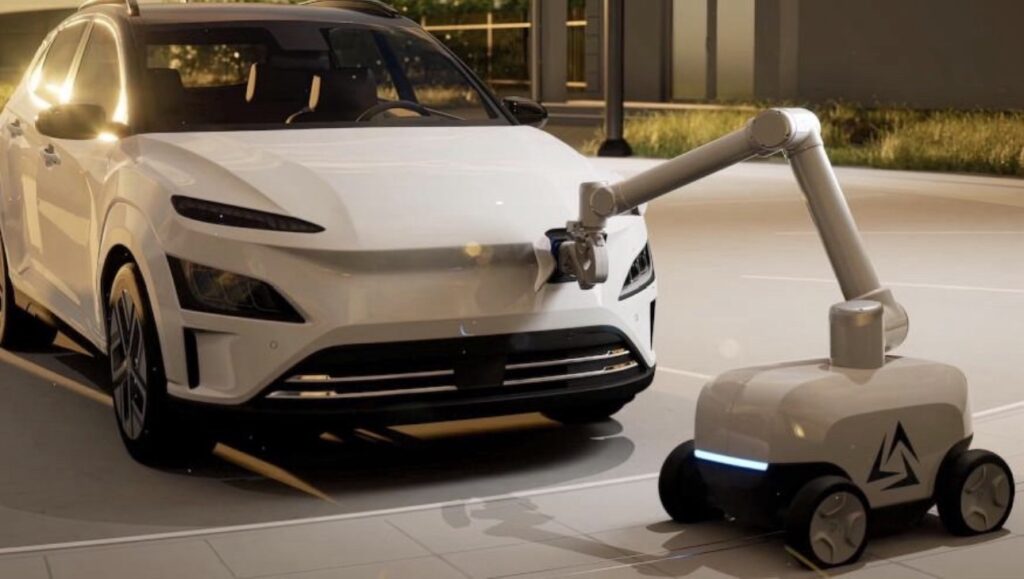
A recent Toyota patent application describes an automatic charging robot equipped with a robotic arm capable of gripping a charging connector and automatically inserting and removing it from a vehicle’s charging port. The system is designed to allow vehicles parked in multiple spaces to be charged automatically.
That may sound like a relatively small improvement.
It isn’t.
For the automotive industry, autonomous energy management could become an important piece of the wider transition towards software-defined and autonomous vehicles.
From Autonomous Driving To Autonomous Energy
The industry’s vision of autonomous vehicles has traditionally focused on driving.
A vehicle that can leave a passenger at their destination, find a parking space and park itself represents a significant technological achievement.
But an autonomous vehicle that still requires a human being to plug it into a charger is only partially autonomous.
Toyota’s charging-robot patents suggest a broader concept.
The vehicle could potentially arrive at a designated area, park, communicate with the charging infrastructure and have a robotic system establish the physical connection required to recharge it.
Once charging is complete, the connector can be removed and returned to its charging position.
The importance of this becomes much clearer when viewed through the lens of autonomous fleets.
The Fleet Opportunity Could Be Bigger Than The Private Car
Imagine a fleet of autonomous taxis operating around a major city.
During peak periods, vehicles are constantly moving passengers.
During quieter periods, they need to recharge.
Today, managing that process requires people, fixed infrastructure and carefully coordinated vehicle movements.
A highly automated charging environment could change the economics.
Vehicles could enter a depot or parking facility, position themselves and have robotic systems connect them to available charging infrastructure.
The same principle could eventually apply to delivery fleets, autonomous shuttles, rental vehicles, corporate fleets and commercial trucks.
The business opportunity therefore extends well beyond making life easier for private motorists.
Autonomous charging could become critical infrastructure for autonomous mobility.
Toyota Is Not Starting From Zero
The latest charging technology should also be viewed within Toyota’s broader history of exploring automated vehicle energy services.
Toyota previously patented systems involving autonomous refuelling, including a concept in which an autonomous drone could travel to a vehicle requiring fuel and deliver it. Another Toyota patent describes a predictive smart-refuelling service that could determine when a vehicle requires energy and dispatch a refuelling solution based on vehicle information and route conditions.
The latest charging-robot work therefore represents part of a much larger technological direction.
The underlying idea is simple:
The vehicle should increasingly be capable of managing its own energy requirements.
Why This Matters For EV Infrastructure
Electric vehicles create a fundamentally different relationship between the car and the energy network.
A petrol vehicle visits a fuel station, where a human connects a nozzle.
An EV can potentially be charged while stationary for extended periods.
That creates opportunities for automation.
A charging robot does not necessarily need to replace every charging cable or charging station. Instead, it could provide flexibility in locations where installing dedicated charging equipment at every parking bay would be expensive or impractical.
A robotic system could potentially move between vehicles and connect them to shared charging infrastructure.
Toyota’s patent specifically describes a system in which a charging robot can move between vehicles parked in different spaces and automatically connect and disconnect charging equipment.
That could be particularly interesting for large car parks, fleet depots, airports, hotels, shopping centres and autonomous-vehicle facilities.
The AI And Robotics Convergence
There is another important element to this development.
Robotic charging is not simply a mechanical problem.
A useful system needs to identify the correct vehicle, determine where its charging port is located, navigate safely around other vehicles and people, position its robotic arm accurately and establish a secure connection.
That means the technology sits at the intersection of AI, computer vision, robotics, automotive software and energy infrastructure.
This convergence is becoming one of the most important trends in the automotive technology sector.
The car is no longer an isolated machine.
It is becoming part of a much larger intelligent ecosystem.
What About Refuelling?
The concept becomes even more interesting when considering conventional fuel vehicles.
Toyota’s earlier patents demonstrate that automated refuelling has also been part of the company’s technology exploration. Separately, robotic refuelling systems are now appearing in the wider automotive technology ecosystem, with patented systems designed to identify vehicles and operate fuel dispensers automatically.
This suggests that automated energy replenishment could eventually become technology-neutral.
Electric vehicle?
Charge it.
Hybrid?
Manage its energy requirements.
Combustion vehicle?
Automate refuelling.
The larger objective is not necessarily the elimination of one particular energy source.
It is the elimination of human intervention from the energy-replenishment process.
The CEO Question
For automotive executives, this development raises a much bigger strategic question.
If vehicles can eventually drive themselves, park themselves and recharge themselves, what happens to the traditional automotive business model?
Dealerships may increasingly become technology-enabled mobility centres.
Parking facilities could become energy-management hubs.
Fleet operators could run largely automated depots.
Charging infrastructure could become an intelligent service rather than simply a collection of charging points.
And vehicle manufacturers could increasingly compete on the quality of the entire digital ecosystem surrounding the vehicle—not simply on horsepower, styling or range.
This is why seemingly niche patents deserve executive attention.
A patent for a charging robot may appear to be an engineering development.
But viewed alongside autonomous driving, AI, connected vehicles and electrification, it becomes part of a much bigger transformation.
The Road Ahead
None of this means Toyota is about to deploy autonomous charging robots across every car park.
A patent represents intellectual property and technological exploration, not a guarantee of commercial deployment.
There are still substantial challenges around cost, reliability, safety, standardisation, infrastructure integration and the economics of robotic charging.
But those challenges should not obscure the strategic direction.
The automotive industry is steadily moving from vehicles that require drivers to perform tasks towards vehicles that can manage more of their own operation.
Driving is becoming automated.
Parking is becoming automated.
Navigation is becoming intelligent.
Energy management may be next.
And once these systems begin operating together, the definition of the automobile changes fundamentally.
The car stops being simply a machine that transports people.
It becomes an autonomous, connected and increasingly self-managing platform.
AI TradeMarket Insight
Toyota’s autonomous charging research highlights a broader shift taking place across the automotive industry: the convergence of AI, robotics, electrification and connected infrastructure. For CEOs, the opportunity is not simply to build smarter vehicles. It is to rethink the entire ecosystem surrounding them. The companies that connect autonomous vehicles with intelligent energy, parking, servicing and fleet infrastructure could ultimately capture value far beyond the vehicle itself. The future automobile may not ask its owner to refuel or recharge it—it may simply take care of itself.
