
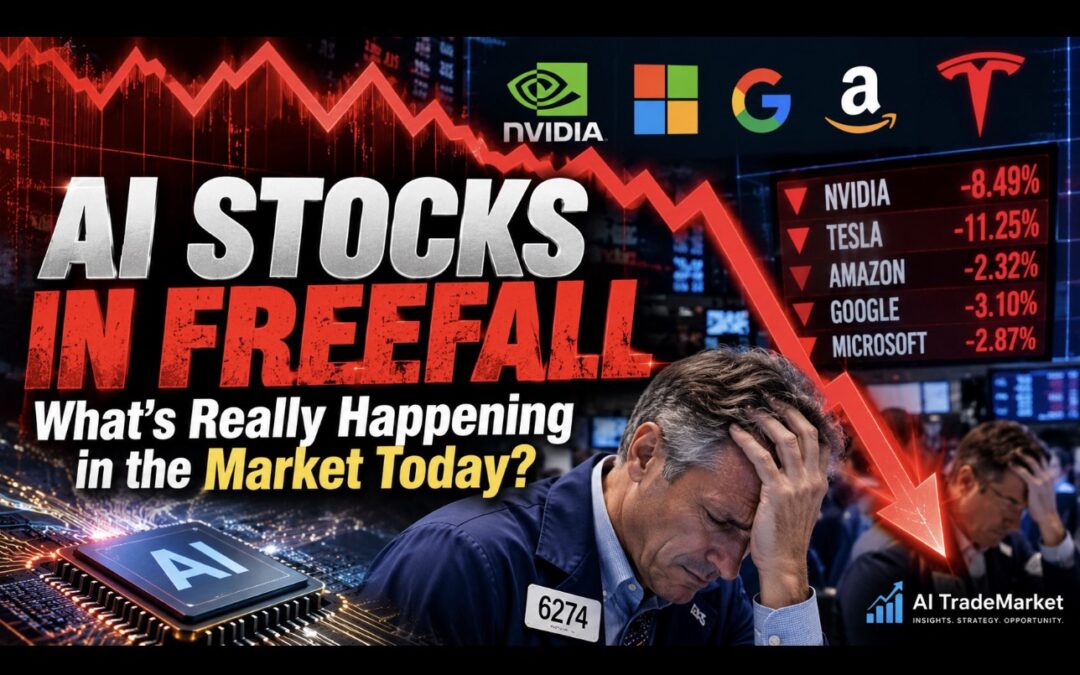
Wall Street has suffered another difficult session, with technology and artificial intelligence-related shares leading the decline. The latest sell-off is more than a routine market correction. It reflects growing uncertainty about whether the financial foundations supporting the AI investment boom are as robust as investors once assumed.
On Monday, November 16, the S&P 500 fell 1.9%, the Nasdaq Composite declined 2.5%, and the Dow Jones Industrial Average lost approximately 739 points, or 1.4%. Nvidia fell a further 4.1%, extending a difficult period for the world’s most influential AI chipmaker.
The figures are significant, but the underlying concern is more important: investors are beginning to question the assumptions underpinning the enormous capital commitments being made across the AI industry.
For several years, the market has rewarded companies associated with artificial intelligence, semiconductor manufacturing, cloud computing and data-center construction. The expectation has been that demand for computing capacity will continue expanding rapidly, justifying extraordinary levels of investment.
That assumption is now being tested.
The Infrastructure Investment Question
The AI industry requires an enormous physical infrastructure. Advanced processors, high-performance networking, data centers, electricity supply, cooling systems and specialist engineering capacity all require substantial capital.
The largest technology companies have been committing hundreds of billions of dollars to this infrastructure, often on the expectation that future AI demand will generate sufficient revenue to justify the expenditure.
But the economics are becoming more complicated.
Investors are increasingly asking how quickly these investments will generate returns, whether computing capacity is being built ahead of sustainable demand, and how much debt can reasonably be supported by businesses whose profitability remains uncertain.
The distinction between the largest technology companies and specialist infrastructure providers is particularly important.
Microsoft, Amazon, Google and Meta have substantial existing businesses generating revenue across advertising, cloud services, software and consumer technology. Their AI investments can be supported, at least in part, by established commercial operations.
Specialist data-center operators and neocloud providers have a different risk profile. Their business models are more directly exposed to the cost of acquiring expensive hardware, financing facilities and securing long-term customer commitments.
If financing becomes more expensive or customers delay their spending, the consequences can be immediate.
The recent market pressure on companies such as CoreWeave illustrates why investors are paying closer attention to the financial structure of the AI infrastructure market.
Nvidia: The Market’s Most Important Barometer
Nvidia remains central to the debate.
Its processors have become fundamental to the development and deployment of advanced AI systems. Its software ecosystem, customer relationships and position in accelerated computing have given it an extraordinary competitive advantage.
However, the company is also facing an unusual period of uncertainty following the departure of founder and former chief executive Jensen Huang.
The market is now assessing not only Nvidia’s financial performance but also its leadership transition and the implications for the company’s strategic direction.
Today’s decline comes ahead of an important test: Nvidia’s forthcoming quarterly results and the first major assessment of its performance under interim chief executive Colette Kress.
Investors will be looking beyond headline revenue growth. They will want evidence that demand remains strong, that margins can be defended, and that customers’ infrastructure commitments are translating into commercially sustainable activity.
Nvidia’s results could therefore have implications well beyond its own share price.
A disappointing outlook could intensify concerns across semiconductor manufacturers, data-center operators and businesses whose valuations depend heavily on continued AI infrastructure expansion.
The Political Dimension: Data Centers Have Become a Commercial Risk
The market’s concerns are not exclusively financial.
The American midterm elections earlier this month introduced a more challenging political environment for companies seeking to expand AI infrastructure.
Democratic victories brought renewed attention to opposition against data-center construction, electricity costs, environmental pressures and the distribution of economic benefits.
On November 5, the Nasdaq suffered a particularly severe decline, falling approximately 5.6% as investors reassessed the potential consequences of the election results for the AI sector.
The concern is understandable from an investment perspective.
Data centers require land, electricity, water and planning approvals. Communities increasingly want to know who pays for the infrastructure and whether local residents receive meaningful benefits.
For technology companies, this is no longer simply a public-relations issue. It can affect project approvals, construction schedules, operating costs and the ability to secure power.
The industry has effectively reached a point where its expansion depends not only on technological capability and access to capital, but also on maintaining public and political consent.
That is a significant change in the investment environment.
The Broader Problem: Concentration and Financial Exposure
There is another issue that deserves attention.
A substantial proportion of the market’s recent enthusiasm has been concentrated in a relatively small group of technology companies. Their performance has helped support broader market valuations, while their infrastructure investments have generated opportunities for an extensive network of suppliers, lenders and specialist operators.
This creates interconnected exposure.
A slowdown in AI infrastructure spending could affect semiconductor manufacturers, data-center operators, construction contractors, networking businesses and financial institutions providing credit.
The risks are not identical across these organisations, and a decline in share prices does not automatically mean a company is insolvent or that its underlying business is failing.
Nevertheless, the concentration of investment and the scale of financial commitments make the sector particularly sensitive to changes in confidence.
Recent reporting has highlighted concerns about leveraged AI infrastructure investments and the potential for crowded positions to amplify market movements. Investors who previously competed to gain exposure to the same companies can become equally motivated to reduce that exposure when sentiment changes.
That is how a correction in one part of the technology market can become a much broader financial event.
Anthropic’s IPO: A Test of Investor Appetite
The timing is particularly interesting because the market is approaching another major event: Anthropic’s anticipated initial public offering.
The company has attracted enormous attention because of its position in the advanced AI market and the scale of its commercial ambitions.
Its public-market debut will provide an important indication of how investors currently value AI businesses, particularly those requiring substantial investment in computing capacity.
A successful offering could demonstrate that institutional appetite for AI remains strong.
A disappointing reception, however, could reinforce concerns that private-market valuations and infrastructure commitments have moved ahead of what public investors are prepared to support.
The comparison with established technology businesses will be important. Revenue growth alone will not settle the question. Investors will want to understand operating losses, contractual commitments, financing requirements and the route to sustainable profitability.
The market is becoming more selective.
What CEOs, CFOs and CIOs Should Take From This
For business leaders, the immediate lesson is not to abandon AI investment. It is to approach it with greater financial discipline.
Boards should be examining the assumptions behind their AI strategies, particularly where projects depend on external infrastructure providers, long-term computing contracts or uncertain future demand.
CFOs should stress-test financing arrangements against higher borrowing costs, delayed returns and changes in supplier pricing.
CIOs should examine whether their organisations are becoming excessively dependent on a small number of infrastructure providers, and whether alternative platforms and contingency arrangements are available.
For companies investing directly in AI, the distinction between strategic necessity and speculative expansion has never been more important.
The businesses most likely to emerge successfully from this period will not necessarily be those spending the most. They will be those capable of converting investment into measurable productivity, defensible margins and sustainable commercial advantage.
AI TRADEMARKET INSIGHT
The AI industry is not necessarily approaching the end of its growth cycle. It may, however, be approaching the end of the assumption that every company connected to AI will automatically become a winner.
The distinction matters.
Artificial intelligence has enormous economic potential, but the infrastructure supporting it is being financed through a complex combination of corporate cash flows, borrowing, long-term contracts and private investment.
That structure creates opportunities, but it also creates financial exposure.
Today’s market decline should therefore be understood as more than a reaction to political developments or a temporary loss of confidence in technology shares. It is another indication that investors want stronger evidence that the AI economy can deliver returns commensurate with the capital being committed.
For CEOs, CFOs and investors, the next phase will be about separating technological progress from financial speculation.
AI may ultimately transform almost every major industry. But that does not mean every AI company, infrastructure provider or investor will benefit equally.
The technology revolution may be real. The valuations, financing structures and business models supporting it still have to prove themselves.
That is where the next chapter of the AI investment story will be decided.
AI TradeMarket
Tracking how artificial intelligence is changing business, industries and markets.
