
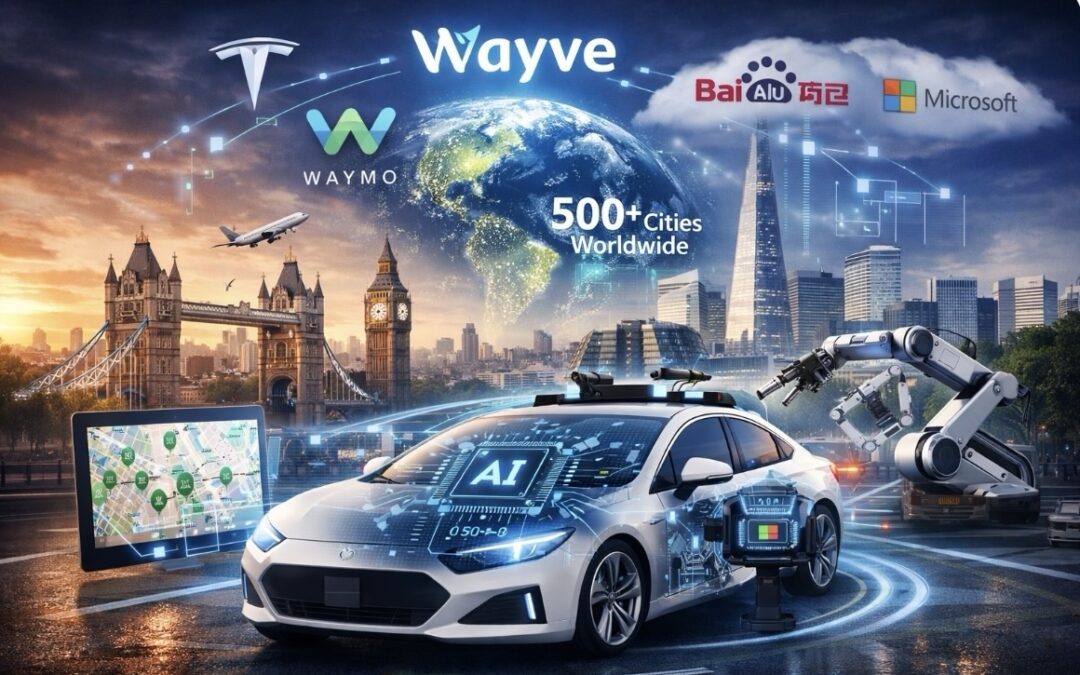
The autonomous vehicle sector has promised transformation for over a decade. Now, with a reported $1.5 billion funding round, UK-based AI company Wayve signals that commercialisation—not experimentation—is the next phase. The capital injection is more than financial muscle; it represents industry alignment around a new strategic model for deploying autonomy at scale.
Unlike vertically integrated competitors such as Waymo (owned by Alphabet Inc.), Tesla, and China’s Baidu, Wayve has deliberately chosen a licensing-led approach. Rather than building its own vehicles or operating proprietary fleets, Wayve aims to become the intelligence layer—the AI driver—that any automaker or fleet operator can integrate.
A Strategic Fork in the Road
Autonomous vehicle companies historically followed two models:
Build the car – controlling hardware and software end-to-end. Build and operate a fleet – controlling deployment and revenue capture.
Wayve’s third path—licensing a high-margin, hardware-agnostic AI driving system—positions it differently. It is effectively creating a universal autonomy stack capable of running across multiple brands, architectures, and geographies.
From a CEO perspective, this is strategically significant. Licensing unlocks a far larger addressable market. Instead of being limited to the number of vehicles a company can manufacture or operate, Wayve can embed its technology across “every fleet and automaker out there.” This asset-light model scales faster, carries lower capital intensity than fleet ownership, and enables recurring software revenue—attractive fundamentals in a capital-hungry industry.
Intelligence That Generalises
One of the core claims emerging from the conversation is geographic scalability. Wayve reportedly deployed its technology to more than 500 cities across Europe, Asia, and North America last year. That breadth speaks to a shift in AI methodology: from map-heavy, rule-based autonomy to end-to-end machine learning systems that can adapt to new environments.
This generalised AI model differentiates it from competitors relying heavily on pre-mapped environments. London, with its dense traffic, irregular road layouts, and centuries-old street patterns, is often cited as more complex than many US cities. If autonomy works reliably in London, it strengthens the global commercial case.
For regulators and customers, however, technical demonstration is not enough. Production-grade deployment demands measurable safety validation, redundancy, and regulatory approval frameworks. Wayve’s emphasis on strengthening teams in Germany, Japan, and the United States suggests a deliberate focus on engineering depth and safety certification—key barriers to trust.
Hardware Flexibility and Strategic Partnerships
Another noteworthy element is chip flexibility. While Wayve’s development has leveraged Nvidia platforms, the company claims its software can operate across different compute architectures depending on customer preference. In a geopolitical environment increasingly sensitive to semiconductor supply chains, hardware flexibility reduces dependency risk and widens commercial appeal.
Training at scale reportedly leverages cloud partnerships, including Microsoft. This hybrid ecosystem—cloud AI training combined with automotive-grade deployment hardware—reflects a mature software strategy rather than a single-vendor lock-in.
A Choice-Based Autonomy Model
Perhaps most strategically astute is Wayve’s positioning of autonomy not as replacement, but as augmentation. The vision is not to eliminate human driving immediately, but to provide AI support—catching mistakes, improving road safety, and allowing optional handover of control.
For regulators, this incremental pathway is more palatable. For consumers, it frames autonomy as empowerment rather than displacement. For investors, it opens phased monetisation: advanced driver assistance today, full autonomy tomorrow.
Commercial Implications
The market reaction—cautiously higher share pricing—reflects optimism tempered by execution risk. Autonomy has burned capital before. Yet the structural conditions may now be different:
AI capability has advanced dramatically in the last five years. Automotive OEMs are under pressure to differentiate through software. Regulators are gradually clarifying frameworks for deployment. Urban congestion and safety demands continue to rise.
If Wayve succeeds, it will not merely be another autonomous vehicle company. It will become the intelligence provider to the global mobility ecosystem.
From the CEO’s vantage point, the strategic question is clear: do you build the vehicle—or do you own the brain inside it? Wayve is betting that intelligence, licensed globally, is the larger prize.
