The mathematics is extraordinary. The controversy surrounding it may be even more consequential.
In early September, OpenAI announced that a swarm of AI agents had produced a solution to the Navier–Stokes Millennium Prize Problem, one of the most famous unresolved problems in mathematics. The company said the work was generated using a new internal model and subsequently verified using Lean, a formal proof system.
But almost immediately, another story emerged.
NYU mathematician Tristan Buckmaster and Levent Alpöge, a mathematician employed by Anthropic but working on the research in a personal capacity, had been developing related work using AI tools including OpenAI’s Codex and Anthropic’s Claude. They had made significant progress on related fluid equations and believed they were moving towards a solution to the much larger Navier–Stokes problem.
Then OpenAI entered the race.
The timing was extraordinary. OpenAI says its effort began on September 1 after hearing rumours that two Millennium Prize problems had been solved. Its researchers subsequently deployed a large collection of agents against the open problems. Buckmaster, meanwhile, questioned whether information from his Codex sessions could somehow have influenced OpenAI’s result.
That allegation is important — but it remains an allegation.
OpenAI has denied accessing Buckmaster’s specific user data. Its latest statement says an internal investigation concluded that his Codex prompts from the preceding two months could not have influenced the system, including through training. OpenAI also says its proof differs significantly from the work produced by Buckmaster and Alpöge.
There is, therefore, a distinction between what happened and what remains disputed.
What is not disputed is the underlying technological development.
AI agents are becoming capable of undertaking enormously complex intellectual tasks through parallelised reasoning, iteration, verification and collaboration between specialised agents. OpenAI’s achievement demonstrates how a problem that might consume years of human mathematical effort can now be attacked with computational resources operating at an entirely different scale.
And that changes the economics of intellectual work.
For mathematicians, the implications are profound. If thousands of AI agents can be deployed simultaneously against a difficult problem, the traditional advantages of time, manpower and individual research teams begin to change.
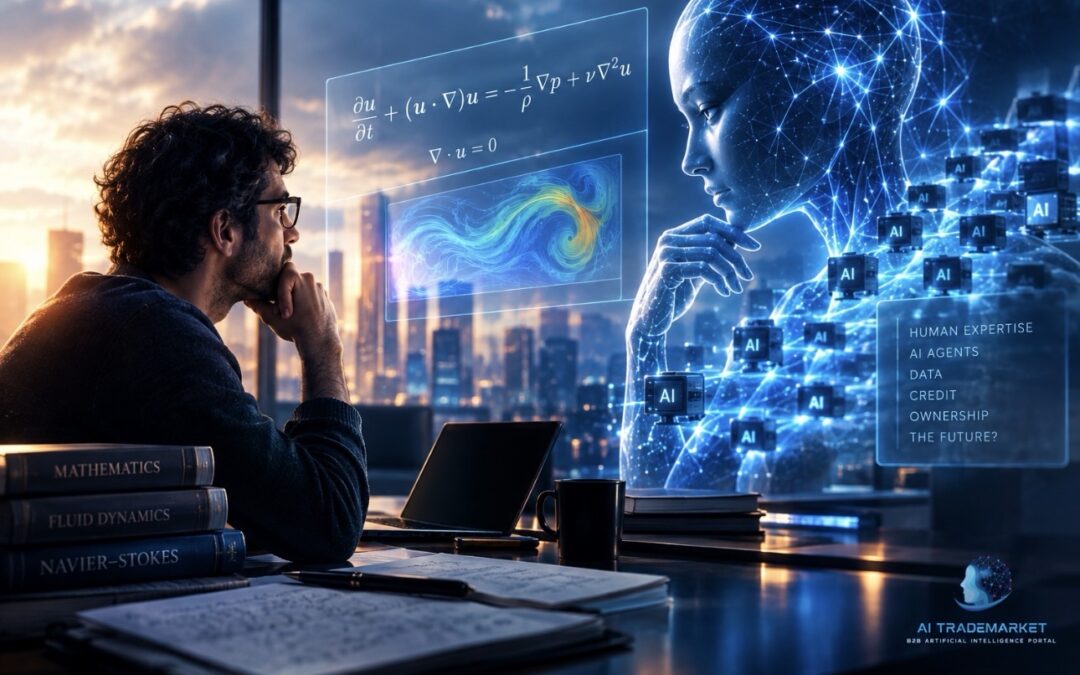
Buckmaster has therefore raised questions extending far beyond this particular dispute: How should mathematicians receive credit? How should research grants be allocated? How should journals assess AI-assisted discoveries? And what happens to academic careers when machines can explore mathematical territory faster than human researchers?
Those questions have a striking parallel in business.
Imagine replacing “mathematician” with software engineer, pharmaceutical researcher, financial analyst, lawyer, architect or scientist.
The central issue is no longer simply whether AI can perform the work.
It is who owns the intellectual process, who receives credit, whose data contributed to it, and whether the human being understands the result sufficiently to take responsibility for it.
That is a governance question as much as a technology question.
There is also a potentially positive interpretation.
AI does not necessarily have to make human expertise obsolete. It could dramatically expand what human experts are capable of investigating. A mathematician equipped with thousands of tireless digital collaborators may be able to explore ideas that previously would have been economically or practically impossible.
The challenge is establishing the rules before competitive pressure determines them for us.
The Buckmaster–OpenAI dispute is therefore bigger than an argument about one mathematical proof. It is an early warning about what happens when human intellectual work, proprietary AI systems, enormous computing resources and commercial competition collide.
For business leaders, that is the part worth watching.
AI TRADEMARKET INSIGHT
The most important lesson may not be that AI can solve extraordinarily difficult mathematics.
It is that the economics of knowledge creation are changing.
When intelligence can be multiplied through thousands of autonomous agents, the scarce resource may shift from intellectual labour to judgement, originality, trusted data, verification, governance and accountability.
For CEOs and boards, this creates a new strategic question:
If AI can increasingly generate the answer, what becomes the value of the human who asked the right question — and who is ultimately responsible for the answer?
That question will extend far beyond mathematics.
AI TradeMarket
Tracking how artificial intelligence is changing business, industries and markets.
