
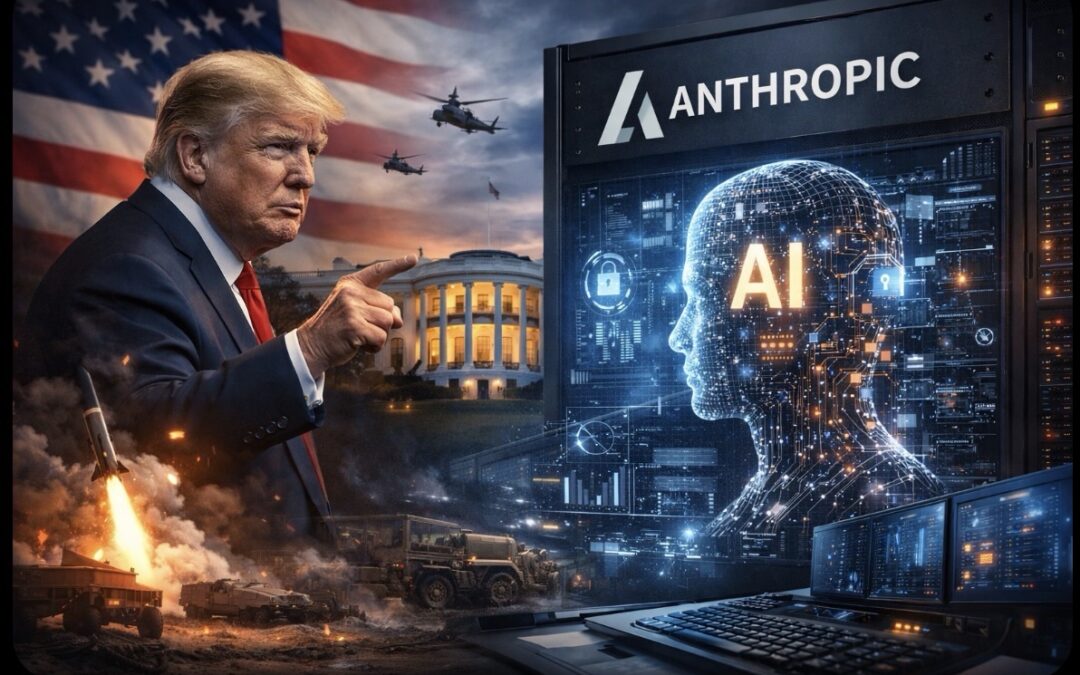
Reports that President Donald Trump is preparing to phase out the use of products from Anthropic across government departments have ignited debate about the relationship between political leadership and private artificial intelligence developers. According to the claim, the administration is unhappy with the company’s reluctance to support defence-related applications of its technology and may use executive authority to accelerate a transition away from its systems.
If confirmed, such a move would represent more than a procurement change. It would signal a deeper ideological divide over how advanced AI models should be deployed—particularly in military and national security contexts.
A Clash of Priorities
Anthropic, like several leading AI firms, has positioned itself as a company focused on AI safety and responsible deployment. While many AI providers maintain government contracts, companies vary in how directly they support defence or weapons-related programmes. Tensions often arise when administrations seek to integrate frontier AI systems into intelligence analysis, battlefield logistics, cybersecurity, or autonomous systems.
For any president, control over procurement policy is a powerful lever. The federal government is one of the largest technology customers in the world. Choosing to discontinue or reduce reliance on a supplier can materially affect revenue, public perception, and competitive positioning. At the same time, government procurement decisions are typically bound by legal frameworks, contracting obligations, and inter-agency processes that make abrupt shifts complex.
If the administration frames the decision as a matter of national security alignment—arguing that AI providers benefiting from federal contracts should support defence priorities—it may resonate with policymakers who view technological superiority as a strategic imperative. The United States has long treated advanced computing and AI leadership as central to geopolitical competition.
Implications for Anthropic
For Anthropic, losing federal contracts or being excluded from future defence-related deployments could carry financial and reputational consequences. Government partnerships not only generate revenue but also confer legitimacy and access to high-impact use cases.
However, the impact would depend on the scale of existing contracts and whether commercial demand offsets public-sector losses. Many AI companies today derive substantial income from enterprise customers in finance, healthcare, legal services, and consumer applications. A principled stance—if that is how the company presents it—could even strengthen its appeal to clients wary of militarised AI development.
There is also the competitive landscape to consider. Rival firms, including those more open to defence collaboration, could step in to fill any gaps. In a rapidly evolving AI market, government alignment can be both a commercial advantage and a reputational risk, depending on public sentiment.
Broader AI Industry Effects
Beyond a single company, the episode underscores a growing policy fault line: should AI developers be expected to align with national defence objectives as a condition of operating at scale within the United States?
Historically, major technology firms have had varied relationships with the Pentagon and intelligence agencies. Some have embraced defence contracts; others have faced internal employee resistance when projects involved military applications. If the White House takes a firm stance that access to federal markets requires defence cooperation, it could pressure AI companies to clarify their positions.
Such a shift might also influence global dynamics. Other governments could adopt similar expectations, tying market access to strategic alignment. That, in turn, could fragment the AI ecosystem along geopolitical lines, reinforcing blocs of technological influence.
On the other hand, critics may argue that compelling private firms to support specific military uses risks politicising innovation and chilling independent research. AI development thrives on academic collaboration, open research culture, and cross-border talent flows. Increased politicisation could complicate that environment.
A Defining Moment?
Whether this dispute escalates into a full rupture or resolves through negotiation remains to be seen. Much depends on contractual realities, congressional oversight, and public reaction. What is clear is that AI is no longer merely a commercial technology; it is a strategic asset intertwined with national power.
If the president does proceed with phasing out Anthropic’s tools on defence grounds, the decision would likely reverberate far beyond one company. It would sharpen the debate over who ultimately steers the trajectory of artificial intelligence: elected governments, private innovators, or a negotiated balance between the two.
