
Artificial intelligence has officially entered its next chapter.
For the past two years, the headlines have been dominated by ever more capable large language models. Businesses have focused on which chatbot writes the best emails, generates the strongest code or answers customer questions most naturally. That conversation is now evolving.
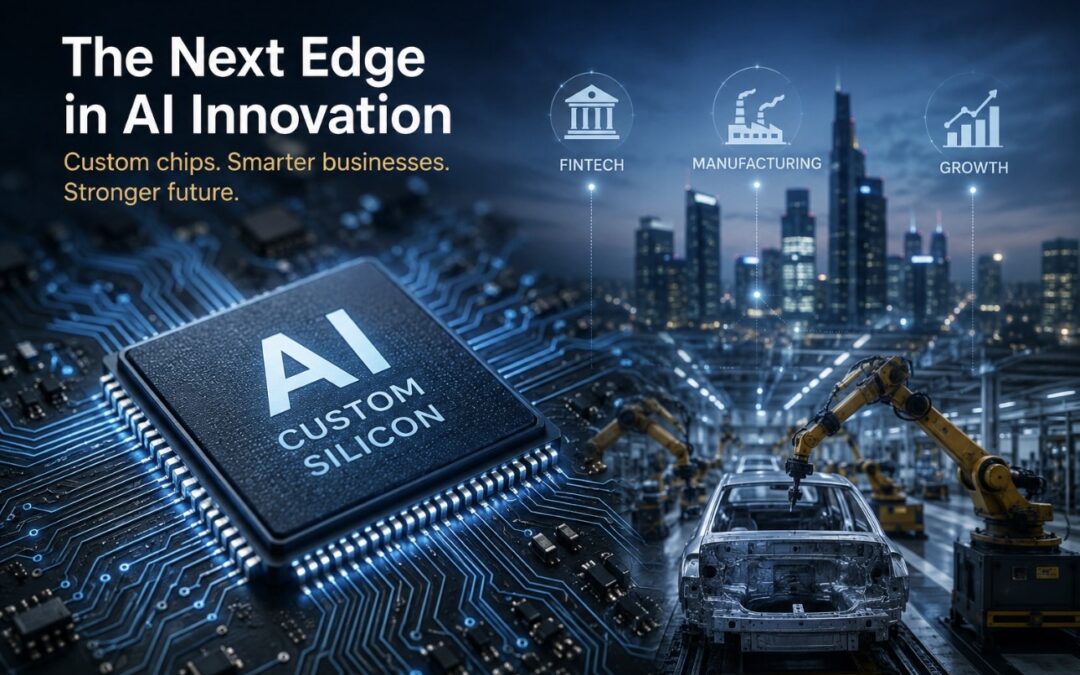
The latest developments suggest the real competitive advantage is moving deeper into the technology stack. Instead of simply building better AI software, the world’s leading AI companies are increasingly investing in custom-designed computer chips built specifically for artificial intelligence.
This week, reports emerged that Anthropic is exploring the development of bespoke AI processors with Samsung, following similar moves elsewhere in the industry. Rather than relying entirely on standard graphics processors, AI companies are seeking hardware optimised for their own workloads, promising lower operating costs, greater efficiency and reduced dependence on existing suppliers.
While this may sound like an engineering story, its implications stretch far beyond Silicon Valley.
For financial institutions, faster and more efficient AI infrastructure could dramatically reduce the cost of fraud detection, risk modelling, compliance monitoring and real-time decision making. As AI becomes cheaper to operate, sophisticated analytics that were previously reserved for the largest banks may become accessible to regional institutions and fintech startups alike.
Manufacturing executives should also be paying close attention.
Modern factories are becoming increasingly data-driven, with AI analysing production lines, forecasting maintenance requirements and improving supply-chain resilience. Lower-cost AI processing means these capabilities become economically viable across a much wider range of manufacturers, not just global corporations with billion-pound technology budgets.
The broader economic impact is equally significant.
Recent manufacturing data from Asia suggests demand for AI hardware is already supporting industrial growth, even as many economies continue to navigate geopolitical uncertainty and higher energy costs. Investment in AI infrastructure is becoming a genuine industrial driver rather than simply another technology trend.
There is also a strategic dimension. Organisations are beginning to recognise that relying entirely on third-party AI platforms may expose them to pricing changes, capacity constraints or regulatory uncertainty. Owning more of the technology stack—from software through to silicon—offers greater resilience and control.
For business leaders, the takeaway is straightforward.
The next wave of competitive advantage is unlikely to come from asking which AI model is marginally more intelligent. Instead, it will come from understanding how AI can be deployed reliably, affordably and at scale throughout an organisation.
In many respects, custom AI chips represent the unseen foundation of the next industrial revolution. The companies that recognise this shift early won’t simply use artificial intelligence more effectively—they’ll build businesses that are fundamentally more productive, more resilient and better prepared for an increasingly AI-powered economy.
