
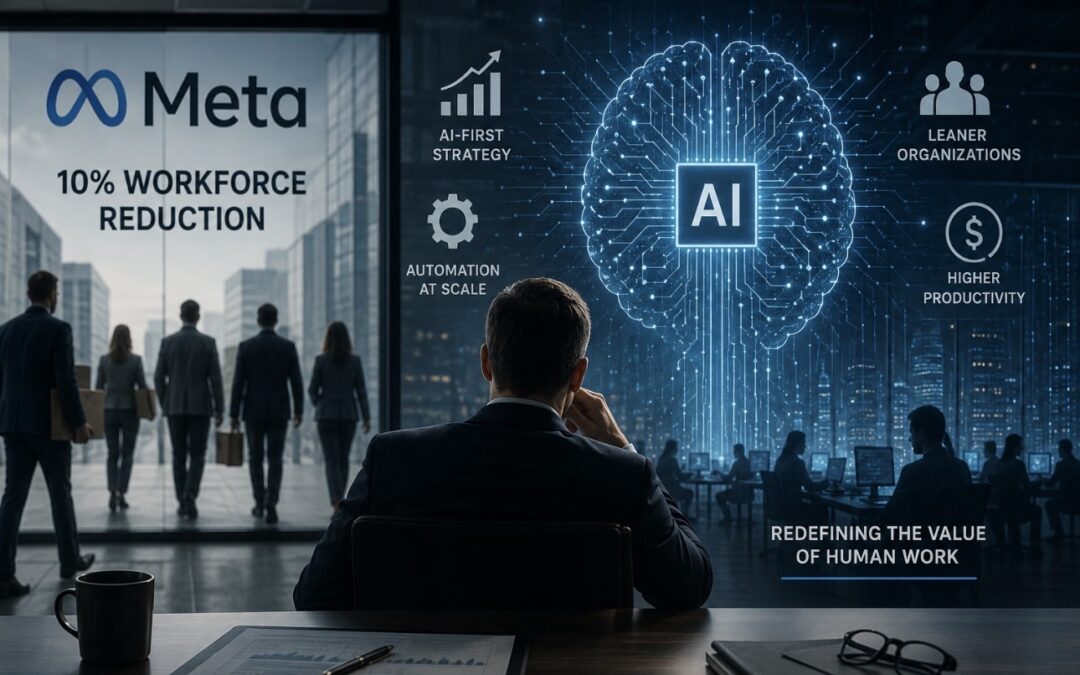
Meta’s AI Workforce Reset Signals a New Corporate Labour Paradigm
Meta’s decision to reduce its workforce by approximately 10% while aggressively accelerating investment into artificial intelligence is more than another technology-sector restructuring. It is a defining signal that the global labour market has entered a new phase: the transition from digital transformation to AI-led organisational redesign.
The announcement, driven by Mark Zuckerberg and tied to billions in planned AI infrastructure spending, reflects a growing corporate belief that future competitive advantage will come not from workforce scale, but from workforce leverage. In practical terms, companies increasingly believe smaller teams equipped with advanced AI systems can deliver equivalent — or greater — output than traditional organisational structures.
For CEOs and boards, the implications are profound.
First, AI is now shifting from productivity enhancer to workforce architecture tool. Previous waves of automation primarily affected repetitive industrial or clerical work. Generative AI, however, directly targets high-income knowledge functions: software engineering, marketing operations, legal review, customer support, finance administration and middle management. Meta’s restructuring reportedly includes flatter hierarchies, fewer managers and mandatory redeployment into AI-focused teams.
Second, the labour market is likely to bifurcate sharply. Demand for elite AI engineers, data scientists and infrastructure specialists will intensify, while demand weakens for generalist white-collar roles vulnerable to automation. This creates an unusual paradox: simultaneous layoffs and talent shortages. Meta itself is reportedly offering extraordinarily high compensation packages to top AI researchers even while reducing overall headcount.
Third, corporate expectations around productivity are being fundamentally reset. Once one major platform demonstrates that AI-enabled teams can operate with materially fewer employees, peer companies face immediate shareholder pressure to pursue similar efficiencies. This dynamic could accelerate workforce reductions well beyond the technology sector into banking, consulting, media, telecommunications and professional services.
The broader macroeconomic risk is not necessarily mass unemployment in the short term, but structural displacement. Workers may remain employable, yet increasingly mismatched to where demand is growing. Historical labour transitions — from agriculture to manufacturing, or manufacturing to services — unfolded over decades. AI adoption is occurring over quarters.
There are also cultural implications for enterprise leadership. Organisations built around institutional knowledge, collaborative management and incremental career progression may evolve into leaner, performance-intensive structures centred around AI orchestration. Meta’s reported use of internal productivity surveillance tied to AI deployment illustrates how rapidly management philosophy itself may change.
For policymakers, the challenge will be reskilling at unprecedented speed. For corporations, the challenge will be balancing efficiency gains with employee trust, morale and reputational risk. And for executives, the key strategic question is no longer whether AI will reshape labour markets, but how quickly.
Meta’s announcement may ultimately be remembered not as a standalone layoff event, but as one of the first large-scale acknowledgements that AI is beginning to redefine the economic value of human labour itself.
